


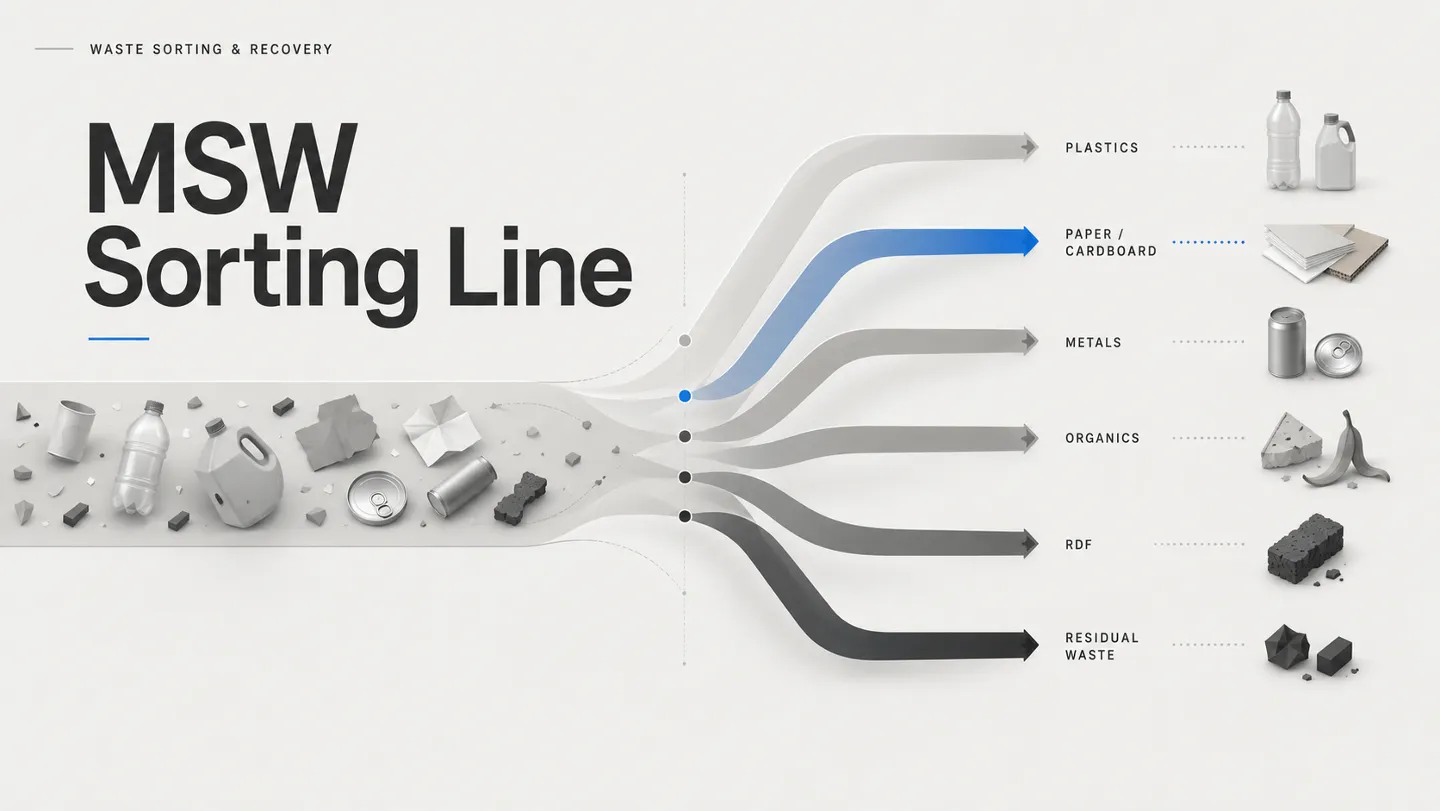
Ein Mülltrennlinie teilt gemischten kommunalen Abfall in recycelbare Materialien, verarbeitbare Fraktionen und kontrolliertes Restmaterial auf. Die Anlage setzt nicht auf eine universelle Maschine. Sie kombiniert dosierte Fütterung, Siebteilung, Dichtetrennung, Metallrückgewinnung, sensorische oder manuelle Sortierung und Produktbehandlung um die tatsächliche Zusammensetzung des eingehenden Abfalls.
Dieser Leitfaden erläutert, wie der Prozess funktioniert, was jede Ausrüstungsstufe macht, wie Kapazität und Leistung gemessen werden sollten und welche Informationen ein Käufer vor der Anfrage eines Anlagenlayouts vorbereiten sollte. Für verfügbare Maschinen siehe MSW-Sortieranlagen-Hub oder die komplette MSW-Sortieranlage.
Was ist eine MSW-Sortieranlage?
Eine MSW-Sortieranlage ist die zusammenhängende Reihe von Förderbändern, Sieben, Trennern, Sortierstationen, Silos und Bündelungs- oder Restbehandlungsanlagen innerhalb einer Abfallverarbeitungseinrichtung. Ihr Zweck ist es, eine variable Mischfütterung in Materialströme zu unterteilen, die verkauft, recycelt, biologisch behandelt, in RDF oder SRF umgewandelt oder bei Genehmigung sicher entsorgt werden können.
Die Sortieranlage ist Teil einer größeren Materialrückgewinnungsanlage (MRF). Die vollständige Anlage umfasst auch die Empfangsfläche, Fahrzeugrouten, Brandschutz, Staub- und Geruchskontrolle, Elektroanlagen, Wartungszugänge, Produktlagerung, Restmateriallagerung und Versorgungsanlagen. Eine Maschinenliste ist daher nicht ein vollständiges Anlagenentwurf.
Beginnen Sie mit einer repräsentativen Abfallprüfung
Verlässliches Design beginnt mit repräsentativen Proben aus dem tatsächlichen Sammelgebiet. Die Abfallzusammensetzung kann sich nach Jahreszeit, Bezirk, Sammelmethode, kommerzieller Aktivität und lokaler Recyclingpolitik ändern. Ein allgemeines Zusammensetzungsdiagramm kann dazu führen, dass eine Stufe überdimensioniert wird, während eine andere zum Engpass wird.
- Zusammensetzung nach Masse: organische Materialien, Papier, Karton, Filme, harte Kunststoffe, Eisenmetall, nicht-ferromagnetischer Metall, Glas, Textilien, Feinmaterial und Restmaterial.
- Physische Eigenschaften: Feuchtigkeit, Schüttmasse, Teilchengrößenverteilung, Beutelsize, voluminöse Gegenstände und Grad der Verdichtung.
- Problematische Materialien: Seile, Schläuche, Batterien, Zylinder, Elektroschrott, gefährliche Behälter, lange Filme und Gegenstände, die das Equipment umwickeln oder beschädigen könnten.
- Ankunftsmodus: durchschnittliche und Spitzenmengen, Fahrplan, saisonale Spitzen und der erforderliche Empfangsbuffer.
- Ergebnisziele: die Qualitäten, die lokale Käufer oder nachgelagerte Verarbeiter akzeptieren, einschließlich Kontaminationsgrenzen und Mindestsendungsmengen.
Die Proben sollten normale und schwierige Betriebsperioden abdecken. Aus trockenen, handausgewählten Proben getroffene Designentscheidungen können trockene, verdichtete Materialien nicht repräsentieren, die von Sammelfahrzeugen geliefert werden.
Wie eine MSW-Sortieranlage funktioniert
1. Empfang, Inspektion und Vor-Sortierung
Fahrzeuge entladen auf einer Empfangsfläche oder in einen kontrollierten Fütterungsbereich. Betreiber überprüfen das Material und entfernen gefährliche, überdimensionierte oder ungeeignete Objekte, bevor sie die Prozesslinie erreichen. Diese Stufe schützt Förderbänder und Trenner und verhindert, dass ein gefährliches Objekt eine gesamte Ausgangscharge kontaminiert.
2. Dosierte Fütterung und Beutelöffnung
Ein Fütterer und Abfallförderband erstellen ein stabiles Materialbett. Wenn Haushaltsabfall in Beuteln ankommt, löst ein Beutelöffner den Inhalt freisetzen, während er eine unnötige Größe reduzierung begrenzt. Stabile Fütterung ist wichtig, da überladene Bänder die Siebteilungseffizienz, die Trenngenauigkeit und die Leistung des manuellen Picking beeinträchtigen.
3. Größen-Trennung
A Trommelsieb, Scheiben- oder Sternsieb teilt den Abfall in ausgewählte Größenfraktionen auf. Die kleinere Fraktion enthält häufig mehr Nahrungsabfälle, Erde, gebrochenes Glas und Feinmaterial, während die größere Fraktion mehr Verpackungen, Papier, Behälter und voluminöse brennbare Materialien trägt. Die Sieböffnungen müssen dem beabsichtigten nachgelagerten Prozess folgen und nicht einer willkürlichen Standardgröße.
4. Form- und Dichtetrennung
Ballistischen, Luft oder anderen Dichtebasierten Trennern können flache und leichte zweidimensionale Materialien, wie Papier und Film, von rollenden oder schwereren dreidimensionalen Objekten, wie Flaschen und Behältern, getrennt werden. Der richtige Ansatz hängt von der Feuchtigkeit, dem Teilchengrößenverteilung, dem Materialaufkommen und den Produkten ab, die die Anlage wiederherstellen soll.
5. Eisen und nicht-ferromagnetischer Metallrückgewinnung
Eine Überkopf- oder Trommelmaschine Magnetabscheider entfernt Eisenmetalle. Nachdem das Material gesiebt und in ein geeignetes Bett verteilt wurde, kann Wirbelstromabscheider Aluminium und andere leitfähige nicht-ferromagnetische Metalle entfernen. Die Position und das Bandladen beeinflussen stark die Erholung; die Installation eines Trenners garantiert nicht von selbst ein sauberes Produkt.
6. Optische Sortierung und manuelle Qualitätskontrolle
Optische Sortiermaschinen können ausgewählte Polymere, Farben oder Papiergrade erkennen, wenn Objekte ausreichend ausgesetzt und getrennt sind. Manuelle Stationen können Verunreinigungen entfernen, eine Zielqualität wiederherstellen oder einen automatisierten Ausgang überprüfen. Automatisierung kann wiederholende Sortierung reduzieren, erfordert jedoch eine kontrollierte Fütterung, Reinigung, Kalibrierung, Wartung und Ausgangsinspektion.
7. Produktlagerung, Ballenbildung und Restbehandlung
Wiedergewinnungsstoffe werden in separate Bunker vor der Ballenbildung oder zum nächsten Prozess übertragen. Der Bunker muss ein Kreuzkontaminieren verhindern und eine sichere Entladung ermöglichen. Ein geeigneter Recycling-Ballenpresse reduziert den Lager- und Transportvolumen. Brandbare Rückstände können in einen RDF- oder SRF-Vorbereitungsprozess eingehen, wenn lokale Vorschriften und Genehmigungen dies zulassen; verbleibende Rückstände folgen dem genehmigten Abfallweg.
Typische Ausgänge und deren nächster Bestimmungsort
| Ausgangsfraktion | Typische Inhalte | Möglicher nächster Schritt |
|---|---|---|
| Eisenmetall | Stahlbehälter und magnetische Metallgegenstände | Qualitätsprüfung, Komprimierung und Metallrecycling |
| Nicht-ferrometall | Aluminium und andere leitfähige Metalle | Weiteres Reinigen und Metallrecycling |
| Rohstoffplastik | PET, HDPE, PP und gemischte Behälter | Polymer trennen, bündeln, waschen oder verkaufen |
| Film und Papier | Flexible Verpackung, Karton und gemischtes Papier | Qualitätstrennung, bündeln oder Brennstoffbereitung, wo erlaubt |
| Biologische und feine Fraktion | Geflügeltes Abfall, Erde, kleines Glas und Feinmaterial | Biologische oder andere Behandlung nach Eignungstest |
| Brennbare Fraktion | Ausgewähltes Papier, Kunststoffe, Textilien und Holz | RDF oder SRF nach vereinbarter Spezifikation vorbereiten |
| Überschüssiger Abfall | Unverwertbares oder kontaminiertes Material | Genehmigte Behandlung oder Entsorgung |
Swipe horizontally to view the full table.
Diese sind mögliche Ströme, keine garantierten Produkte. Die Anlagenkonfiguration muss der lokalen Abfallzusammensetzung, den Käuferspezifikationen, Umweltauflagen und verfügbaren downstream-Infrastruktur entsprechen.
Wie man die Kapazität der MSW-Trennlinie definiert
Ein nur in Tonnen pro Stunde angegebener Kostenvoranschlag ist unvollständig. Gewicht, Volumen, Feuchtigkeit und Zusammensetzung beeinflussen das Verhalten des Materials. Definiere die Kapazität unter Verwendung des vollständigen Betriebsfalls:
- Durchschnittliche und Spitzenempfangsrate
- Stabile Nettoverarbeitungsrate unter repräsentativen Futterbedingungen
- Massendichte und Feuchtigkeitsbereich
- Geplante Betriebszeiten und Schichten
- Geplante Reinigung und vorbeugende Wartung
- Geplante Anlagenverfügbarkeit
- Benötigte jährliche Verarbeitungskapazität
- Erwartete saisonale und kompositionelle Änderungen
Ein nützliches jährliches Planungsgleichung ist:
Jährlich verarbeitete Masse = stabiler Nettodurchsatz × geplante Betriebszeiten × Anlagenverfügbarkeit
Der niedrigste Kapazitätskritische Punkt bestimmt die tatsächliche Linienausgabe. Konveyor, Siebe, Trenner, Silos, Baler, Reststofftransport und Bediener müssen daher als ein System überprüft werden.
Leistungsmetriken: Wiederverwendung, Reinheit und Ertrag
Die Leistung der Anlage sollte durch eine Massengleichung und nicht durch visuelle Eindrücke gemessen werden. Wiege den Eingang, jedes wiederbeschlagene Produkt, recyceltes Material und das endgültige Restmaterial über einen repräsentativen Zeitraum.
| Metrisch | Was es misst | Grundrechnung |
|---|---|---|
| Wiederverwendungsraten | Wie viel des Zielmaterials im Futter das Zielprodukt erreicht | Wiederverwendetes Zielmaterial ÷ eingehendes Zielmaterial |
| Produktreinheit | Wie viel des Ausgangsmaterials ist das gewünschte Material | Zielmaterial im Ausgang ÷ Gesamtmasse des Ausgangs |
| Produktausbeute | Gesamtabsetzbarer Ausgang im Verhältnis zur Gesamteinlage | Verkaufsfähige Ausgangsmasse ÷ Gesamtmasse der Eingabe |
| Restquote | Material, das ohne Wiederverwendung verlässt | Endrestmasse ÷ Gesamtmasse der Eingabe |
| Verfügbarkeit | Zeit, in der die Linie betriebsbereit ist | Verfügbare Betriebszeit ÷ geplante Zeit |
| Nettodurchsatz | Tatsächlich verarbeitetes Futter während der Laufzeit | Verarbeitete Masse ÷ tatsächliche Betriebsstunden |
Swipe horizontally to view the full table.
Wiederverwendung und Reinheit müssen gemeinsam bewertet werden. Aggressive Entfernung kann die Wiederverwendung erhöhen, während sie Kontamination hinzufügt; strenge Qualitätskontrolle kann die Reinheit verbessern, während mehr Zielmaterial in den Rest verfällt. Der richtige Ausgleich wird durch den nachfolgenden Käufer oder Prozessspezifikation festgelegt.
Anlagenlayout und Betriebsanforderungen
| Anlagenfläche | Designanforderung | Risiko bei Übersehen |
|---|---|---|
| Empfangsfläche | Sichere Fahrzeugbewegung, Inspektion, Puffermenge, Entwässerung und Brandschutzabtrennung | Unstabile Futterung und unsichere Verkehrsführung |
| Förderbänder | Kontrollierte Schüttungshöhe, Schutzeinrichtungen, Reinigung und Abfallzugriff | Verringerter Trennschärfegrad und häufige Verstopfungen |
| Sortierkabine | Ergonomie, Lüftung, Beleuchtung, Notausgang und sichere Güterladung | Schlechte manuelle Wiederherstellung und Exposition der Arbeiter |
| Produktbunker | Unabhängige Lagerung, Niveauregelung und sichere Entladung | Kreuzkontamination und unterbrochene Produktion |
| Wartungszonen | Plattformen, Hebepunkte, Entnahmefläche, Umleitungsplanung und Ersatzteilzugriff | Langer Stillstand für regelmäßige Reparaturen |
| Staub- und Brandkontrolle | Risikobewertung, Ordnungspflege, Detektion, Isolation und geeignete Löschung | Brand, Staubansammlung und unerwarteter Stillstand |
Swipe horizontally to view the full table.
Die endgültige Anordnung muss den Sicherheits-, Bau-, Brandschutz-, Umweltschutz- und Beschäftigungsanforderungen am Standort entsprechen. Der Abfallentsorgungshierarchie ist ein nützlicher Kontext, aber lokale Genehmigungen und Outputverträge bestimmen, welche Wiederbeschaffungspfade tatsächlich verfügbar sind.
Was bestimmt den ROI der Mülltrennplattform?
Einnahmen können aus Tor- oder Schüttgebühren, wiederbeschafften Warenverkäufen und vermiedenen Entsorgungskosten stammen. Betriebskosten umfassen Arbeitskraft, Strom, mobile Ausrüstung, Verschleißteile, Reinigung, Wartung, Komprimiertes Luft, Bündelungskonsumgüter, Reststofftransport und Entsorgung. Allein die Rohstoffpreise sollten die Investition nicht unterstützen.
Jährliche Beiträge = Torgebührenerlös + Warenverkaufserlös + vermiedene Entsorgungskosten − Arbeitskraft − Energie − Wartung − Reststoffentsorgung − andere Betriebskosten
Modellierte konservative Szenarien mit niedrigerem Wiederverwendung, höherer Feuchtigkeit, reduzierter Betriebszeit, niedrigeren Rohstoffpreisen und mehr Reststoffen. Ein robuster Projekt sollte betriebsfähig bleiben, wenn tatsächliche Bedingungen von den besten Szenarien abweichen.
RFQ-Checkliste für Mülltrennlinie
- Vertretende Zusammensetzungstudie mit saisonalen Bereichen
- Fotos, Videos, Probenmassen, Feuchtigkeit, Schüttgutdichte und Partikelgrößen
- Durchschnittliche und Spitzenwerte des täglichen Tonnagens und geplanter Betriebsplan
- Erforderliche wiederbeschaffte Produkte und schriftliche Käuferanforderungen
- Reststoffe, Organika, Glas und RDF oder SRF-Routen
- Lageplan, verfügbare Grundstücksfläche, Fahrzeugrouten und zukünftige Erweiterungsfläche
- Stromversorgung, Druckluft, Wasser, Abwasser und Umweltauflagen
- Erforderter Automatisierungsgrad und verfügbare Schichtarbeiter
- Feuer- und Brandschutz, Staub, Geruch, Lärm und Hygienemaßnahmen
- Zielverfügbarkeit, Ersatzteilkonzept und Servicereaktionszeit
- Installation, Inbetriebnahme, Schulung, Leistungstest und Akzeptanzumfang
- Massengleichgewichtsgarantien und die genauen Futterbedingungen, unter denen sie gelten
Bevor die endgültige Ausrüstung ausgewählt wird, fordern Sie einen Prozessfluss, Massenbilanz, Anlagenliste, allgemeinen Aufbauplan, Motorenliste, Kontrollphilosophie, Wartungszugänglichkeitsprüfung und klar definierte Leistungstests an. Senden Sie diese Projektinputs über unsere Kontaktseite für eine Konfigurationsprüfung.
Häufig gestellte Fragen
Anfragen Sie eine MSW-Sortieranlagenprüfung
Senden Sie repräsentative Abfalldaten, geplante Ausgangsprodukte, geplante Kapazität, verfügbare Standortfläche, Betriebsplan und lokale Versorgungsbedingungen. Rumtoo kann die Trennsequenz überprüfen, mögliche Engpässe identifizieren und eine Ausrüstungskonfiguration für das Projekt vorbereiten.
