


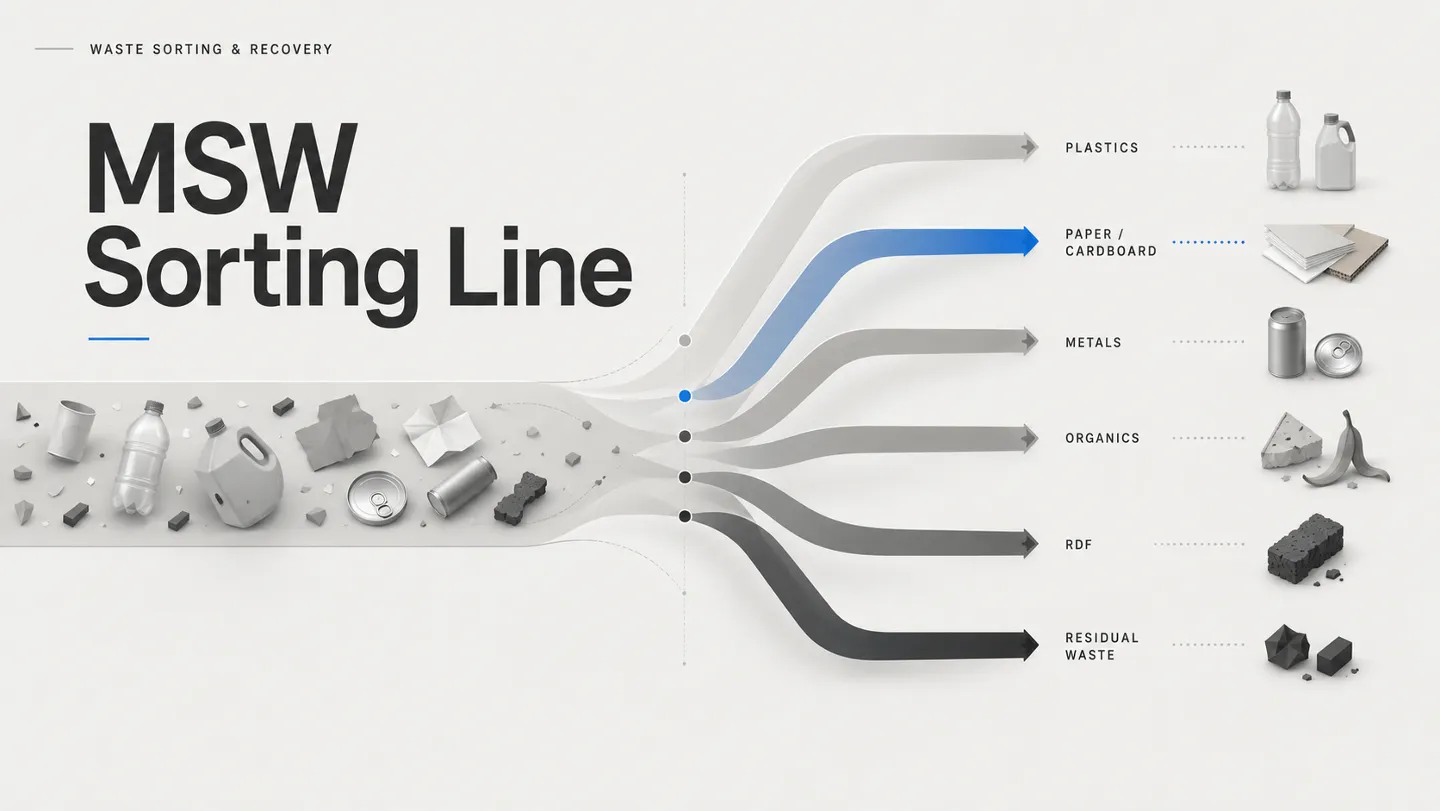
Un Ligne de tri des déchets ménagers Sépare les déchets municipaux mixtes en matériaux récupérables, fractions traitables et résidus contrôlés. L'unité ne repose pas sur une seule machine universelle. Elle combine l'alimentation mesurée, le tri, la séparation par densité, le recyclage des métaux, le tri par capteurs ou manuel, et la gestion des produits en fonction de la composition réelle des déchets entrants.
Ce guide explique comment le processus fonctionne, ce que chaque étape d'équipement fait, comment mesurer la capacité et le rendement, et quelles informations un acheteur devrait préparer avant de demander un plan d'usine. Pour les équipements disponibles, voir le Centre d'équipements de tri des déchets ménagers ou le usine de tri des déchets ménagers tout compris.
Qu'est-ce qu'une ligne de tri des déchets ménagers (MSW) ?
Une ligne de tri des déchets ménagers et assimilés est la séquence connectée de convoyeurs, de sieves, de séparateurs, de stations de tri manuel, de décharges et d'équipements de conditionnement ou de traitement des résidus à l'intérieur d'un site de traitement des déchets. Son objectif est de diviser une alimentation mixte variable en flux de matériaux qui peuvent être vendus, recyclés, traités biologiquement, convertis en RDF ou SRF lorsque autorisé, ou éliminés de manière sûre.
La ligne de tri fait partie d'un plus grand site de récupération de matériaux (MRF). L'usine complète comprend également le sol de réception, les itinéraires des véhicules, la protection contre les incendies, le contrôle de la poussière et de l'odeur, les systèmes électriques, l'accès à l'entretien, l'entreposage des produits, l'entreposage des résidus et les services publics. Un seul liste d'équipements n'est donc pas un projet d'usine complet.
Commence par une auditorie des déchets représentative
Un design fiable commence par des échantillons représentatifs de la zone de collecte réelle. La composition des déchets peut varier selon la saison, le quartier, la méthode de collecte, l'activité commerciale et la politique de recyclage locale. Une carte de composition générique peut entraîner une surdimensionnement d'une étape tandis qu'une autre devient un goulot d'étranglement.
- Composition par masse : matériaux organiques, papier, carton, films, plastiques rigides, métal ferreux, métal non ferreux, verre, textiles, fines et résidus.
- Propriétés physiques : humidité, densité de volume, distribution des tailles de particules, taille des sacs, articles encombrants et degré de compaction.
- Matériaux problématiques : câbles, tuyaux, batteries, réservoirs, déchets électroniques, conteneurs dangereux, films longs et objets pouvant enrouler ou endommager l'équipement.
- Modèle d'arrivée : tonnages moyennes et maximales, horaire des véhicules, pics saisonniers et le tampon de réception requis.
- Output targets: les catégories que les acheteurs locaux ou les transformateurs finaux accepteront, y compris les limites de contamination et les volumes de livraison minimums.
L'échantillonnage doit couvrir les périodes de fonctionnement normales et difficiles. Les décisions de conception prises à partir d'échantillons secs, sélectionnés à la main, ne peuvent pas représenter la matière sèche, compactée, livrée par les véhicules de collecte.
Comment une ligne de tri des déchets municipaux fonctionne-t-elle
1. Réception, Inspection et Pré-séparation
Les véhicules déchargent sur un sol de réception ou dans une zone d'alimentation contrôlée. Les opérateurs inspectent le matériau et enlèvent les objets dangereux, trop grands ou inadaptés avant qu'ils n'atteignent la ligne de traitement. Cette étape protège les convoyeurs et les séparateurs et empêche qu'un seul objet dangereux ne contamine une entire livraison.
2. Alimentation mesurée et Ouverture des sacs
Un alimentateur et convoyeur de déchets Créer un lit de matière stable. Si les déchets ménagers arrivent en sacs, un déchiqueteur de sacs libère le contenu tout en limitant la réduction de taille inutile. La alimentation stable est importante parce que les courroies surchargées réduisent l'efficacité du tri, la précision des séparateurs et la performance de la sélection manuelle.
3. Séparation par taille
UN crible à tambour, le séparateur à disque ou le séparateur à étoiles divise les déchets en fractions de taille sélectionnée. La fraction plus petite contient généralement plus de déchets alimentaires, de terre, de verre brisé et de fines, tandis que la fraction plus grande contient plus d'emballages, de papier, de contenants et de matériaux combustibles en vrac. Les ouvertures des séparateurs doivent correspondre au processus downstream prévu plutôt qu'à une taille standard arbitraire.
4. Séparation par forme et densité
Les séparateurs balistiques, à air ou d'autres séparateurs basés sur la densité peuvent séparer des matériaux plats et légers à deux dimensions, tels que le papier et les films, des objets à trois dimensions roulants ou plus lourds, tels que les bouteilles et les conteneurs. La méthode correcte dépend de l'humidité, de la taille des particules, de la charge du matériau et des produits que l'usine souhaite récupérer.
5. Récupération des métaux ferreux et non ferreux
Un overhuys ou un tambour séparateur magnétique Supprime le métal ferreux. Après que le matériau ait été criblé et réparti sur un lit approprié, un séparateur à courants de Foucault Peut éjecter de l'aluminium et d'autres métaux non ferreux conducteurs. La position et la charge par bande influencent fortement le taux de récupération ; l'installation d'un séparateur ne garantit pas un produit propre par lui-même.
6. Triage optique et contrôle qualité manuel
Les trieurs optiques peuvent identifier les polymères sélectionnés, les couleurs ou les grades de papier lorsque les objets sont suffisamment exposés et séparés. Les stations manuelles peuvent enlever les contaminants, recouvrer une classe cible ou vérifier une sortie automatisée. L'automatisation peut réduire le tri répétitif, mais elle nécessite toujours une présentation contrôlée de l'alimentation, un nettoyage, une calibration, une maintenance et une inspection de la sortie.
7. Stockage du produit, conditionnement et traitement des résidus
Les matériaux récupérés sont acheminés vers des bunkers séparés avant d'être conditionnés ou transférés vers le processus suivant. La conception des bunkers doit empêcher la contamination croisée et permettre un déversement sûr. Un approprié presse à balles de recyclage réduit le volume de stockage et de transport. Le résidu combustible peut entrer dans Processus de préparation des RDF ou SRF où les spécifications locales et les autorisations le permettent ; le résidu restant suit la route d'élimination approuvée.
Sorties typiques et destinations suivantes
| Sortie en fraction | Contenu typique | Étape suivante possible |
|---|---|---|
| Métal ferreux | Boîtes en acier et articles en métal magnétique | Vérification de la qualité, compaction et traitement des métaux |
| Métal non ferreux | Aluminium et autres métaux conducteurs | Nettoyage supplémentaire et recyclage des métaux |
| Matériaux rigides | PET, HDPE, PP et contenants mélangés | Triage des polymères, conditionnement, lavage ou vente |
| Films et papier | Emballage flexible, carton et papier mixte | Triage, enroulement ou préparation de combustible lorsque autorisé |
| Fraction organique et fine | Déchets alimentaires, sol, petits verres et fines | Tests de conformité avant traitement biologique ou autre |
| Fraction combustible | Sélectionné papier, plastiques, textiles et bois | Préparation de RDF ou SRF selon une spécification convenue |
| Déchets résiduels | Matériaux non récupérables ou contaminés | Traitement ou élimination approuvé |
Swipe horizontally to view the full table.
Voici des flux possibles, pas des produits garantis. La configuration de l'usine doit suivre la composition locale des déchets, les spécifications du acheteur, les permis environnementaux et l'infrastructure downstream disponible.
Comment définir la capacité de la ligne de tri des déchets ménagers (MSW)
Une quotation indiquée uniquement en tonnes par heure est incomplète. Le poids, le volume, l'humidité et la composition affectent tous comment le matériau se comporte. Définissez la capacité en utilisant le cas d'opération complet :
- Taux d'accueil moyen et pic
- Taux de traitement net stable sous des conditions de alimentation représentatives
- Densité en vrac et plage d'humidité
- Heures d'exploitation planifiées et plages de travail
- Heure de nettoyage prévue et de maintenance préventive
- Disponibilité de l'usine cible
- Tonnage annuelle traitée requise
- Changements saisonniers et compositionnels attendus
Une équation de planification annuelle utile est :
Masse traitée annuelle = flux net stable × heures de fonctionnement planifiées × disponibilité de l'usine
Le stage à la capacité la plus basse détermine le réel débit de la ligne. Les convoyeurs, les séparateurs, les bunkers, les balayeuses, le transport des résidus et les opérateurs doivent donc être vérifiés comme un système.
Indicateurs de Performance : Récupération, Pureté et Taux de Rendement
La performance de l'usine doit être mesurée par un bilan massique, et non par des impressions visuelles. Pesez l'entrée, chaque produit récupéré, le matériau récirculé et le résidu final sur une période représentative.
| Métrique | Qu'est-ce qu'il mesure | Calculations de base |
|---|---|---|
| Taux de récupération | Combien du matériau cible dans l'alimentation atteint l'output cible | Pourcentage de matière cible récupérée ÷ Quantité de matière cible entrante |
| Purité du produit | Combien de la sortie est la matière désirée | Matière cible dans le rendement de sortie ÷ masse totale de sortie |
| Rendement du produit | Rendement vendable total par rapport à l'alimentation totale | Mass d'output vendable ÷ masse d'entrée totale |
| Taux de résidu | Matériau quittant sans récupération | Masse résiduelle finale ÷ Masse d'entrée totale |
| Disponibilité | Le temps pendant lequel la ligne est prête à fonctionner | Temps de fonctionnement disponible ÷ Temps programmé |
| Capacité nette de traitement | Traitement réel des matières premières au cours du temps de fonctionnement | Masse traitée ÷ heures de fonctionnement réelles |
Swipe horizontally to view the full table.
Le recyclage et la pureté doivent être évalués ensemble. Un éjection agressive peut augmenter le recyclage tout en ajoutant des contaminations ; un contrôle qualité strict peut améliorer la pureté tout en perdant plus de matière cible dans les résidus. Le bon équilibre est défini par le acheteur ou la spécification du processus en aval.
Disposition de l'usine et exigences de fonctionnement
| Zone de production | Exigences de conception | Risque en cas d'omission |
|---|---|---|
| Plancher de réception | Flux de véhicules sûr, inspection, volume tampon, drainage et separation par le feu | Alimentation instable et trafic dangereux |
| Conveyeurs | Profondeur de lit contrôlée, protection, nettoyage et accès aux fuites | Réduction de l'exactitude du séparateur et blocages fréquents |
| Cabine de tri | Ergonomie, ventilation, éclairage, accès d'urgence et chargement sûr des courroies | Faible récupération manuelle et exposition des travailleurs |
| Bancs de produits | Stockage indépendant, contrôle de niveau et décharge sûre | Contamination croisée et interruption de la production |
| Zones de maintenance | Plateformes, points d'levage, espace de retrait, planification de contournement, accès aux pièces de rechange | Longes périodes de inactivité pour les réparations courantes |
| Contrôle des poussières et des incendies | Évaluation des risques, entretien, détection, isolement et extinction appropriée | Feu, accumulation de poussière et arrêt de fonctionnement non planifié |
Swipe horizontally to view the full table.
L'arrangement final doit respecter les exigences en matière de sécurité, de construction, d'incendie, environnementales et d'emploi sur le site d'installation. Hiérarchie de la gestion des déchets C'est utile, mais les autorisations locales et les contrats de sortie déterminent quels itinéraires de recyclage sont effectivement disponibles.
Qu'est-ce qui détermine le ROI d'une usine de tri des déchets ménagers ?
Les revenus peuvent provenir des droits d'entrée ou des frais de déversement, des ventes de matières premières récupérées et des coûts d'élimination évités. Les coûts d'exploitation comprennent le personnel, l'électricité, le matériel mobile, les pièces d'usure, l'entretien, la maintenance, l'air comprimé, les consommables de conditionnement, le transport des résidus et l'élimination. Les prix des matières premières seules ne devraient pas soutenir le cas d'investissement.
Contribution annuel = revenu des droits d'entrée + revenu des matières premières + coût évité de l'élimination − main-d'œuvre − énergie − entretien − élimination des résidus − autres coûts d'exploitation
Modélisez des scénarios conservateurs avec une récupération plus faible, une humidité plus élevée, une disponibilité réduite, des prix des matières premières plus bas et plus de résidus. Un projet solide devrait rester opérationnel lorsque les conditions réelles diffèrent de l'hypothèse la plus favorable.
Liste de contrôle de demande de devis (RFQ) pour la ligne de tri des déchets ménagers (MSW)
- Étude de composition représentative avec intervalles saisonniers
- Photos, vidéos, poids d'échantillon, humidité, densité de volume et données de taille des particules
- Tonnage quotidienne moyenne et pic et horaire d'exploitation planifié
- Produits récupérés requis et spécifications écrites du acheteur
- Résideux, organiques, verre, et itinéraires RDF ou SRF
- Plan du site, emprise disponible, itinéraires des véhicules et zone d'expansion future
- Alimentation électrique, air comprimé, eau, évacuation des eaux usées et limites environnementales
- Niveau d'automatisation requis et nombre d'opérateurs disponibles par shift
- Protection contre les incendies, la poussière, les odeurs, le bruit et les exigences de nettoyage
- Disponibilité cible, stratégie de pièces de rechange et réponse en service
- Installation, mise en service, formation, essai de performance et champ d'acceptation
- Garanties de balance de masse et les conditions d'alimentation exactes sous lesquelles elles s'appliquent
Avant le choix final du matériel, demandez un flux de processus, un équilibre massique, une liste des services, un dessin d'agencement général, une liste des moteurs, une philosophie de contrôle, une revue de maintenance-dépannage et un test de performance clairement défini. Envoyez ces entrées de projet par notre Page de contact pour une revue de configuration.
Foire aux questions
Demandez un examen de la ligne de tri des déchets ménagers
Envoyez des données de déchets représentatives, les objectifs de production, la capacité planifiée, la surface du site disponible, l horaire d exploitation et les conditions des services publics locaux. Rumtoo peut examiner la séquence de séparation, identifier les goulots d étranglement probables et préparer une configuration d équipement pour le projet.
