


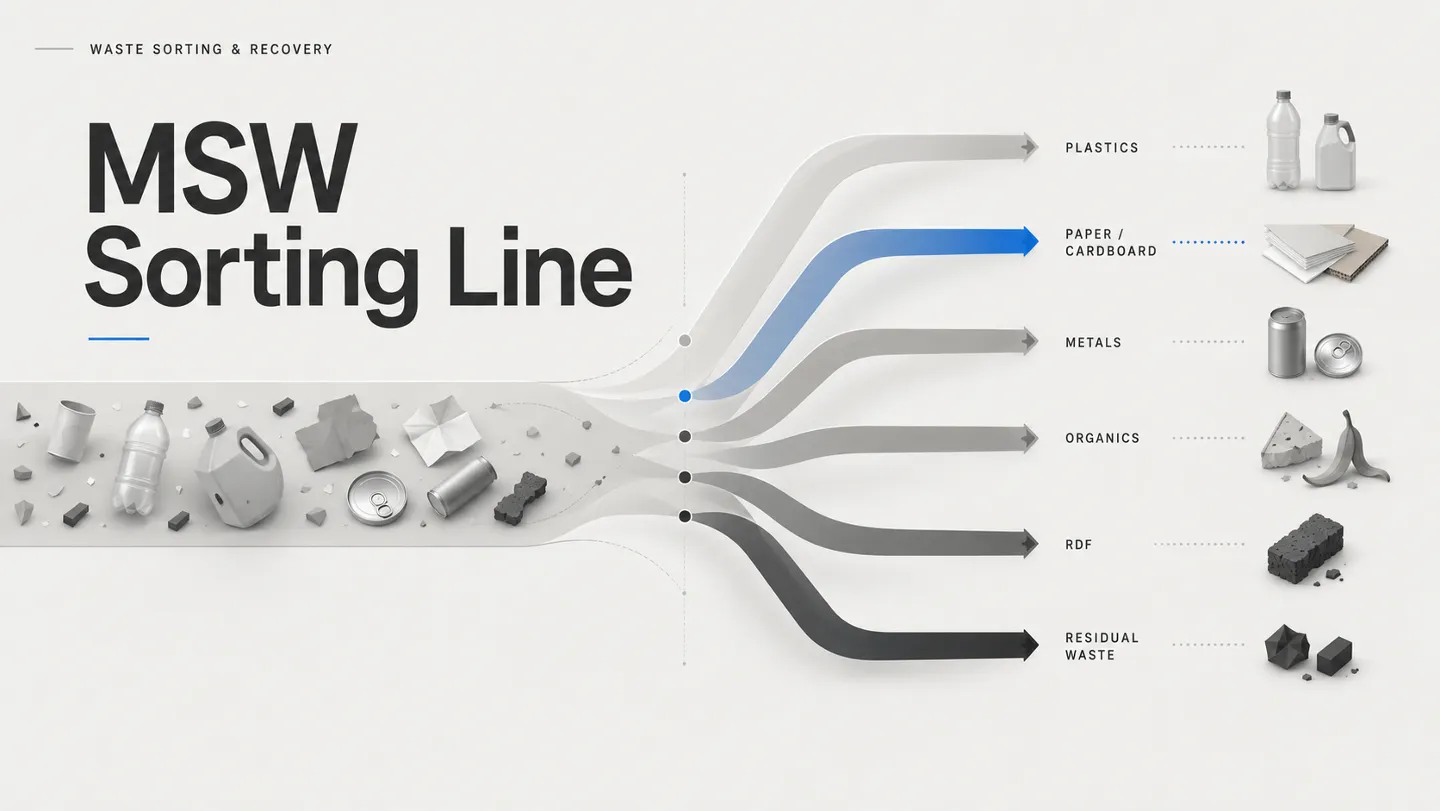
An MSW sorting line separates mixed municipal solid waste into recoverable materials, processable fractions, and controlled residue. The line does not rely on one universal machine. It combines metered feeding, screening, density separation, metal recovery, sensor or manual sorting, and product handling around the actual composition of the incoming waste.
This guide explains how the process works, what each equipment stage does, how capacity and performance should be measured, and what information a buyer should prepare before requesting a plant layout. For available machinery, see the MSW sorting equipment hub or the turnkey MSW sorting plant.
What Is an MSW Sorting Line?
An MSW sorting line is the connected sequence of conveyors, screens, separators, picking stations, bunkers, and baling or residue-handling equipment inside a waste processing facility. Its purpose is to divide a variable mixed feed into material streams that can be sold, recycled, biologically treated, converted into RDF or SRF where permitted, or disposed of safely.
The sorting line is part of a larger material recovery facility (MRF). The complete facility also includes the receiving floor, vehicle routes, fire protection, dust and odor control, electrical systems, maintenance access, product storage, residue storage, and utilities. A machine list alone is therefore not a complete plant design.
Start With a Representative Waste Audit
Reliable design begins with representative samples from the real collection area. Waste composition can change by season, neighborhood, collection method, commercial activity, and local recycling policy. A generic composition chart may cause one stage to be oversized while another becomes the bottleneck.
- Composition by mass: organics, paper, cardboard, films, rigid plastics, ferrous metal, non-ferrous metal, glass, textiles, fines, and residue.
- Physical properties: moisture, bulk density, particle-size distribution, bag size, bulky items, and degree of compaction.
- Problem materials: ropes, hoses, batteries, cylinders, e-waste, hazardous containers, long films, and objects that may wrap or damage equipment.
- Arrival pattern: average and peak tonnage, vehicle schedule, seasonal peaks, and the required receiving buffer.
- Output targets: the grades local buyers or downstream processors will accept, including contamination limits and minimum shipment volumes.
Sampling should cover normal and difficult operating periods. Design decisions made from dry, hand-selected samples may not represent wet, compacted material delivered by collection vehicles.
How an MSW Sorting Line Works
1. Receiving, Inspection, and Pre-Sorting
Vehicles unload on a receiving floor or into a controlled feed area. Operators inspect the material and remove hazardous, oversized, or unsuitable objects before they reach the process line. This stage protects conveyors and separators and prevents one dangerous item from contaminating an entire output batch.
2. Metered Feeding and Bag Opening
A feeder and waste conveyor create a stable material bed. If household waste arrives in bags, a bag opener releases the contents while limiting unnecessary size reduction. Stable feeding matters because overloaded belts reduce screening efficiency, separator accuracy, and manual picking performance.
3. Size Separation
A trommel screen, disc screen, or star screen divides the waste into selected size fractions. The smaller fraction commonly contains more food waste, soil, broken glass, and fines, while the larger fraction carries more packaging, paper, containers, and bulky combustible material. Screen openings must follow the intended downstream process rather than an arbitrary standard size.
4. Shape and Density Separation
Ballistic, air, or other density-based separators can split flat and light two-dimensional material, such as paper and film, from rolling or heavier three-dimensional objects, such as bottles and containers. The correct method depends on moisture, particle size, material loading, and the products the plant intends to recover.
5. Ferrous and Non-Ferrous Metal Recovery
An overhead or drum magnetic separator removes ferrous metal. After the material has been screened and spread into a suitable bed, an eddy current separator can eject aluminum and other conductive non-ferrous metals. Position and belt loading strongly influence recovery; installing a separator does not guarantee a clean product by itself.
6. Optical Sorting and Manual Quality Control
Optical sorters can identify selected polymers, colors, or paper grades when objects are sufficiently exposed and separated. Manual stations may remove contaminants, recover a target grade, or check an automated output. Automation can reduce repetitive sorting, but it still requires controlled feed presentation, cleaning, calibration, maintenance, and output inspection.
7. Product Storage, Baling, and Residue Handling
Recovered materials move to separate bunkers before baling or transfer to the next process. Bunker design must prevent cross-contamination and allow safe discharge. A suitable recycling baler reduces storage and transport volume. Combustible residue may enter an RDF or SRF preparation process where local specifications and permits allow it; remaining residue follows the approved disposal route.
Typical Outputs and Their Next Destination
| Output Fraction | Typical Contents | Possible Next Step |
|---|---|---|
| Ferrous metal | Steel cans and magnetic metal items | Quality check, compaction, and metal reprocessing |
| Non-ferrous metal | Aluminum and other conductive metals | Further cleaning and metal reprocessing |
| Rigid plastics | PET, HDPE, PP, and mixed containers | Polymer sorting, baling, washing, or sale |
| Film and paper | Flexible packaging, cardboard, and mixed paper | Quality sorting, baling, or fuel preparation where permitted |
| Organic and fine fraction | Food waste, soil, small glass, and fines | Biological or other treatment after suitability testing |
| Combustible fraction | Selected paper, plastics, textiles, and wood | RDF or SRF preparation to an agreed specification |
| Residual waste | Non-recoverable or contaminated material | Approved treatment or disposal |
Swipe horizontally to view the full table.
These are possible streams, not guaranteed products. The plant configuration must follow local waste composition, buyer specifications, environmental permits, and available downstream infrastructure.
How to Define MSW Sorting Line Capacity
A quotation stated only in tons per hour is incomplete. Weight, volume, moisture, and composition all affect how the material behaves. Define capacity using the complete operating case:
- Average and peak receiving rate
- Stable net processing rate under representative feed conditions
- Bulk density and moisture range
- Scheduled operating hours and shifts
- Planned cleaning and preventive-maintenance time
- Target plant availability
- Required annual processed tonnage
- Expected seasonal and composition changes
A useful annual planning equation is:
Annual processed mass = stable net throughput × scheduled operating hours × plant availability
The lowest-capacity critical stage determines the real line output. Conveyors, screens, separators, bunkers, balers, residue transport, and operators must therefore be checked as one system.
Performance Metrics: Recovery, Purity, and Yield
Plant performance should be measured by a mass balance, not by visual impressions. Weigh the input, every recovered product, recirculated material, and final residue over a representative period.
| Metric | What It Measures | Basic Calculation |
|---|---|---|
| Recovery rate | How much of a target material in the feed reaches the target output | Target material recovered ÷ target material entering |
| Product purity | How much of the output is the desired material | Target material in output ÷ total output mass |
| Product yield | Total saleable output relative to total feed | Saleable output mass ÷ total input mass |
| Residue rate | Material leaving without recovery | Final residue mass ÷ total input mass |
| Availability | Time the line is ready to operate | Available operating time ÷ scheduled time |
| Net throughput | Actual processed feed over running time | Processed mass ÷ actual operating hours |
Swipe horizontally to view the full table.
Recovery and purity must be evaluated together. Aggressive ejection may raise recovery while adding contamination; strict quality control may improve purity while losing more target material to residue. The correct balance is set by the downstream buyer or process specification.
Plant Layout and Operating Requirements
| Plant Area | Design Requirement | Risk if Overlooked |
|---|---|---|
| Receiving floor | Safe vehicle flow, inspection, buffer volume, drainage, and fire separation | Unstable feed and unsafe traffic |
| Conveyors | Controlled bed depth, guarding, cleaning, and spillage access | Reduced separator accuracy and frequent blockages |
| Sorting cabin | Ergonomics, ventilation, lighting, emergency access, and safe belt loading | Poor manual recovery and worker exposure |
| Product bunkers | Independent storage, level control, and safe discharge | Cross-contamination and interrupted production |
| Maintenance zones | Platforms, lifting points, withdrawal space, bypass planning, and spare-parts access | Long downtime for routine repairs |
| Dust and fire controls | Risk assessment, housekeeping, detection, isolation, and suitable suppression | Fire, dust accumulation, and unplanned shutdown |
Swipe horizontally to view the full table.
The final arrangement must comply with the safety, building, fire, environmental, and employment requirements at the installation site. The waste management hierarchy is useful context, but local permits and output contracts determine which recovery routes are actually available.
What Determines MSW Sorting Plant ROI?
Revenue may come from gate or tipping fees, recovered commodity sales, and avoided disposal costs. Operating costs include labor, electricity, mobile equipment, wear parts, cleaning, maintenance, compressed air, baling consumables, residue transport, and disposal. Commodity prices alone should not support the investment case.
Annual contribution = gate-fee revenue + commodity revenue + avoided disposal cost − labor − power − maintenance − residue disposal − other operating costs
Model conservative scenarios with lower recovery, higher moisture, reduced uptime, lower commodity prices, and more residue. A robust project should remain operable when actual conditions differ from the best-case sample.
MSW Sorting Line RFQ Checklist
- Representative composition study with seasonal ranges
- Photos, videos, sample weights, moisture, bulk density, and particle-size data
- Average and peak daily tonnage and planned operating schedule
- Required recovered products and written buyer specifications
- Residue, organics, glass, and RDF or SRF routes
- Site drawing, available footprint, vehicle routes, and future expansion area
- Power supply, compressed air, water, drainage, and environmental limits
- Required automation level and available operators per shift
- Fire protection, dust, odor, noise, and housekeeping requirements
- Target availability, spare-parts strategy, and service response
- Installation, commissioning, training, performance test, and acceptance scope
- Mass-balance guarantees and the exact feed conditions under which they apply
Before final equipment selection, request a process flow, mass balance, utility list, general arrangement drawing, motor list, control philosophy, maintenance-access review, and clearly defined performance test. Send these project inputs through our contact page for a configuration review.
Frequently Asked Questions
Request an MSW Sorting Line Review
Send representative waste data, target outputs, planned capacity, available site area, operating schedule, and local utility conditions. Rumtoo can review the separation sequence, identify likely bottlenecks, and prepare an equipment configuration for the project.
