


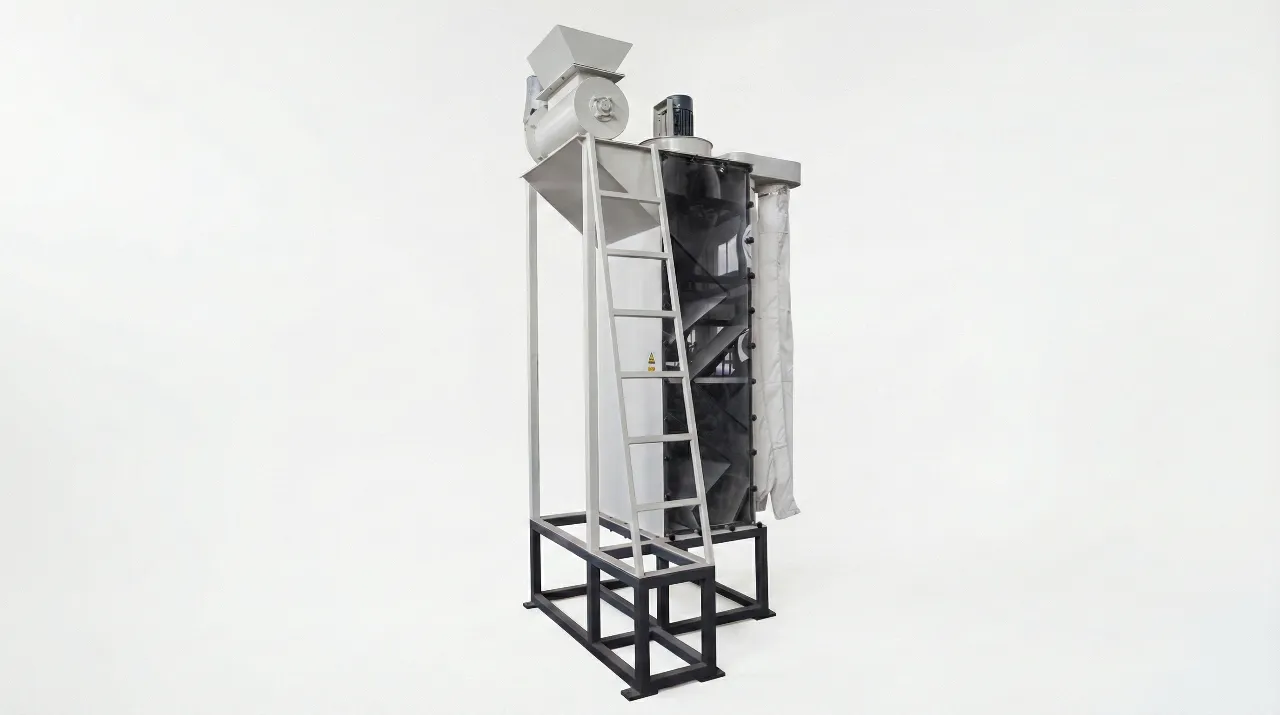
Zig-Zag Air Classifier for Plastic Recycling
Engineered for high-purity recycling lines, this zig-zag column strips paper, film fines, and dust away from dense PET or HDPE flakes through tightly controlled airflow. A zig-zag air classifier is also known as a wind sifter, windsifter, zig-zag separator, or air separator.
- Removes light contaminants without damaging valuable flakes.
- Adjustable airflow profile for different polymers and contamination loads.
- Fits PET, HDPE, PP, film, and mixed rigid recycling applications.
Zig-Zag Air Classifier in Action: Video Demonstration
Watch how controlled airflow lifts light contaminants while clean flakes continue through the process.
Zig-Zag Air Classifier Working Principle
A rising air column carries light fractions upward while gravity keeps dense flakes moving to the bottom outlet.
Light Fraction Extraction
Labels, film fines, and paper fibers are carried upward, collected through the top hood, and routed to dust control.
Clean Flake Discharge
Dense PET, HDPE, or PP flakes fall through the lower section, ready for conveying, packing, or pelletizing.
Adjustable Cut Point
Fan speed and damper settings can be tuned to match density, moisture, particle shape, and targeted purity.
Key Advantages of Our Zig-Zag Air Classifiers
Designed to deliver cleaner flakes, more stable downstream processing, and better resale value.
-
High-Purity Output
Removes the light contamination that mechanical separation alone often leaves behind.
-
Energy-Optimized Flow
Balanced blower and rotary valve pairing maintains separation velocity with modest power draw.
-
Compact Footprint
The vertical zig-zag column integrates above conveyors or mezzanines to save floor space.
-
Low Maintenance
Minimal moving parts and abrasion-resistant surfaces keep maintenance predictable and downtime low.
Frequently Asked Questions
It is typically positioned after drying so that flakes are free-flowing and light contaminants can be evacuated efficiently before packing or pelletizing.
Yes. Any application requiring separation of light versus heavy fractions, including PP regrind, paper-plastic streams, or biomass fuel preparation, can benefit from the adjustable airflow design.
Operators mainly inspect fan bearings, rotary valve blades, and dust collection points. With proper filtration, the system runs months between planned service stops.
Standard systems cover roughly 300 to 3000 kg/h. Final sizing depends on polymer type, bulk density, flake geometry, moisture, and contaminant loading. Column cross-section, height, number of stages, and blower curve are selected to meet purity and pressure-drop targets.
The light fraction is routed to a cyclone and then a downstream filter such as a baghouse or cartridge collector. Sealed ducting and slight negative pressure prevent fugitive dust. Optional HEPA final stage or spark arrestor can be added for stricter regulations.
Product-contact surfaces are typically stainless steel, with 304 as standard and 316 optional. Clean-out doors and inspection windows are included, while washdown packages and CIP nozzles can be specified for high-hygiene applications.
Warranty & Global Installation Support
-
Warranty Coverage
Standard warranty coverage is available for supported machine components and manufacturing defects.
-
Installation & Support
We provide installation guidance, commissioning support, operator training, and spare parts service according to project scope.
Get a Zig-Zag Air Classifier Quote
Tell us about your material, bulk density, throughput requirements, and line configuration. Our engineering team will recommend the right column size and layout.
