


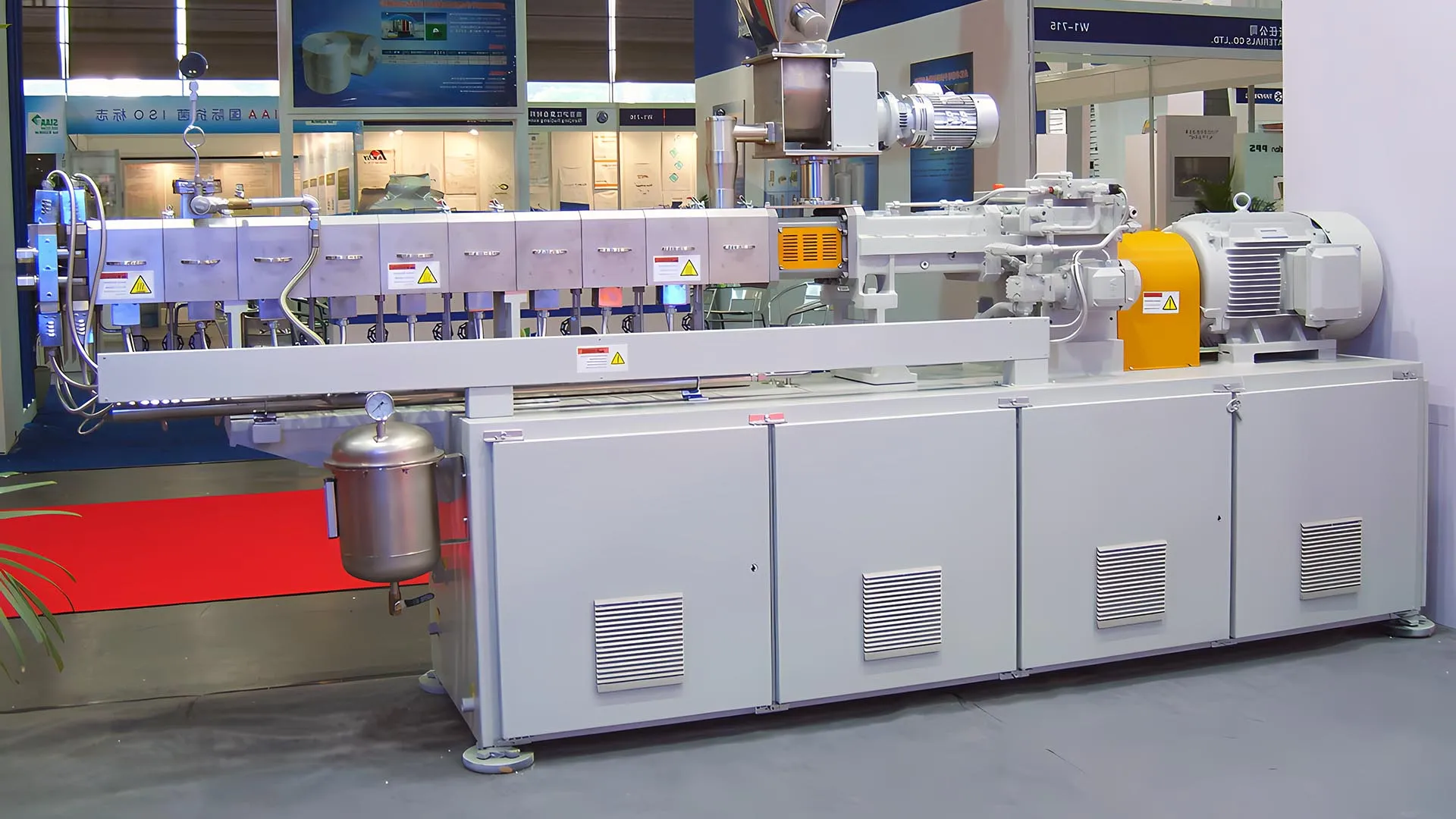
When plastic recycling moves beyond simple regrind into compounding — blending recycled resin with fillers, fibers, colorants, or performance additives — the extruder becomes the heart of the line. A high-velocity, co-rotating dubbelschroefsextruder is built exactly for this job: it mixes, melts, devolatilizes, and homogenizes in one continuous pass, turning washed flakes or regrind into uniform, high-value pellets. This guide explains how it works, how it compares to single-screw machines, and how to specify the right setup. For an overview of complete lines, see our plastic recycling pelletizing machine range.
Waarom compounding om een dubbelschroefsextruder vraagt
Not every recycling job needs compounding, but many of the profitable ones do. If you want to upgrade mixed polyolefin flakes into a filled compound, reinforce recycled PP with glass fiber, or produce rigid PVC blends with consistent quality, a standard melting extruder will leave you with streaks, gels, and weak spots. Twin-screw machines solve this with two intermeshing screws that knead the melt far more intensively than a single screw ever can.
Our twin-screw extruders are high-velocity, co-rotating machines designed for exactly these demanding tasks: extrusion of plastics with high percentages of fillers, reinforcing fibers, or heat-sensitive and shear-sensitive additives such as flame retardants and glass fibers. They are particularly advantageous in the production of rigid PVC and wood fiber blends, where uniform dispersion decides the final product quality.
Werkingsprincipe
All extruders from Rumtoo Recycling come standard with our patented Heat Wave Stabilization™, where heat is uniformly dispersed throughout the entire length of the barrel. This uniform distribution of heat, combined with co-rotating screw shafts that evenly blend the molten plastics into each other in a figure-8 motion, creates the optimal environment for the plastic pelletizing process. We also manufacture counter-rotation extruders based on our customers’ needs and specifications.

In practice, the process runs in stages along the barrel: solid conveying and melting in the feed zone, intensive kneading and distributive mixing in the middle zones (where fillers and fibers are folded into the melt hundreds of times per second), devolatilization under vacuum to pull out moisture and volatiles, and finally pressure build-up at the die. Because the screws are self-wiping, material does not stagnate and degrade — a critical advantage when running heat-sensitive formulations.
Belangrijkste kenmerken
Our extruders come standard with a hydraulic screen changer to ensure uninterrupted operation during screen changes — the melt flow never has to stop for a screen swap, which keeps output steady and avoids degraded plugs. The drive shaft and barrel are made of premium blended steel reinforced using gas nitriding technology, specially treated to guard against corrosion and wear from abrasive fillers like calcium carbonate or glass fiber.
- Co-rotating, self-wiping screws for intensive dispersive and distributive mixing.
- Patented Heat Wave Stabilization™ for uniform barrel temperature and stable melt quality.
- Hydraulic screen changer for continuous operation during screen changes.
- Gas-nitrided barrel and shafts resisting corrosion and abrasive wear.
- Counter-rotation option available for formulations that need it.
- Vacuum devolatilization ports to remove moisture and volatiles from recycled feedstock.
Enkelschroefs- vs dubbelschroefsextruders
The choice comes down to what you feed and what you need out of the die. A enkelschroefsextruder is simpler, cheaper, and perfectly adequate for straightforward melt filtration and pelletizing of clean, uniform material — for example, turning washed PET flakes into pellets, as described in our guide to the single-screw pelletizer for PET plastic flakes.
A twin-screw machine earns its place when the formulation gets complicated: high filler loadings, fiber reinforcement, reactive additives, or blends of dissimilar polymers. The kneading blocks generate the shear needed to break up agglomerates and wet out fibers, while the modular screw design lets the processor tune the shear profile to the recipe. Rule of thumb: if your product specification mentions dispersion quality, you need twin screws.
Taking the best of both worlds, a twin-screw extruder can be coupled with a single-screw extruder in a 2-stage array. In this setup, a larger twin-screw extruder is used mainly for mixing and compound dispersion, and the molten plastic then travels to a smaller single-screw extruder, where superior, low-shear melt pumping and pressure build-up are accomplished. This combination is popular for heat-sensitive materials that need great mixing but gentle final handling.
Waterring- vs strenggranulering
Depending on your preference for “melt pelletizing” or “strand pelletizing,” a water-ring cutter or a strand pelletizer with water tank can be added downstream. Water-ring (die-face) cutting produces near-spherical pellets directly at the die — compact, easy to automate, and well suited to high outputs. Strand pelletizing extrudes spaghetti-like strands through a water bath before cutting; it is forgiving with start-ups and grade changes and remains the workhorse for many kunststofpelletiseermachine installations.
For film and woven-bag recycling lines, water-ring systems pair especially well with the upstream washing process — see our PP/PE-folie waterringpelletiseersysteem for a complete example. To further enhance automation, a vertical dewatering machine with blower to a product silo can be added after pelletizing, so dried pellets travel straight to storage without manual handling.
Toepassingen
Typical applications for our twin-screw extruder pelletizing lines include filled PP and PE compounds (talc or calcium carbonate loadings of 10–40%), glass-fiber-reinforced recycled polyolefins, rigid PVC blends, wood-plastic composites, color and additive masterbatch, and devolatilized food-grade rPET/rHDPE pellet production. Anywhere the recipe — not just the polymer — determines product value, twin-screw compounding pays for itself.
Technische specificaties
Four standard 2-stage configurations cover outputs from 150 to 1,000 kg/h. Larger or customized lines are available on request.
| Model | Schroefdiameter | L/D | Aandrijfmotor | Uitgangsmateriaal |
|---|---|---|---|---|
| SHJ50/SJ120 | ⌀50.2mm / ⌀120mm | 24/48, 7/20 | 37-45 KW / 30-37 KW | 150-300 KG/H |
| SHJ75/SJ150 | ⌀62.4mm / ⌀150mm | 24/48, 7/20 | 55-75 KW / 37-45 KW | 150-300 KG/H |
| SHJ75/SJ180 | ⌀71mm / ⌀180mm | 24/48, 7/20 | 90-110 KW / 45-55 KW | 300-600 KG/H |
| SHJ95/SJ200 | ⌀93mm / ⌀200mm | 24/48, 7/20 | 132-135 KW / 55-75 KW | 500-1.000 KG/H |
Hoe de juiste configuratie te kiezen
Before requesting a quote, gather the following information — it lets the supplier size the screws, drives, and downstream equipment correctly on the first pass:
- Feedstock: polymer type(s), form (flakes, regrind, powder), bulk density, and contamination level.
- Formulation: filler type and loading (%), fiber type and length, additives (flame retardants, stabilizers, colorants) and their heat/shear sensitivity.
- Target output: required kg/h and daily operating hours.
- Pellet spec: pellet size and shape, moisture target, and any dispersion or color-consistency requirements.
- Pelletizing preference: water-ring (melt pelletizing) or strand (with water tank).
- Utilities and layout: available power, cooling water, compressed air, and floor space for the extruder plus dewatering and silo.
- Single or 2-stage: whether your recipe needs twin-screw compounding alone or a twin-plus-single 2-stage array for gentle final pumping.
Veelgestelde vragen
Wat is het verschil tussen een enkelschroefsextruder en een dubbelschroefsextruder?
A single-screw extruder uses one rotating screw to convey, melt, and pump polymer — simple and economical for straightforward pelletizing of clean material. A twin-screw extruder uses two intermeshing, co-rotating screws that knead the melt intensively, making it the right choice for compounding: blending fillers, fibers, and additives into recycled resin with uniform dispersion.
Welke materialen kan een dubbelschroefsextruder verwerken?
Our machines handle polyolefins (PP, PE), rigid PVC, PET, and engineering resins, including formulations with high percentages of fillers such as calcium carbonate or talc, reinforcing fibers such as glass fiber, and heat-sensitive or shear-sensitive additives such as flame retardants. They are particularly advantageous for rigid PVC and wood fiber blends.
Wat betekent de L/D-verhouding en waarom is deze belangrijk?
L/D is the screw length divided by its diameter. A higher L/D (for example 48:1 on the compounding section) gives the material more residence time for melting, mixing, and devolatilization. Longer L/D ratios suit demanding compounding jobs; shorter ones suit simple melt pumping.
Moet ik kiezen voor waterring- of strenggranulering?
Water-ring (die-face) cutting produces uniform, near-spherical pellets directly at the die and automates well at high outputs. Strand pelletizing extrudes strands through a water bath before cutting — it is more forgiving during start-ups and grade changes. Both can be paired with a vertical dewatering machine and blower to a product silo.
What is Heat Wave Stabilization™?
It is our patented barrel heating approach in which heat is uniformly dispersed throughout the entire length of the barrel. Combined with the figure-8 blending action of the co-rotating screws, it creates a stable thermal environment that prevents hot spots and material degradation during pelletizing.
Kunnen dubbelschroefsextruders warmtegevoelige additieven verwerken?
Yes — that is one of their strengths. The modular screw design lets processors configure kneading intensity along the barrel, and the self-wiping action prevents material from stagnating and overheating. For very sensitive formulations, a 2-stage array (twin-screw compounding followed by gentle single-screw pumping) is available, as are counter-rotation extruders built to customer specifications.
Welke informatie heeft u nodig om een granuleringsslijn te offreren?
Polymer type and feedstock form, formulation details (fillers, fibers, additives and loadings), target output in kg/h, pellet specifications, your pelletizing preference (water-ring or strand), and available utilities and floor space. See the RFQ checklist above for the full list.
Bekijk het granuleringssysteem en vraag een offerte aan
Rumtoo Recycling Machinery supplies complete twin-screw compounding and pelletizing lines — extruder, screen changer, pelletizer, dewatering, and silo — sized to your material and output. Browse our kunststofpelletiseermachine range and send your material details for a tailored quotation.
