


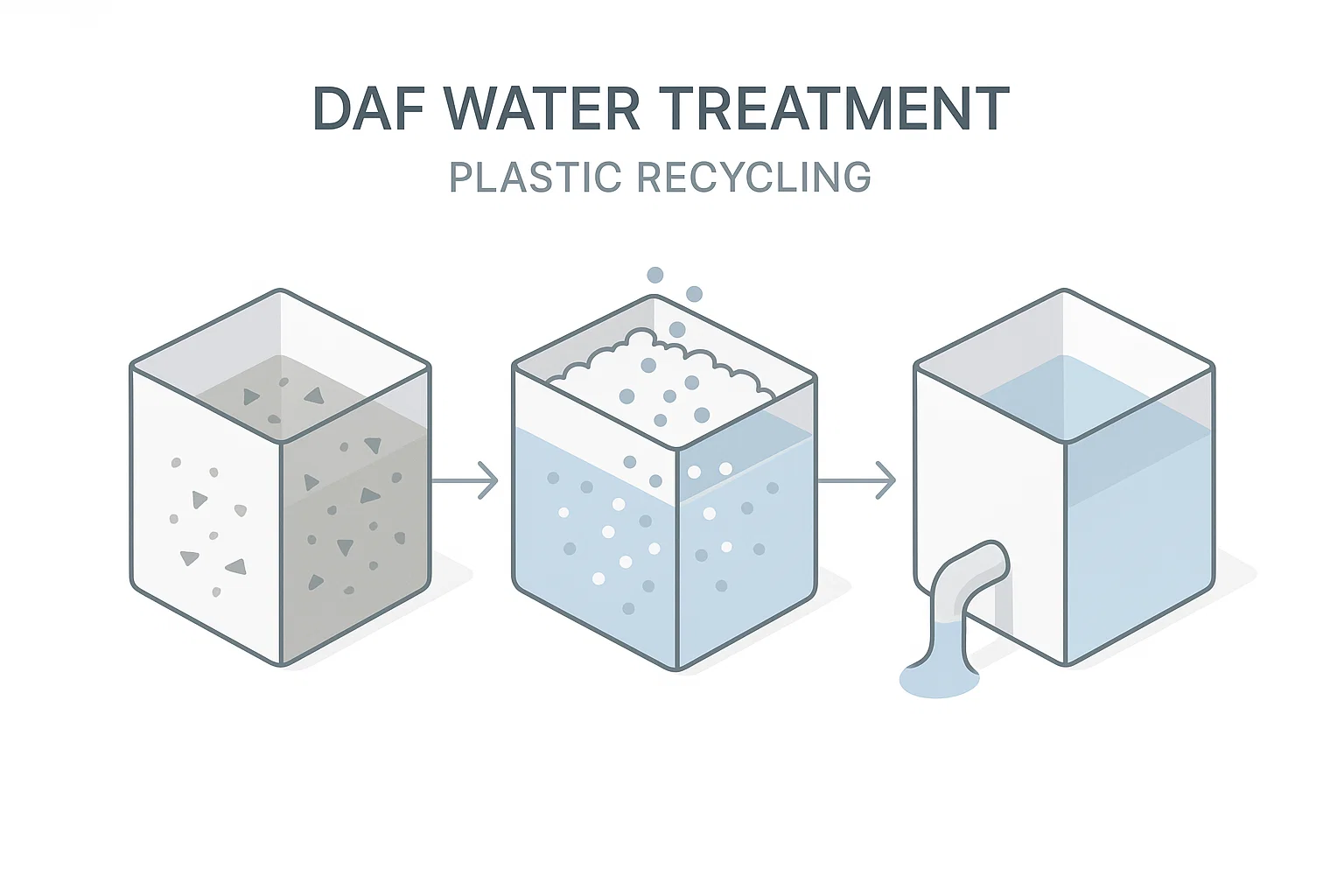
Wasser ist der wichtigste Verbrauchsstoff in jeder Waschanlage. Eine Standard-PET-Anlage mit einer Kapazität von 2.000 kg/h verbraucht 4–5 Tonnen Wasser pro Stunde, wenn es nicht rezirkuliert wird. Die Implementierung eines geschlossenen Wasserkreislaufs mit Druckentspannungsflotation (DAF) ist eine bewährte Methode, um den Verbrauch zu reduzieren und gleichzeitig die für chemische Reinigungsmittel erforderliche Waschqualität aufrechtzuerhalten.
Bei Rumtoo integrieren wir DAF-Systeme, um die drei wichtigsten Kennzahlen von Industrieabwässern zu optimieren: Schwebstoffe (SS), Fette, Öle und Schmierstoffe (FOG) und biochemischer Sauerstoffbedarf (BSB).
Die technische Herausforderung: SS, FOG und BOD
Abwasser aus dem Kunststoffrecycling ist nicht einfach nur “schmutzig”, sondern enthält auch spezifische Verunreinigungen, die durch herkömmliche Filtration nicht entfernt werden können.
1. Schwebstoffe (SS): Mikroplastik und Papierfasern (<50 Mikrometer), die mechanische Siebfilter passieren, aber das Wasser trüben und dadurch die Effizienz optischer Sortieranlagen verringern.
2. FOG (Fette, Öle, Schmierstoffe)Rückstände von Lebensmittelbehältern (Polypropylenwannen, HDPE-Milchflaschen). Diese hydrophoben Bestandteile überziehen die Kunststoffflocken und verhindern so die Wirkung von Reinigungsmitteln.
3. BSB (Biologischer Sauerstoffbedarf)Gelöste organische Stoffe wie Zucker aus Limonadenflaschen. Ein hoher BSB-Wert führt zu Bakterienwachstum und unangenehmen Gerüchen in den Wassertanks.
So funktioniert die Rumtoo DAF-Technologie
Die Flotation mit gelöster Luft (DAF) basiert auf dem Prinzip der Dichteunterschiede. Im Gegensatz zu Sedimentationsbecken, die auf Schwerkraft beruhen (langsam und platzraubend), nutzt DAF Mikrobläschen (30–50 Mikrometer), um Verunreinigungen an die Oberfläche zu befördern.
Der 4-stufige Prozess
- Chemikaliendosierung: Die Behandlung des Wassers mit einem Koagulationsmittel (z. B. PAC) und einem Flockungsmittel (PAM), um feine Partikel zu größeren Clustern, sogenannten “Flocken”, zu binden.
- MikroblaseninjektionWasser, das mit Luft unter hohem Druck (5–7 bar) gesättigt ist, wird in den Tank geleitet. Der plötzliche Druckabfall erzeugt Millionen von Mikrobläschen.
- Haftung und AufstiegBlasen lagern sich an FOG und Feststoffflocken an und verringern so deren Dichte unter Wasser. Sie steigen schnell zur Oberfläche auf.
- AbschöpfenEin mechanischer Schaber entfernt die schwimmende Schlammschicht, während geklärtes Wasser vom Boden zur Wiederverwendung entnommen wird. Wäscheleine aus Kunststoff.
Leistungsvergleich: DAF vs. Sedimentation
Für Recyclinganlagen ist DAF überlegen, da Kunststofffeinstoffe und Öle von Natur aus dazu neigen, zu schwimmen und nicht zu sinken.
| Metrisch | Sedimentationsbecken | Druckentspannungsflotation |
|---|---|---|
| SS-Entfernung | 40-60% | > 95% |
| FOG-Entfernung | 50-70% | > 97% |
| Hydraulische Last | Niedrig (langsames Absinken) | Hoch (Schnelle Flotation) |
| Fußabdruck | Große Fläche erforderlich | Kompaktes Design |
Abschluss
Installation eines DAF-System Die DAF-Anlage wandelt Abwasser von einer Entsorgungsbelastung in einen wiederverwendbaren Rohstoff um. Mit dem richtigen Chemikalienprogramm und der passenden Anlagendimensionierung kann sie 90–951 TP6T+ an Zielschadstoffen entfernen. Dadurch lassen sich die Wiederverwendungszyklen des Waschwassers deutlich verlängern und die Kosten für die Chemikaliendosierung sowie die Gebühren für die Umwelteinleitung reduzieren.
