


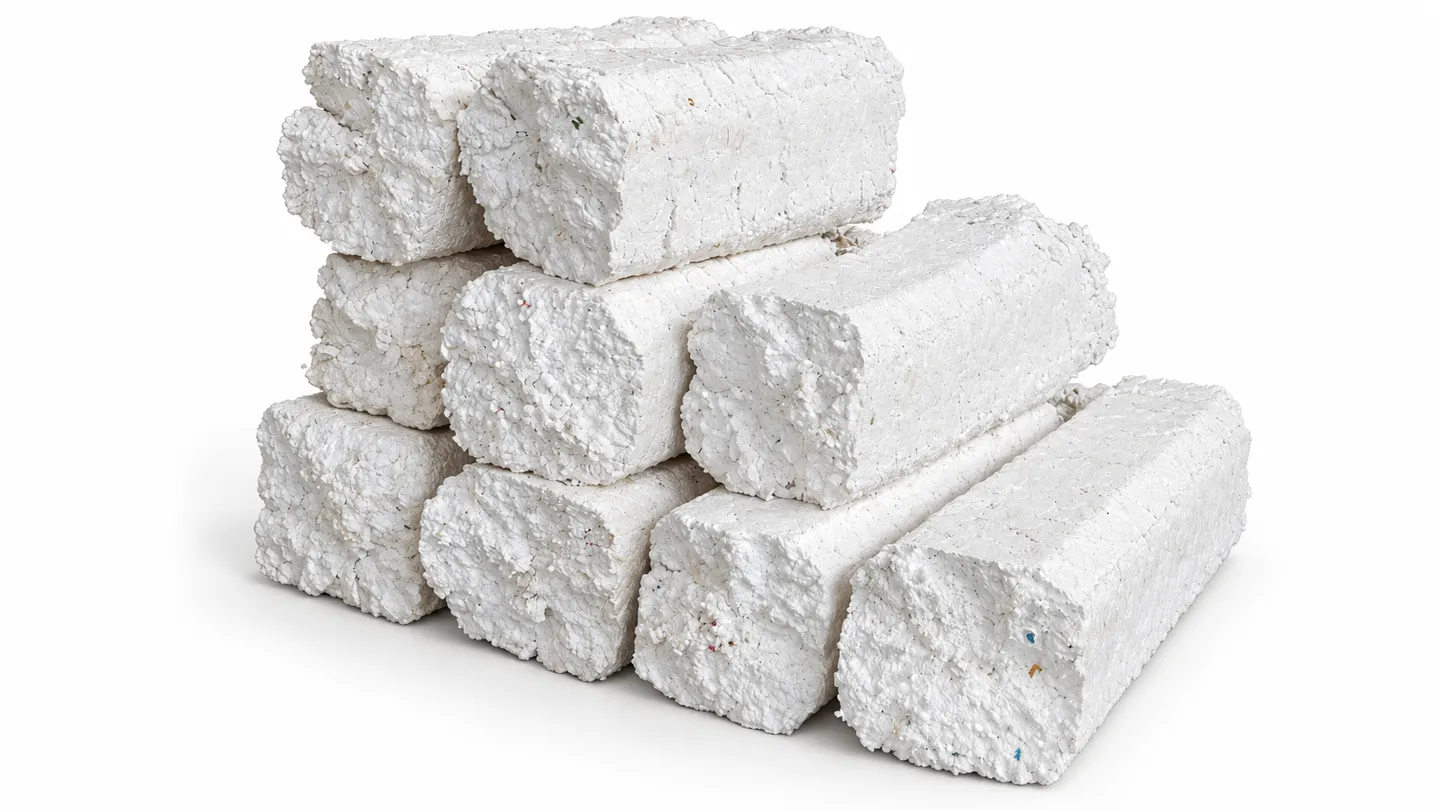
An EPS foam cold press should be selected around the condition of your incoming foam and the block specification your recycler accepts — not around a catalogue kg/h figure alone. The right machine matches feed opening to your largest pieces, screw and drive to your daily weight and loose volume, and block discharge to a handling and collection method the buyer has already agreed.
This guide gives recycling operators, collection centers, and packaging-waste managers a practical selection method for screw-type EPS compactors. It covers how cold compaction works, which foam streams suit it, how to size the RTM-CP range, and what to agree with your recycler before ordering.
If you already have foam photos, daily weight and loose volume, use the RFQ checklist below before requesting a quotation. It will help separate a real project configuration from a catalogue rating.
Quick answer: how should you select an EPS cold press?
Select an EPS cold press by matching four things: the largest foam pieces to the feed opening, the daily weight and loose volume to the throughput range, the block size to the recycler’s acceptance specification, and the site’s power and loading method to the machine layout.
- Choose the RTM-CP50 (40–50 kg/h) when daily EPS is modest, pieces fit a 612 × 500 mm feed opening, and a single-operator loading routine is realistic.
- Choose the RTM-CP100 (80–100 kg/h) when collection volumes need a full shift of steady feeding through a 1,000 × 600 mm opening.
- Choose the RTM-CP200 (150–200 kg/h) when a collection center or foam processor runs high daily volumes and block palletizing is already planned.
- Confirm buyer acceptance of cold-compacted blocks before any model decision — some recyclers only take fused hot-melt output.
Throughput figures are planning ranges under stated assumptions, not guarantees. The sections below show what moves a real installation toward the top or bottom of each range.
How an EPS screw compactor works
A cold press compacts EPS mechanically, without a melting stage. The process runs in three steps:
- Size reduction. Incoming foam is broken into manageable pieces — either manually or through the integrated crusher — so it feeds evenly. Oversized rigid pieces that bridge the feed opening are the most common cause of uneven throughput.
- Screw compression. A rotating screw conveys the foam forward while the compression ratio rises along its length, squeezing air out of the cellular structure. The 189 mm, 290 mm, and 350 mm screw diameters across the RTM-CP range set the volumetric capacity of this stage.
- Block discharge. Compacted material exits as a continuous block or log stream, which is cut or broken to length, then stacked and palletized. Block density and handling strength depend on feed material and machine setup — they are not fixed by the model alone.
There is no heater and no molten stage. Friction can still generate heat during mechanical processing; “cold pressing” describes the compaction method, not a guarantee of ambient temperature throughout the machine.
Which EPS streams suit cold compaction
Select the machine around the source, cleanliness, dimensions, and daily volume of your EPS foam. Four streams cover most projects:
Appliance and electronics packaging
Molded EPS protectors and cushioning inserts from unpacking, retail, and distribution operations. Remove tape, film, labels, and other packaging materials before compaction — they do not compress with the foam and end up as contamination in the block.
EPS fish boxes and produce containers
Sorted polystyrene boxes after emptying and cleaning. Free liquids and food residues must be removed before evaluating feeding and block quality. Wet boxes should be drained and dried; water adds weight the buyer will not pay for and can weaken block integrity.
Foam production and cutting scrap
Known-grade EPS offcuts, rejected molded pieces, and clean factory scrap. This is the most predictable feed: record the loose bulk density and largest piece dimensions when selecting the feed opening, and the sizing decision becomes straightforward.
Sorted collection-center EPS
Source-separated packaging collected for volume reduction before shipment. Keep incompatible foams and heavily contaminated material out of the EPS stream — a collection center’s biggest risk is mixed material undoing the value of compaction.
What does not belong in a cold press
A cold press is specified for expanded polystyrene. The following need separate assessment and should never be treated as interchangeable feed:
- EPE, EPP, XPS, and polyurethane foams. Different cell structures and recovery behavior; they compact differently and contaminate the EPS block.
- Wet or food-contaminated fish boxes fed as-is. Empty, clean, and dry them first, or agree contamination limits with the buyer upfront.
- Foam with embedded non-EPS materials — wood, metal clips, heavy tape masses. Sort them out; the screw is a compactor, not a separator.
Describe the actual incoming condition when requesting a proposal. A supplier can only size the crusher stage and feed opening against real material.
Sizing: weight, loose volume, and piece size
For EPS, kilograms per day alone is not enough. Loose cubic meters matter just as much because feeding behavior depends on bulk density — 50 kg of molded protectors and 50 kg of loose fill occupy very different volumes and feed very differently.
Size from three inputs together:
- Daily weight (kg/day) mapped against shift hours to an hourly rate, then compared with the 40–50, 80–100, and 150–200 kg/h planning ranges.
- Loose volume (m³/day) to check that the feed opening and loading routine can physically present that volume to the screw within the shift.
- Largest piece dimensions checked against the feed opening — 612 × 500 mm on the RTM-CP50, 1,000 × 600 mm on the RTM-CP100 and RTM-CP200. Pieces that must be pre-broken add labor; say so in the RFQ.
Throughput depends on EPS density, cleanliness, and feeding conditions. Ask the supplier to state the assumptions behind the quoted range — foam grade, contamination level, and feeding method — and treat the range as provisional until those match your material.
Block handling: the step buyers actually judge
The compactor’s job ends at the discharge; the project’s economics are decided at the buyer’s gate. Agree these with the receiving recycler before selecting the machine:
- Block dimensions and handling weight. Confirm what the buyer stacks, pallets, or container-loads — then check the discharge produces blocks in that envelope.
- Block integrity. Check that blocks hold together during moving and stacking. Crumbly blocks cost labor and lose material; agree a practical handling test.
- Cleanliness limits. Tape, labels, food residue, and mixed foam fractions each have a tolerance. Put the numbers in writing.
- Collection logistics. Plan pallet handling and pickup around the actual block weight and daily block count, not the loose-foam volume you used to have.
For most recyclers, cold-compacted blocks are a finished, sellable product. If the end goal is recycled PS pellets, that is a separate reprocessing and pelletizing decision — confirm it with the recycler rather than assuming the block price covers it.
Site and utility planning
A cold press is simpler to site than a thermal system — no heater load, no cooling zone, no thermal extraction — but four items still need confirmation:
- Electrical supply. Main motor ratings are 4 kW (RTM-CP50), 7.5 kW (RTM-CP100), and 15 kW (RTM-CP200), plus crusher motors (2.2 kW, 2 × 2.2 kW, and 4 × 2.2 kW respectively). These are component ratings, not measured energy use or total installed power. Confirm voltage, frequency, and available capacity, plus auxiliaries, in the quotation.
- Floor space and loading access. Allow room for foam staging, the feed opening approach, block discharge and stacking, and maintenance access around the screw and crusher. State whether loading is manual, by conveyor, or by forklift-fed staging.
- Dust control. Crushing and handling EPS generates dust and light airborne particles. Plan housekeeping and, where volumes are high, local dust management around the crusher and discharge.
- Block storage and collection. Size the pallet area from the compacted block volume and the collection frequency — the whole point of the machine is converting a volume problem into a stacking plan.
Cold press or hot melt? A short decision frame
Both routes densify EPS dramatically compared with loose foam. The choice turns on buyer acceptance and site capability:
| Criterio de selección | EPS cold press | máquina de fusión térmica de EPS |
|---|---|---|
| Core process | Mechanical screw compression | Controlled heating and thermal densification |
| Forma del producto | Compacted EPS blocks or logs | Fused polystyrene blocks or ingots after cooling |
| Enfoque operativo | Steady feeding, compression, block integrity | Feed rate, temperature, cooling, extraction |
| Site planning | Loading, drive power, dust control, block storage | Loading, drive and heater power, ventilation, cooling space |
| Buyer acceptance | Confirm acceptance of cold-compacted EPS | Confirm acceptance of hot-melt output |
Choose the cold press when the buyer accepts compacted blocks and the project benefits from simpler utilities. Choose hot melting when the buyer requires fused output and the site supports thermal processing. For the full side-by-side comparison, see Máquina de fusión térmica de EPS vs. prensa en frío: guía de compra de densificadores de EPS, then compare the EPS foam cold press machine con la máquina de fusión térmica de EPS on the same feedstock data.
RFQ checklist for an EPS cold press
A useful RFQ lets two suppliers quote against the same duty. Send the following in a table, supported by foam photos:
- Foam source and EPS grade; largest piece dimensions.
- Kilograms per day and cubic meters of loose EPS per day.
- Shift hours, operating days per week, and peak collection loads.
- Contamination profile: tape, labels, food residue, moisture, mixed foams.
- Loading method: manual, conveyor, or staged forklift feeding.
- Required block dimensions, handling weight, and pallet or container arrangement.
- Buyer acceptance: written confirmation that cold-compacted blocks are accepted, with cleanliness limits.
- Floor space, loading access, and maintenance clearance.
- Voltage, frequency, and available power.
- Target for the output: direct sale to recycler, or further reprocessing to PS pellets.
Ask each supplier to mark assumptions directly in the quotation. If foam density, contamination, or block specification remains “to be confirmed,” the throughput and model selection should remain provisional too.
Common selection mistakes
Sizing from kg/h alone
Loose volume determines whether the feed opening and loading routine can keep the screw fed. Always pair daily weight with loose cubic meters and shift hours.
Skipping the buyer-acceptance check
The most expensive mistake is installing a compactor whose blocks the intended recycler will not take. Get block size and cleanliness acceptance in writing before ordering.
Feeding unsorted mixed foam
EPE, EPP, and PU mixed into the EPS stream do not compact the same way and contaminate the block. The compactor cannot sort; the process before it must.
Treating the catalogue range as a guarantee
Throughput ranges assume stated foam conditions. If your foam is lighter, dirtier, or fed intermittently, expect the lower end — and say so in the acceptance criteria.
Underplanning block logistics
Compaction converts a volume problem into a stacking and collection plan. If pallet storage and pickup frequency are not sized from the block output, the machine’s benefit stalls at the warehouse door.
Preguntas frecuentes
Does an EPS cold press melt the foam?
No. The RTM-CP series uses crushing and screw pressure to form compacted EPS blocks without a thermal melting stage. Friction can still generate heat during mechanical processing; cold pressing describes the compaction method.
How do I choose between RTM-CP50, RTM-CP100, and RTM-CP200?
Their listed EPS throughput ranges are 40–50, 80–100, and 150–200 kg/h respectively. Compare these with your daily weight, shift hours, loose foam density, and piece size. The feed opening (612 × 500 mm vs 1,000 × 600 mm) and loading method also affect the practical processing rate.
What compression ratio will my EPS achieve?
Volume reduction varies with the starting foam density, contamination, feeding, and block formation. Use representative material to measure loose input volume and compacted output volume on the same basis, then check that the blocks hold together during handling.
Can I feed wet fish boxes or mixed foam directly?
Empty and clean EPS boxes and remove free liquids before compaction. EPE, EPP, XPS, polyurethane, and mixed foams require their own suitability assessment. Keep the EPS stream sorted and describe its actual condition when requesting a proposal.
Does the machine produce recycled polystyrene pellets?
The cold press produces compacted blocks, not finished pellets. A receiving recycler can assess the blocks for further preparation and suitable PS extrusion or pelletizing. Agree cleanliness and output requirements with that recycler before selecting the machine.
Should I choose cold compaction or hot melting?
Start with the output your recycler accepts and the utilities at your site. Cold compaction produces mechanically compressed blocks with simpler site requirements. Hot melting produces fused material and adds heating, cooling, and extraction. Compare actual feed trials and operating needs for both routes.
What power supply does the RTM-CP series need?
Main motor ratings are 4 kW, 7.5 kW, and 15 kW across the three models, plus crusher motors. These are component ratings, not measured energy consumption. Confirm voltage, frequency, available capacity, and auxiliaries in your quotation.
Specify the machine around the foam, not the catalogue
An EPS foam cold press is a materials-handling decision as much as a machine purchase. Start with the foam source, piece size, daily weight and loose volume, and the block specification the recycler has accepted in writing. Those facts determine the model, feed opening, loading method, and collection plan.
Revise el EPS foam cold press machine against the RTM-CP50, RTM-CP100, and RTM-CP200 specifications, then send foam photos and daily processing targets for a duty-specific configuration.
Obtenga una propuesta a medida: Send foam photos, daily weight and loose volume to EPS foam cold press machine — or email [email protected] / call +1 332 250 1915.
Rumtoo Machinery, Zhangjiagang Town, Suzhou City, Jiangsu 215600, China. +13322501915
