


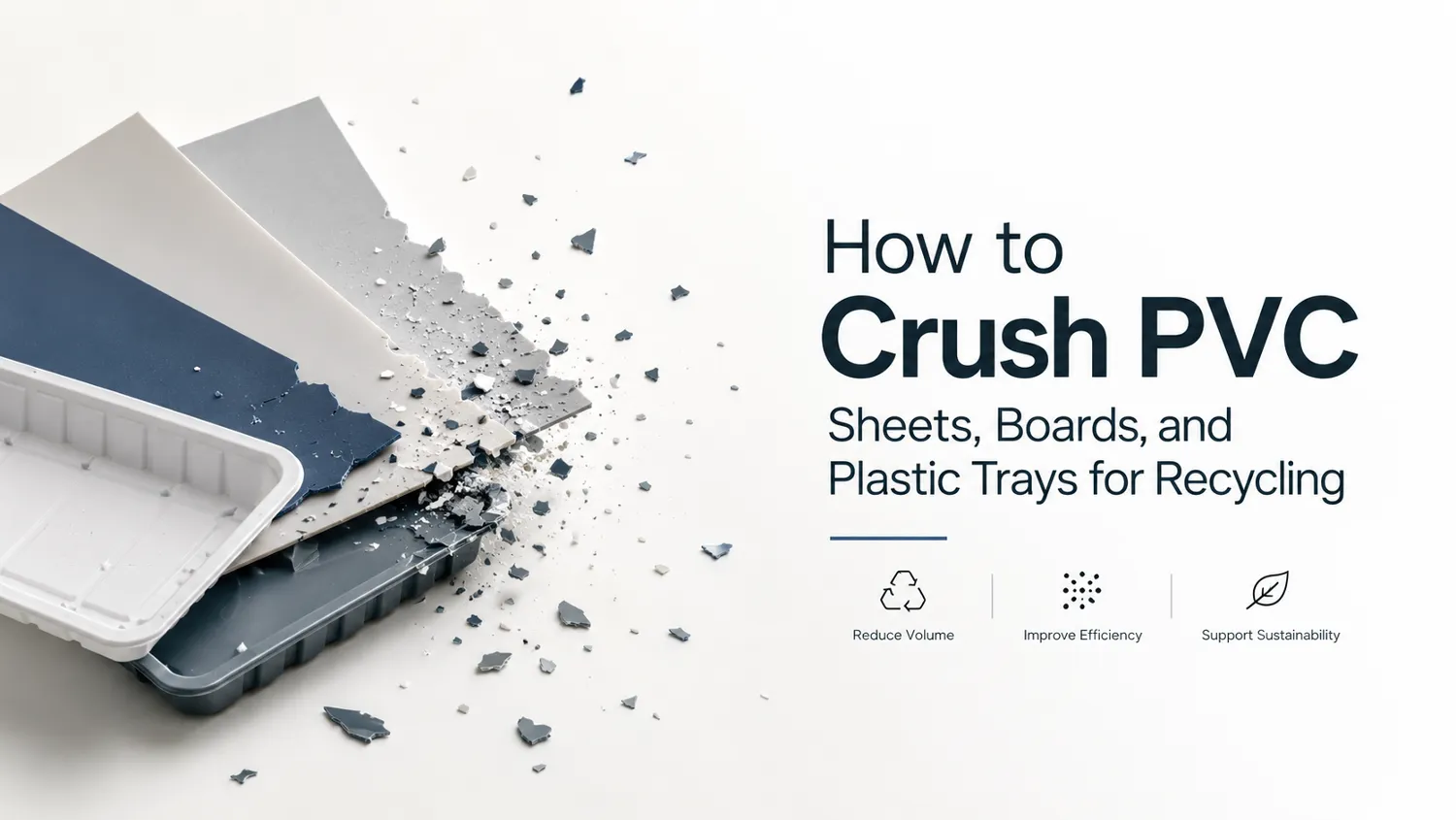
Aplastante Láminas de PVC, placas rígidas y bandejas de plástico es un trabajo diferente del triturado de botellas o tuberías. El material plano es ancho, rígido y engorroso: una hoja de 1.2 m no pasará por una tolva vertical, las bandejas se cruzan sobre aberturas estrechas y las tablas de WPC contienen relleno mineral que desgasta las cuchillas estándar. Esta guía explica cómo se comporta el material plano rígido en una trituradora, por qué un diseño de alimentación horizontal se adapta a él, qué tamaño de salida debe tenerse como objetivo y cómo dimensionar la máquina para su tabla más ancha.
¿Por qué el Material Plano Supera una Trituradora de Alimentación Superior Estándar
Una granuladora convencional se alimenta desde arriba: el material cae a través de una tolva vertical sobre el rotor. Esto funciona para botellas, soportes y pequeñas piezas moldeadas — cualquier cosa que caiga libremente. Las hojas y las bandejas no caen libremente:
- Conexión. Las piezas planas se apoyan en la garganta de la tolva y permanecen allí mientras el rotor gira debajo. Los operadores terminan empujando el material, lo que es exactamente lo que nunca debería invitar el diseño de seguridad de una trituradora.
- Límites de ancho. Una hoja más ancha que la abertura de la tolva debe ser pre-cortada con una sierra — lenta, polvosa y un costo de mano de obra en cada tabla.
- Agarrado sin control. Cuando finalmente una hoja grande y rígida se captura, el rotor toma un gran bocado no controlado, aumentando la carga del motor.
A trituradora horizontal gira la geometría de lado a lado: el material se carga de manera plana a lo largo de una trayectoria horizontal baja, a mano o por conveyance, y la alimentación se controla en el rotor. Las hojas anchas, las bandejas, los perfiles, los purges y hasta las paletas de plástico entran en su orientación natural — sin cortar previamente el material que se ajusta a la abertura de alimentación, sin cruzar, sin subir a una tolva alta.
Cómo se Comportan los Materiales: PVC, WPC/SPC y Bandejas Termoformadas
El material plano rígido abarca varias familias de polímeros, y cada una trae su propia nota de manejo:
- PVC rígido en láminas y perfiles. Tritura limpiamente a velocidades de alimentación controladas, pero el PVC es sensible al calor — una cámara de corte sobrecargada y caliente descolora el reciclado y desvanece su valor. La alimentación horizontal constante mantiene la temperatura de la cámara baja.
- Las hojas de espuma de PVC (espuma integral y espuma libre). Comunes en señalización y construcción, a densidades de aproximadamente 0.45–1.05 g/cm³ en comparación con 1.4+ para el PVC rígido. Se cortan fácilmente, pero el rendimiento es volumen-limitado: a la mitad de la densidad, el mismo rotor mueve la mitad de los kilogramos por hora. Siempre cotiza y compara la capacidad de las hojas de espuma en kg/h en la densidad declarada, no contra las cifras de las hojas rígidas.
- Las tablas de WPC y SPC (decking, pavimento, paneles de pared). La harina de madera y el núcleo mineral son abrasivos. El acero de cuchilla estándar se desgasta rápidamente; especifique cuchillas resistentes al desgaste para las tablas llenas — disponibles como paquete opcional en la trituradora horizontal — y planifique intervalos de inspección de la separación de cuchillas más ajustados.
- bandejas termoformadas de PP y PET Ligero y elástico en lugar de resistente. El desafío es el volumen, no la fuerza de corte: las bandejas se cruzan en tolvas verticales pero se alimentan de manera plana sin quejarse en una trayectoria horizontal.
- Policarbonato y ABS en láminas. Materiales frágiles que se trituran fácilmente pero generan más finos — una malla más grande con un segundo paso de granulación a menudo da un reciclado más limpio que forzar una malla fina en un solo paso. Para el manejo del polvo, vea nuestra guía sobre controlando el polvo y el ruido en el reciclaje de PVC rígido.
La Secuencia de Fragmentación, Paso a Paso
- Carga plana. Las hojas, las tablas o las bandejas abaladas entran en la trayectoria de alimentación horizontal a mano o por conveyance — la altura de carga permanece baja, lo que es importante para la alimentación manual durante todo el turno.
- Alimentación controlada. El sistema de alimentación mide el material en la cámara de corte para que el rotor tome mordidas consistentes en lugar de un solo agarre no controlado, manteniendo la carga del motor estable.
- Corta contra cuchillas fijas. Las cuchillas del rotor cortan el material contra cuchillas contrapuestas estáticas — corte limpio, no impacto de trituración, lo que limita los finos y el calor.
- Criba para tamizado. El reciclado se recircula hasta que pasa la malla. Cambiando la malla cambia el tamaño de salida sin tocar el rotor.
¿Qué Tamaño de Salida Deberías Objetivar?
Coincida la malla con el destino del reciclado, no con el hábito:
- 10–15 mm — alimentando extrusión o granulación directamente; suficientemente pequeña para una alimentación estable, suficientemente grande para limitar los finos.
- 15–25 mm — entrando en una línea de lavado, donde una escama más gruesa lava y deshidrata bien.
- 25 mm+ — reducción de volumen pura para el almacenamiento o el transporte, con la granulación final hecha más tarde.
Las mallas finas cuestan rendimiento en tablas gruesas: si necesita un reciclado fino de 20 mm+, un paso inicial grueso más una segunda etapa de granulación generalmente supera forzar una máquina a hacer ambas cosas. Nuestra Guía de tipos de trituradoras de plástico cubre cuándo dividir el trabajo.
Dimensionando la Máquina: Comienza con tu Tabla Más Ancha
La longitud del rotor es el límite de ancho para la alimentación plana, por lo que la hoja más grande que procesas determina la máquina — no la media. Ancho de la abertura de alimentación a medida: las tres configuraciones a continuación son referencias, y la longitud del rotor se escala a la anchura de la hoja.
| Modelo | Rotor (diametro × longitud) | Motor | Rendimiento | Apta |
|---|---|---|---|---|
| ECH-800 | 450 × 800 mm | 22–37 kW | 300–600 kg/h | Bandejas, hoja estrecha, perfiles |
| ECH-1200 | 500 × 1,200 mm | 37–55 kW | 500–1,000 kg/h | Ancho estándar de hoja y tablero |
| ECH-1500 | 560 × 1,500 mm | 55–75 kW | 800–1,500 kg/h | Paneles de ancho completo, paletas, alto volumen |
El stock de hojas en señalización y construcción alcanza hasta 2 m y más, y el precorte de cada tablero anula el propósito de la alimentación horizontal. Por eso, la abertura de alimentación no es un límite catalogado fijo: indique su ancho máximo de hoja en la Solicitud de Cotización (RFQ) — 1,800 mm, 2,100 mm o más ancho — y el largo del rotor y la clase del motor se configuran en torno a él como práctica estándar.
Cinco factores determinan la especificación: polímero y tipo de producto; longitud, ancho, grosor y peso unitario máximos; contenido de relleno o refuerzo; tasa horaria requerida; y el tamaño de salida necesario para su proceso posterior. Envíe estos con su RFQ y la cotización se ajustará a la realidad en lugar de a un promedio de catálogo.
Horizontal o Vertical? Elegir según la Forma de Alimentación
El triturador horizontal se merece su lugar en alimentación ancha, plana, voluminosa . Para longitudes redondas largas — tubos y perfiles extruidos alimentados por el extremo primero — un triturador de tuberías PVC vertical es la mejor geometría. Y donde los tableros llegan sucios, un molino húmedo combina la trituración con un lavado inicial en la misma pasada. La forma de alimentación decide la máquina; el material solo decide las cuchillas y la malla.
Preguntas frecuentes
¿Se puede hacer más ancha la abertura de alimentación para hojas grandes?
Sí — el ancho de alimentación es personalizable como estándar. Los modelos listados son tamaños de referencia; para hojas de 2 m y más, el largo del rotor y la abertura de alimentación se construyen según su ancho máximo de hoja, con la clase del motor escalada para coincidir. No se necesita precorte para el stock que se ajusta a la abertura configurada.
¿Puede manejar un triturador horizontal WPC y SPC pavimentos?
Sí — Las tablas WPC y SPC son aplicaciones fundamentales, pero sus rellenos de harina de madera y minerales son abrasivos. Especifique el paquete de cuchillas resistentes al desgaste y inspeccione el espacio entre cuchillas con mayor frecuencia que con PVC sin relleno; esto mantiene estable el tamaño de salida y evita cambios de cuchilla no planeados.
¿Las láminas de PVC necesitan ser cortadas previamente antes de la trituración?
No, si la lámina se ajusta a la abertura de alimentación. La carga horizontal eleva las láminas hasta la longitud del rotor — 800 a 1,500 mm dependiendo del modelo — en su orientación plana natural. Solo las existencias más anchas que el camino de alimentación necesitan un corte de ajuste primero, en lugar de cortar cada tabla con una sierra para una máquina de carga superior.
¿A qué tamaño reducen las cucharas las bandejas de plástico?
El tamiz lo determina, generalmente 10–25 mm. Para las bandejas que alimentan una línea de lavado, 15–25 mm de escama funciona bien; para la extrusión directa, 10–15 mm de alimentación es más estable. Los tamices se intercambian sin quitar el rotor.
¿Se puede triturar las láminas con la película protectora aún en ellas?
Sí. La delgada película protectora de PE de las láminas de PVC nuevas no necesita ser eliminada antes de la trituración; se desmenuza junto con la lámina. Los fragmentos de la película terminan en el reciclado, lo que es normalmente aceptable cuando el material vuelve a su propia extrusión; si el reciclado se vende a un especificador de pureza, indique al comprador el contenido de la película o elimine la película en el proceso anterior.
¿Por qué mi reciclado de PVC se descolora durante la trituración?
El calor. El PVC se degrada y amarillea cuando la cámara de corte está caliente, generalmente debido a una sobrefeeder, cuchillas afiladas o un tamiz obstruido. La alimentación controlada, un espacio entre cuchillas mantenido y un tamiz correctamente dimensionado mantienen baja la temperatura de la cámara y el reciclado brillante.
Obtenga un triturador dimensionado según sus tablas
Envíenos su material (lámpana de PVC, tablas WPC/SPC, bandejas o stock rígido mixto), las dimensiones máximas de la tabla y su tasa de objetivo. Confirmaremos si el triturador horizontal para tablas de plástico y láminas de PVC se ajusta y qué modelo, cuchillas y tamiz necesita su materia prima de alimentación. Contáctenos con nuestro equipo de ingeniería para obtener un presupuesto configurado.
