


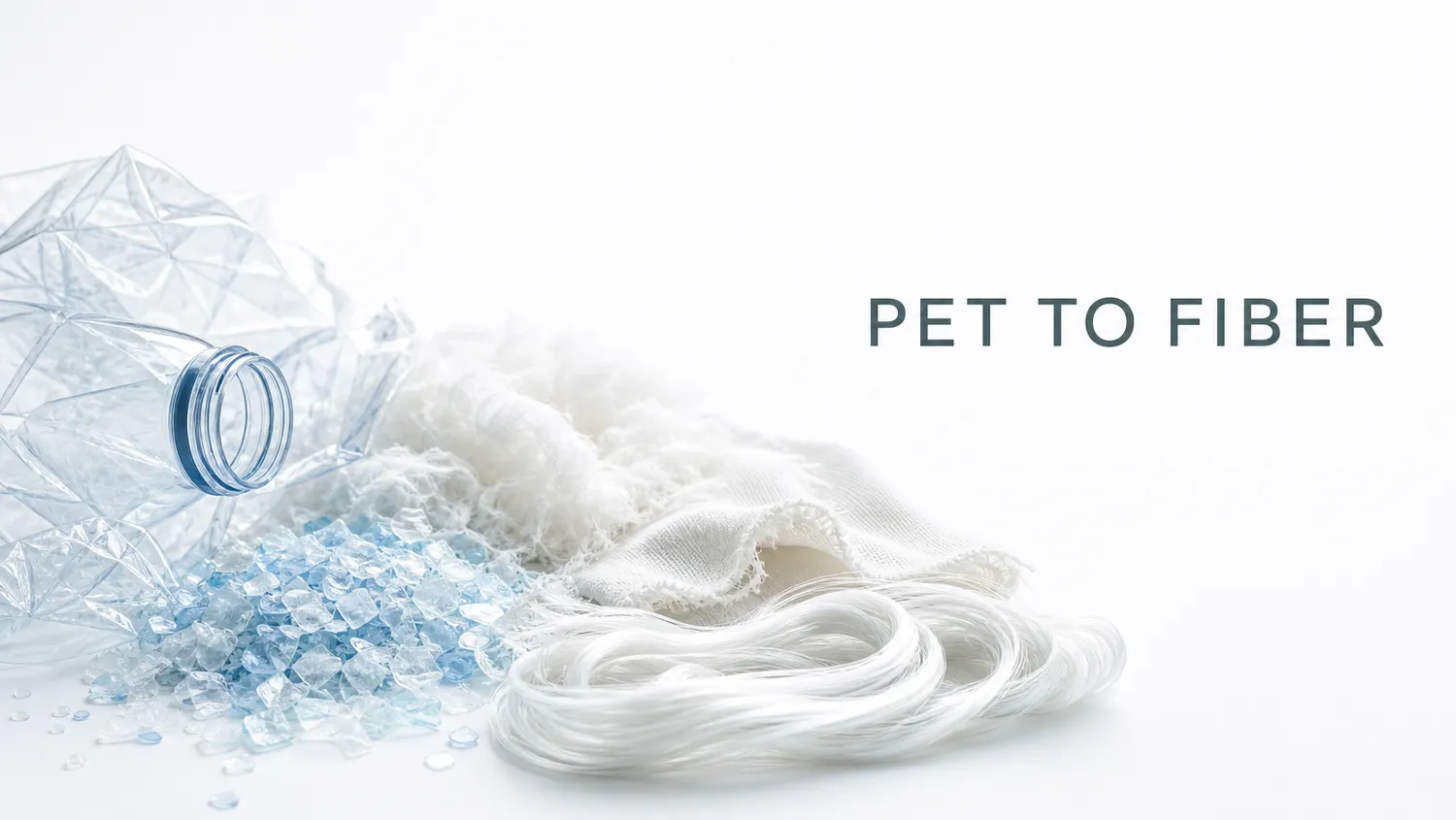
Una máquina de reciclaje de poliéster Convierte residuos de PET — botellas o textiles — de nuevo en fibra de poliéster reutilizable o perlas. El poliéster y el PET son el mismo polímero, por eso los dos mayores flujos de alimentación terminan en el mismo lugar: botellas de consumo final lavadas en escamas que las fábricas de hilos extraen en fibra reciclada, y ropa o escama de tela de poliéster triturada y repelatinizada. Esta guía explica ambos recorridos, el equipo que cada uno necesita y lo que realmente determina el precio de una línea.
Polietileno tereftálico y PET: un polímero, dos fluxos de residuos
La fibra de poliéster es polietileno tereftalato — la misma resina que una botella de agua. Por lo tanto, una máquina de reciclaje de poliéster no es una sola máquina, sino una línea adaptada a la forma en que llegan los residuos:
| Materia Prima | Recorrido de proceso | Salida |
|---|---|---|
| Botellas de PET (empacadas) | Clasificar → lavar → separar → secar | Escamas de rPET de lavado en caliente para cardado o pelletizado |
| Textiles de poliéster (texto de ropa, desechos de tejido, restos) | Triturar → abrir fibra → densificar o pelletizar | Fibra recuperada para relleno/nonwoven, o perlas de rPET |
La ruta de las botellas es el negocio de volumen — la mayor parte de la fibra de poliéster reciclada en el mercado comienza como escamas de botella. La ruta textil está creciendo rápidamente a medida que las marcas devuelven el desecho de ropa, y requiere maquinaria de entrada completamente diferente.
Recorrido 1: Botellas de PET a fibra de poliéster
Las fábricas de hilos que compran escama para fibra tienen una exigencia irrenunciable: escama limpia y seca, libre de PVC y con viscosidad intrínseca estable. La línea de lavado lo entrega en cinco etapas:
- Descompactado y eliminación de etiquetas — Los balones se abren y una máquina despegadora de etiquetas elimina la película de etiquetas de PVC y PP que contaminaría el melt.
- Moldeo a escamas — las botellas se trituran húmedamente en láminas de 10–14 mm.
- Lavado en caliente — a lavadora caliente continua con solución cáustica elimina pegamento, aceite y residuos de alimentos que el agua fría no puede tocar. En el caso de escamas de grado de fibra, esta etapa es obligatoria, no opcional.
- Separación de flotación-sumersión — en tanque de separación hundimiento-flotación, La escama de PET se hunde mientras las tapas y fragmentos de etiqueta de PP/PE flotan, eliminando la contaminación de poliolefina en una sola pasada. A arandela de fricción Lava los trocitos entre las etapas.
- El secado — El secado por centrifugación y luego por aire caliente reduce la humedad para que las láminas puedan ser almacenadas y enviadas sin pérdidas por hidrólisis.
Desde allí, las láminas se venden directamente a la fábrica textil o pasan por un granulador de escamas de PET cuando el comprador quiere pellets en lugar de escama. La configuración completa es nuestra Sistema de reciclado de botellas PET.
Vía 2: residuos textiles de poliéster a fibra recuperada
Las prendas, el desperdicio de la sala de cortes y los rollos de tela de poliéster no pueden entrar en una línea de lavado de botellas — las envolturas de tela enroscan los rotores y retienen agua. La ruta textil comienza con una reducción de tamaño diseñada para fibra:
- Trituración de textiles. A trituradora de fibras textiles Con baja velocidad del eje y geometría del rotor antidesenrollamiento, tritura prendas y tejidos en fibras primarias sin fusionar la fibra sintética — el modo de fallo de los trituradores estándar rápidos en polipropileno.
- Apertura de fibras. Las máquinas de apertura en la parte inferior liberan el material triturado de vuelta a fibras útiles para relleno, aislamiento y producción de no tejidos.
- Pelletizado (opcional). Los residuos de polipropileno limpios y de un solo polímero pueden densificarse y re pelletizarse en gránulos de rPET para extrusión — esta es la vía para los cortes postindustriales con composición conocida.
El punto de bifurcación es la contaminación: las prendas de fibra mixta (mezclas poli-cotton) se mantienen en la vía de recuperación de fibras, mientras que los residuos de polipropileno limpios 100% valen más como gránulos.
¿Qué determina el precio de una máquina de reciclaje de polipropileno?
Las cotizaciones para una “máquina de reciclaje de polipropileno” van desde el costo de un solo triturador hasta una planta de planta llave en mano de siete cifras, ya que el término abarca ambos. Cinco factores establecen el número real:
- Forma del materia prima — una línea de trituración textil es una fracción del costo de una planta de lavado de botellas; conozca la vía que está cotizando.
- Rendimiento — las líneas de botellas se cotizan típicamente en 500–3,000 kg/h; cada paso en la capacidad escalona cada tanque, secador y transportador de la línea.
- Lavado caliente o no — el ciclo de lavado caliente (caldera o calefacción eléctrica, dosificación de sosa cáustica, etapas de enjuague) es el bloque de costo más grande, y los gránulos de grado de fibra no pueden saltárselo.
- Especificación de salida — los gránulos para la venta local necesitan menos que los gránulos de grado de exportación con límites estrictos de PVC ppm; los gránulos adicionan la etapa de pelletizado.
- Tratamiento de aguas — la filtración en ciclo cerrado es cada vez más requerida por las licencias ambientales y debe incluirse en el presupuesto inicial, no en una reforma posterior.
Preguntas frecuentes
¿Qué máquina convierte botellas de PET en fibra de polipropileno?
Una línea de lavado de botellas de PET produce el gránulo lavado en caliente, y una línea de hilado de fibra (generalmente una planta separada) extrae el gránulo en fibra de polipropileno primario. La maquinaria de reciclaje cubre despalillado, remoción de etiquetas, trituración, lavado en caliente, separación de flotación-sumergimiento, lavado por fricción y secado — todo hasta el gránulo de grado de hilado.
¿Se pueden reciclar las prendas de poliéster con máquina?
Sí. Las prendas de poliéster y los desperdicios de tela se trituran con un triturador de textil de bajo rendimiento y se reabren en fibras para su uso en relleno y no tejidos. Los desperdicios de poliéster 100% limpios también se pueden regranular en gránulos de rPET. Las mezclas de tejidos (poli-cotton) permanecen en la ruta de recuperación de fibras porque los dos polímeros no se pueden separar mecánicamente.
¿El poliéster reciclado es lo mismo que rPET?
Sí — el poliéster reciclado (rPET) es polietileno tereftalato reciclado. La fibra comercializada como poliéster reciclado se teje principalmente a partir de escamas de botella de PET lavadas con agua caliente, por lo que las líneas de lavado de botellas son la columna vertebral de la cadena de suministro del poliéster reciclado.
¿Cuánto cuesta una línea de reciclaje de poliéster?
Depende de la ruta y la capacidad: una configuración de trituración textil comienza mucho más baja que una planta de lavado de botellas, y una línea completa de 1,000 kg/h de fibra de grado con lavado caliente y tratamiento de agua es de una clase presupuestaria diferente. Envíe su materia prima, la producción objetivo y la capacidad para obtener un presupuesto configurado en lugar de un precio desde una cifra genérica.
Obtén una línea adaptada a tu materia prima
La máquina de reciclaje de poliéster adecuada sigue de tres respuestas: en qué forma llega su desperdicio, lo que requiere el comprador de su producto final y su tasa por hora. Envíe fotos de su materia prima Rumtoo, el objetivo de capacidad y la especificación de salida — configuraremos la ruta de lavado de botellas o textil según corresponda y emitiremos un presupuesto completo de la línea. Contáctenos con nuestro equipo de ingeniería para una recomendación probada.
