


Petite machine de recyclage de plastique Les options semblent attrayantes lorsque vous souhaitez tester un matériau, former une équipe ou commencer avec un budget limité. Une ligne de recyclage industrielle est plus adaptée lorsque vous avez besoin d'une production en kg/h stable, de paillettes ou de granulés plus propres, de contrôles de sécurité pour l'opérateur et un processus qui peut fonctionner jour et nuit. Ce guide compare ces deux voies afin que vous puissiez choisir l'équipement qui correspond à votre flux de déchets, à l'espace de votre usine et à vos objectifs commerciaux.
Pour une vue d'ensemble complète des catégories d'équipements industriels, ouvrez notre machines de recyclage du plastique page pendant que vous lisez. Elle montre comment les systèmes de broyage, de lavage, de séchage, de tri et de granulation s'interconnectent dans une usine complète.
Réponse rapide : Machine compacte ou ligne industrielle ?
Un ensemble de recyclage compact convient aux tests, à l'éducation, aux ateliers à faible volume et aux déchets triés. Une ligne industrielle convient à la production commerciale, aux déchets post-consommation, à une contamination plus élevée, à une qualité de paillettes ou de granulés répétée et aux acheteurs qui nécessitent des spécifications stables.
| Objectif du projet | Meilleure adaptation | Pourquoi |
|---|---|---|
| Enseigner le recyclage du plastique ou organiser des démonstrations | Machine compacte | Besoin de moins d'espace, exploitation plus simple, apprentissage visuel plus facile |
| Tester un nouveau flux de déchets avant l'investissement | Machine compacte ou installation pilote | Aide à confirmer les problèmes de broyage, de fusion, d'odeur et de contamination |
| Recycler les découpes de fabrication propres en interne | Installation industrielle compacte | Un input plus propre peut passer de la broyage à la granulation avec moins d'étapes |
| Traiter des bouteilles en PET sales, du film ou de l'emballage rigide | Ligne industrielle | Nécessite le tri, le lavage, la séparation, le séchage et le contrôle de la qualité |
| Vendre des paillettes ou des granulés à des clients répétés | Ligne industrielle | Nécessite un débit stable, une qualité documentée et un accès au service |
Qu'est-ce qu'une petite machine de recyclage de plastique ?
Une petite machine de recyclage de plastique est une unité à faible capacité ou un ensemble compact d'unités qui gère généralement une seule étape de processus : broyage, injection, extrusion, compression ou fabrication de granulés simple. Les acheteurs utilisent souvent ces machines dans les écoles, les studios de design, les ateliers de réparation, les projets communautaires, les laboratoires et les entreprises de recyclage en phase initiale.
L'équipement de petite taille peut rendre le recyclage du plastique visible et pratique. Des projets tels que Precious Plastic ont popularisé les machines à petite échelle en partageant des designs pour le broyage, l'extrusion, l'injection et la compression en feuille. Source : Aperçu des machines Precious Plastic.
- Matériaux typiques : caps propres, petites pièces en HDPE/PP, paillettes triées, impressions 3D ratées et déchets de atelier à faible volume.
- Sorties typiques : paillettes, pièces moulées simples, profilés extrudés, petites feuilles ou pâtes de test.
- Limites typiques : alimentation manuelle, faible automatisation, gamme de matériaux étroite, lavage limité et plus de manipulation de l'opérateur.
Qu'est-ce qu'une ligne de recyclage industriel de plastique ?
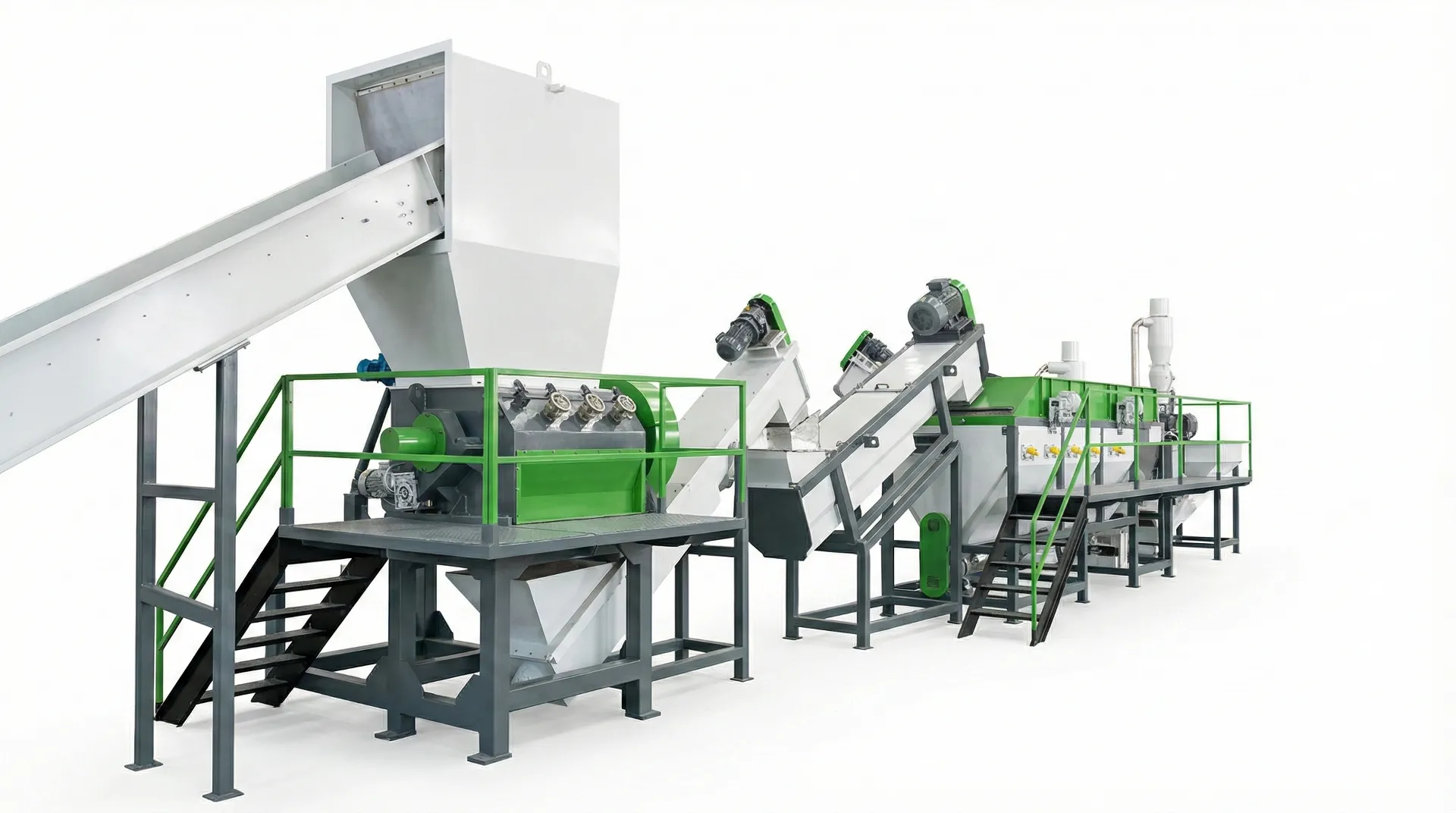
Une ligne de recyclage industriel de plastique est un système connecté conçu pour une production continue. Elle combine la manutention du matériel, la réduction de taille, le lavage, la séparation, le séchage, l'extrusion, la filtration, la pelletisation, les commandes et les fonctionnalités de sécurité selon le flux de déchets entrants.
L'équipement industriel devient important lorsque le matériel est sale, humide, volumineux, mélangé ou lié à une spécification de l'acheteur. Selon l'EPA américaine, les plastiques ont représenté 35,7 millions de tonnes de génération de déchets solides municipaux aux États-Unis en 2018, et les contenants et emballages en plastique ont dépassé 14,5 millions de tonnes. Cette échelle explique pourquoi les usines commerciales ont besoin de systèmes répétitifs plutôt que de machines manuelles uniquement. Source : EPA Plastics : Données spécifiques aux matériaux.
- Usines de bouteilles en PET nécessitent le débalisage, le retrait des étiquettes, le broyage, le lavage, la séparation et le séchage avant que les paillettes puissent répondre aux exigences des acheteurs.
- Usines de films PP/PE nécessitent une alimentation stable, un lavage par friction, le séchage ou le pressage, le dégazage, la filtration et la pelletisation.
- Usines rigides HDPE/PP nécessitent le broyage ou la granulation, le lavage, la séparation par flottaison, le séchage et parfois l'extrusion.
Petite machine de recyclage de plastique vs Ligne industrielle : Différences fondamentales
La principale différence n'est pas seulement la taille. La véritable différence réside dans le contrôle que vous avez besoin sur les matières premières, la qualité de la production, la sécurité, la main-d'œuvre et le temps de disponibilité quotidien.
| Facteur | Équipement à petite échelle | Ligne de recyclage industrielle |
|---|---|---|
| Capacité | Idéale pour les tests, les lots et les travaux à faible volume | Conçue autour d'une cible stable en kg/h |
| Travail | Plus d'alimentation manuelle, de tri et de manipulation | Les convoyeurs, les commandes et le flux de processus réduisent la manipulation manuelle |
| État du matériel | Fonctionne mieux avec du plastique propre, trié et sec | Peut inclure le lavage, la séparation et le séchage pour les déchets sales |
| Contrôle de la production | Idéal pour les démonstrations et les échantillons préliminaires | Meilleur pour des paillettes ou des pâtes répétitifs |
| Conception de sécurité | Dépend fortement de l'origine de la machine et des gardes locales | Peut inclure des verrous, des gardes, des arrêts d'urgence et des plateformes de service |
| Expansion | Limité par les étapes manuelles et le cycle de travail de la machine | Peut ajouter des modules de tri, de lavage, de séchage et de granulation |
| Process d'achat | Compare les spécifications de l'appareil et les besoins de l'opérateur | Comparez l'étendue complète du processus, les équipements, l'installation et le support |
Quand une petite machine de recyclage de plastique a du sens
Un petit équipement est pertinent lorsque l'apprentissage, les tests ou la réutilisation à faible volume sont plus importants que le débit commercial. Il peut aider votre équipe à comprendre le comportement des matériaux avant de s'engager dans une ligne plus grande.
- Vous avez besoin de preuves avant un achat plus important. Lancez des échantillons propres, testez le comportement du mélange, vérifiez l'odeur et enregistrez les problèmes d'alimentation.
- Votre flux de déchets est propre et restreint. Une approvisionnement régulier d'un polymère, comme des bouchons en HDPE ou des copeaux en PP, réduit le risque de processus.
- Votre production reste dans votre propre atelier. La réutilisation interne permet souvent une tolérance plus grande que la vente de granulés à des acheteurs extérieurs.
- Votre site dispose de peu d'énergie et d'espace. Une petite unité peut s'adapter où une ligne de lavage ou de granulation complète ne peut pas.
D'après notre expérience, les petites machines fonctionnent mieux lorsque l'opérateur contrôle étroitement l'entrée. Elles ont du mal lorsque l'alimentation change toutes les heures, contient de l'eau ou du sable, ou inclut des étiquettes, du métal, du PVC, du film multilayer ou des polymères inconnus.
Quand une ligne industrielle est le meilleur choix
Une ligne industrielle est le meilleur choix lorsque vous avez besoin de production vendable, de qualité documentée et de production régulière. Elle protège également votre projet contre les coûts cachés causés par le lavage, l'humidité, la filtration, la main-d'œuvre et les pannes.
- Votre matière première est du déchet post-consommateur. Les bouteilles, les films, les tonneaux et les emballages mélangés nécessitent généralement un lavage et une séparation.
- Votre acheteur fixe les limites de qualité. L'humidité, la couleur, le PVC, la cendre, l'odeur, le débit de fusion et la taille des granulés peuvent tous affecter l'acceptation.
- Vous avez besoin d'une cible de sortie définie. Une ligne de 300 kg/h, 500 kg/h ou 1 000 kg/h nécessite une conception différente pour l'alimentation, le séchage et le contrôle.
- Vous prévoyez de fonctionner en shifts. Le travail continu nécessite l'accès aux lames, les pièces de rechange, les alarmes de contrôle, les horaires de maintenance et la formation de l'opérateur.
Si vous êtes déjà proche d'une décision commerciale, lisez notre guide de sélection de machines de recyclage de plastique. Il explique comment correspondre au type de polymère, à la contamination, à la forme de l'alimentation, à la production cible et aux devis des fournisseurs.
Adaptabilité des matériaux : Déchets propres, bouteilles, films et plastiques rigides
L'adaptabilité des matériaux devrait déterminer le chemin de l'équipement avant le prix. L'équipement compact peut gérer des flux de nettoyage étroits, mais les lignes industrielles gèrent les étapes supplémentaires nécessaires pour les plastiques sales ou mélangés.
| Matériel | Petite machine adaptée | Ligne industrielle clé en main | Principale préoccupation |
|---|---|---|---|
| HDPE ou PP de rebut propre | Convient pour les tests et la petite recyclabilité | Convient pour la production de granulés en usine | Métal, débit de fusion et uniformité des dimensions |
| Impression 3D ratées | Convient pour le broyage et les essais | Utilisable si le volume devient stable | Séparation des polymères et additifs |
| bouteilles PET | Mauvais si non déjà propre et trié | Bon ajustement pour le lavage et la sortie de copeaux | Étiquettes, PVC, humidité, couleur et colle |
| LDPE/PP film | Restreint sauf s'il est propre et sec | Adaptabilité forte pour le lavage, le pressage et la granulation | Eau, sable, encre, alimentation et dégazage |
| Boîtes rigides, fûts, bouchons | Possible à petite quantité après coupure | Adaptabilité forte avec le broyeur, le lavage, le séchage et le granulateur | Densité en vrac, étiquettes, saleté et polymères mélangés |
Les détails d'emballage peuvent changer tout le processus. L'Association des recycleurs de plastique explique que les étiquettes, les encres, les adhésifs et les fermetures affectent le recyclage du PET parce qu'elles peuvent transporter de la contamination dans le flux de lavage et de flake. Source : Guide de conception APR pour l'emballage rigide en PET.
Capacité et coût : Comment penser au-delà du prix d'achat
Le prix d'achat ne raconte qu'une partie de l'histoire. Vous devriez comparer le coût par kilogramme utilisable, pas seulement la facture de la machine.
- Main dœuvre : Les petites machines nécessitent souvent plus de temps de l'opérateur pour l'alimentation, le tri, le nettoyage et le traitement.
- Services publics : Le lavage et le séchage industriels nécessitent de l'énergie, de l'eau, de l'air comprimé et la planification des eaux usées.
- Consommables : Les lames, les écrans, les filtres, les chauffeurs, les bandes, les roulements et l'huile affectent le coût réel d'exploitation.
- Période de temps sans activité : Une machine moins chère peut coûter plus cher si les changements de lames, le nettoyage des tamis et les réparations stoppent souvent la production.
- Rejet de production: Des copeaux sales, des granulés humides, des odeurs ou un flux de fusion instable peuvent annuler les économies d'un prix d'achat bas.
Utilisez un simple calcul de retour sur investissement avant d'acheter : production utile mensuelle x marge par kilogramme, moins la main-d'œuvre, l'énergie, l'eau, les consommables et l'entretien. Pour une analyse des coûts plus détaillée, voir notre guide des coûts des machines de recyclage plastique.
Vérifications de sécurité et de conformité avant l'achat
Les vérifications de sécurité sont importantes pour les petites machines et les lignes industrielles, car les équipements de recyclage des plastiques incluent des coupeurs, des arbres tournants, des fûts chauds, des tableaux électriques, des systèmes hydrauliques et des points de pincement. Un unité à faible coût peut devenir coûteuse si elle manque de gardes, d'arrêts d'urgence ou d'accès de nettoyage sécurisé.
Selon OSHA, les machines en plastique peuvent exposer les travailleurs aux parties mobiles, aux points de pincement, au voltage élevé et aux températures élevées, et les employeurs devraient utiliser des gardes, des dispositifs de verrouillage/tagout et des équipements de protection individuelle. Source : Protection des machines OSHA : Machines en plastique.
- Vérifiez les gardes fixes, les verrous, les arrêts d'urgence et les points de verrouillage.
- Demandez des schémas de câblage, des manuels, des listes de pièces de rechange et des horaires d'entretien.
- Confirmez les normes électriques locales, le voltage, la fréquence, la disposition du boîtier et l'accès aux composants.
- Examinez les points de nettoyage pour les concasseurs, les granulateurs, les lavages, les sécheurs, les filtres et les granulateurs.
Un Cadre de Décision Pratique
Ce cadre vous aide à choisir le bon chemin avant de demander des devis aux fournisseurs. Répondez à chaque question avec votre matériau réel, pas avec un échantillon idéal.
| Question | Choisissez un petit équipement si… | Choisissez une ligne industrielle si… |
|---|---|---|
| Combien de matière traitez-vous ? | Lots, démonstrations ou faible volume quotidien | Objectif kg/h défini et horaire de quart |
| Combien de saleté contient le matériau ? | Entrée propre, sèche et triée | Étiquettes, sable, huile, résidus alimentaires ou polymères mélangés |
| Qui utilise la production ? | Votre propre atelier ou équipe de tests | Acheteurs extérieurs ou lignes de production |
| Combien de stabilité la qualité doit-elle avoir ? | Des échantillons et une réutilisation de base sont acceptables | Les limites de humidité, de couleur, du flux de fusion et de contamination importent |
| Quel soutien avez-vous besoin ? | Pièces de rechange de base et compétences de l'opérateur peuvent suffire | L'installation, la mise en service, la formation et le service à long terme sont importants |
Dans nos revues de projets, l'erreur courante est d'acheter un broyeur ou un extrudeur de petite taille pour un flux de déchets qui nécessite en réalité un lavage et un séchage préalables. Si l'entrée est humide ou sale, passez du temps sur la conception du processus avant de chercher une machine. Notre Guide de disposition d'usine de recyclage plastique peut vous aider à cartographier ce processus.
Ce qu'il faut envoyer à un fournisseur avant de demander un devis
Un fournisseur peut recommander la bonne configuration plus rapidement lorsque vous envoyez des détails spécifiques sur le matériau et le projet. Une demande vague pour une petite unité produit souvent une offre vague.
- Photos et vidéos du plastique avant et après le tri, et après tout broyage existant.
- Types de polymères et pourcentages, tels que 80% LDPE film et 20% PP woven bags.
- Notes de contamination : étiquettes, colle, sable, résidus alimentaires, huile, métal, papier, eau et couleurs mélangées.
- Sortie cible : copeaux, granulés, pièces moulées, feuille, fil, ou recyclage interne.
- Capacité attendue en kg/h ou en kilogrammes par jour.
- Espace au sol disponible, alimentation électrique, alimentation en eau, air comprimé et plan d'évacuation des eaux usées.
- Portée préférée : machine unique, installation pilote ou ligne de recyclage complète.
Si votre objectif est des granulés propres, comparez lignes de granulation de plastique. Si votre premier goulet d'étranglement est la réduction de taille, consultez notre déchiqueteurs de plastique et broyeurs de plastique.
FAQ sur les petites machines de recyclage du plastique
Est-ce qu'une petite machine de recyclage de plastique est suffisante pour commencer une entreprise ?
Une petite machine de recyclage de plastique peut vous aider à tester une idée de produit ou à collecter des échantillons précoce, mais elle peut ne pas soutenir une entreprise de recyclage complète. Les acheteurs commerciaux ont généralement besoin de volumes stables, d'une sortie plus propre et d'une qualité documentée.
Peut une petite machine recycler des bouteilles en PET ?
Une petite machine peut broyer des bouteilles PET propres pour des tests, mais le recyclage des bouteilles nécessite généralement la suppression des étiquettes, le lavage, la séparation et le séchage. Une Chez Rumtoo, nous spécialisons dans la conception et la fabrication de systèmes de recyclage industriels qui permettent aux entreprises de répondre à ces exigences. Ce guide ne s'agit pas seulement du “pourquoi” du recyclage – c'est du “comment”. Nous vous guiderons à travers tout le processus industriel de recyclage des bouteilles en PET, de la transformation des balles brutes à la production de paillettes rPET de grade supérieur, et démontrerons comment un système de recyclage de bouteilles en PET stratégiquement choisi s'adapte mieux lorsque vous avez besoin de copeaux commercialisables.
Qu'est-ce que le plus grand risque à l'achat d'une unité de petite taille ?
Le plus grand risque est d'attendre que l'unité de petite taille résolve à la fois le tri, le lavage, le séchage, l'extrusion et le contrôle de qualité. Définissez d'abord votre production, puis choisissez les étapes du processus.
Quand devrais-je passer d'une machine petite à une ligne industrielle ?
Passer à une ligne industrielle lorsque votre approvisionnement en matière première devient stable, que votre acheteur nécessite une spécification de qualité et que votre objectif de production cible nécessite une production continue en kg/h. À ce moment-là, la maîtrise du processus est plus importante que le prix le plus bas de la machine.
Quelle est la première machine que tous les projets devraient tester ?
La plupart des projets devraient d'abord tester la réduction de taille, car les problèmes d'alimentation apparaissent tôt. Un essai d'une déchiqueteuse ou d'un concasseur montre si le matériau forme des ponts, s'enroule, fond, crée de la poussière ou usure trop rapide les lames.
Étape suivante : Choisir selon le flux de déchets, pas la taille de la machine
Un ensemble de départ est utile lorsque vous avez besoin d'apprendre, de tester ou de réutiliser en faible volume. Une ligne industrielle est le meilleur choix lorsque vous avez besoin de production régulière, de copeaux ou de granulés plus propres, d'accès de maintenance sécurisé et de processus correspondant à des déchets post-consommation ou post-industriel.
Pour passer de la comparaison à la planification de l'équipement, consultez notre catégories de machines de recyclage plastique industrielles ou envoyez Rumtoo des photos de votre matériau, votre capacité cible, l'espace de l'usine et votre objectif de sortie pour une recommandation pratique de ligne.
