


Comparaison entre les lignes de recyclage de PET, HDPE et PP/PE nécessitent différents équipements car chaque matériau se comporte différemment lors du tri, du lavage, du séchage, du fondage et de la granulation. Les bouteilles en PET nécessitent généralement le retrait des étiquettes, un lavage à chaud et un contrôle strict du PVC. Les plastiques rigides en HDPE nécessitent une réduction de taille forte et une séparation par flottaison-déflottaison, tandis que les films PP/PE nécessitent un lavage agressif, un écrasement, un séchage, un dégazage et un alimentation stable.
Cette comparaison aide les acheteurs de centrales de recyclage à choisir la bonne ligne avant de commander du matériel. Si vous souhaitez comparer les catégories d'équipements complètes tout en lisant, commencez par notre machines de recyclage de plastique industriel page.
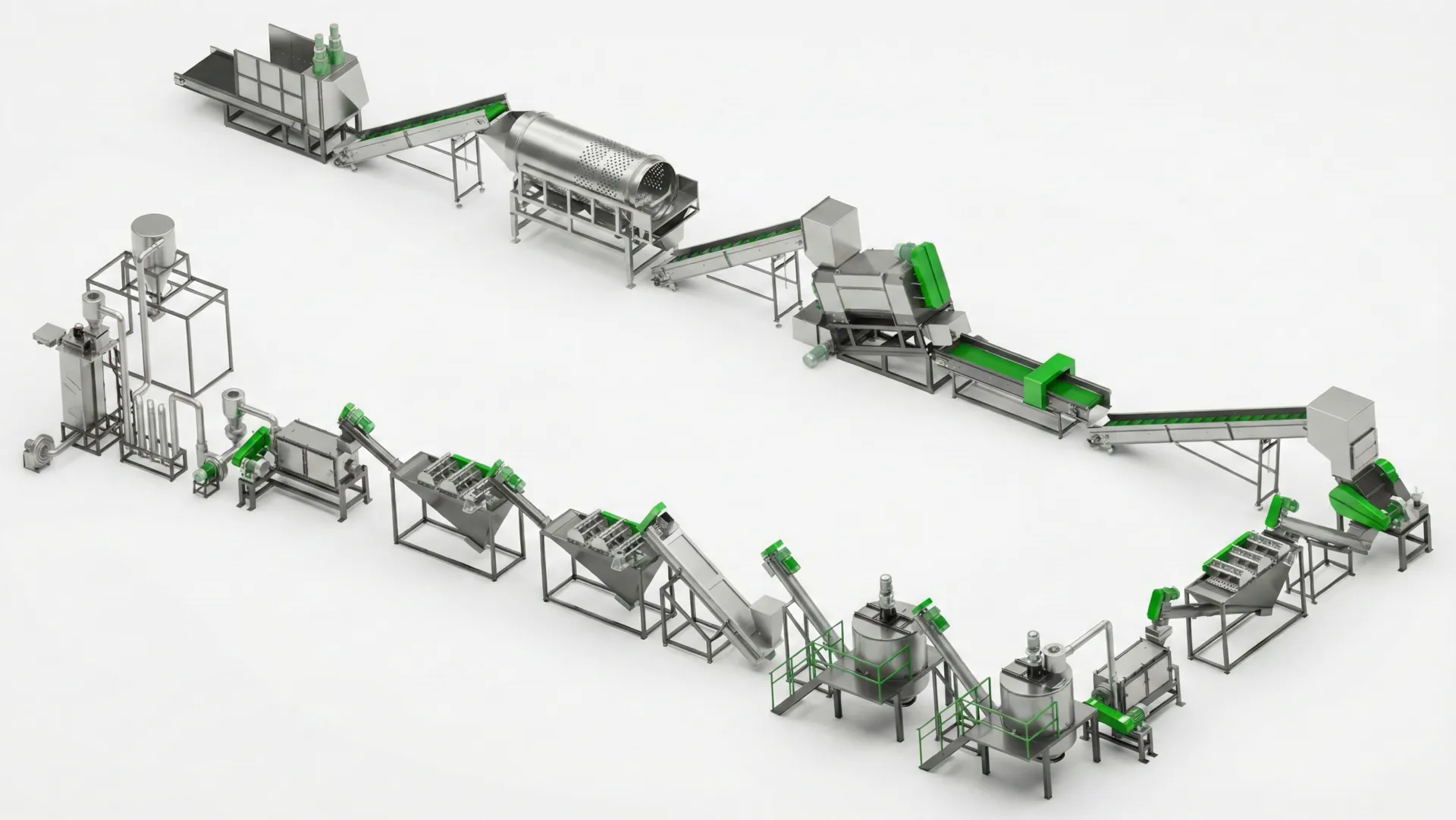
Comparaison rapide : Lignes PET, HDPE et PP/PE
Les lignes PET, HDPE et PP/PE diffèrent le plus en termes de forme d'alimentation, de contrôle de la contamination, de demande de séchage et de cible de produit final. Une usine peut partager certains concepts d'équipement, mais elle ne devrait pas copier directement le design d'une ligne de matériau sur une autre alimentation.
| Flux de matériaux | Entrée courante | Itinéraire principal de l'équipement | Produit typique | Risque critique |
|---|---|---|---|---|
| ANIMAL DE COMPAGNIE | Bouteilles de boissons, plateaux, thermoformes | Déballage, retrait des étiquettes, broyeur, lavage froid/chaud, flottaison-déflottaison, sécheur, trieuse | Flakes de PET propres, parfois des granulés | PVC, étiquettes, colle, humidité, mélange de couleur |
| Plastiques rigides en HDPE | Bouteilles de lait, barils, caisses, bouteilles, capsules | Déchiqueteuse ou granulateur, lavage par friction, flottaison-déflottaison, sécheur, granulateur si nécessaire | Flakes ou granulés propres | Mélange PP, étiquettes, métal, sale, variation de débit de fusion |
| Film PP/PE | Film agricole, film étirable, sacs, sacs tissés | Déchiqueteuse, lavage par friction, réservoir flottant, écraseur, sécheur, coupe-compresseur granulateur | Flakes ou granulés secs | Eau, sable, encre, faible densité volumique, alimentation instable |
Pourquoi une ligne de recyclage ne peut pas s'adapter à tous les plastiques
Une ligne de recyclage ne peut pas s'adapter à tous les plastiques car la densité du résine, le comportement de fusion, la conception d'emballage et le type de contamination changent le processus. Le PET coule dans l'eau, tandis que l'HDPE et le PP flottent généralement. Le film contient également plus d'eau et de saleté par kilogramme que de nombreux plastiques rigides en raison de sa grande surface.
Selon l'EPA américaine, la génération de plastiques dans les déchets solides municipaux aux États-Unis a atteint 35,7 millions de tonnes en 2018, et les contenants et emballages en plastique ont représenté plus de 14,5 millions de tonnes. L'EPA a également signalé des taux de recyclage de 29,1% pour les bouteilles et jarres en PET en 2018 et de 29,3% pour les bouteilles en HDPE naturel. Source : EPA Plastics : Données spécifiques aux matériaux.
Ces chiffres montrent pourquoi la conception de la ligne est importante. Les bouteilles en PET, les contenants en HDPE et les films PP/PE peuvent tous entrer dans une entreprise de recyclage, mais chaque flux nécessite un processus qui protège le rendement et la qualité de la production.
Ligne de recyclage de PET : Équipements et Priorités de Qualité
Une ligne de recyclage de PET est construite pour enlever les étiquettes, les bouchons, le PVC, la colle, la saleté et l'humidité des flux de bouteilles ou de plateaux. Les acheteurs de paillettes de PET se soucient souvent de la couleur, du niveau de PVC, du résidu d'étiquette, de l'humidité et de la poussière fine, car ces facteurs affectent les applications d'extrusion, de fibre, de feuille ou de grade bouteille en aval.
- Tri initial : Retirer les bouteilles non PET, le métal, le verre, les pierres et les couleurs difficiles avant le broyage.
- Retrait des étiquettes : Réduire la charge d'étiquettes avant le lavage afin que les paillettes et l'eau de lavage restent plus propres.
- Réduction de taille : Utilisez un broyeur ou un granulateur humide pour créer des paillettes de PET régulières.
- Lavage froid et chaud : Retirer la saleté, le sucre, la colle, l'huile et la contamination superficielle.
- Séparation par flottaison-déflottaison: Séparer les bouchons et les étiquettes flottants des paillettes de PET en sinking.
- Séchage et classification par air : Réduire l'humidité et éliminer les étiquettes légères ou les fines.
L'Association des Recycleurs de Plastique prévient que les matériaux d'étiquette, les encres, les adhésifs et la surface de couverture peuvent affecter la qualité du recyclage du PET. Les adhésifs non libérants et les matériaux d'étiquette incompatibles peuvent voyager avec les paillettes et réduire la valeur de sortie. Source : Guide de conception APR pour l'emballage rigide en PET.
Pour les projets de PET, commencez par notre Chez Rumtoo, nous spécialisons dans la conception et la fabrication de systèmes de recyclage industriels qui permettent aux entreprises de répondre à ces exigences. Ce guide ne s'agit pas seulement du “pourquoi” du recyclage – c'est du “comment”. Nous vous guiderons à travers tout le processus industriel de recyclage des bouteilles en PET, de la transformation des balles brutes à la production de paillettes rPET de grade supérieur, et démontrerons comment un système de recyclage de bouteilles en PET stratégiquement choisi page. Si le contrôle du PVC est votre principal risque, lisez notre guide sur le contrôle du PVC dans les lignes de recyclage des bouteilles en PET.
Ligne de recyclage rigide en HDPE : Équipements et Priorités de Qualité
Une ligne de recyclage rigide en HDPE est construite pour les bouteilles, les fûts, les caisses, les bouchons et d'autres articles polyoléfiniques épais. Le processus se concentre généralement sur la réduction de taille, le lavage, la séparation de densité, le séchage et l'option de granulation.
- Broyage ou granulation : Choisissez le broyage pour les fûts, les caisses et les grandes pièces rigides ; utilisez la granulation pour les bouteilles et les petits articles.
- Lavage par friction : Retirer la saleté superficielle, les étiquettes et les résidus organiques après la réduction de taille.
- Séparation par flottaison : Gardez l'HDPE flottant et le PP tout en enlevant les matériaux plus denses où possible.
- Séchage: Utilisez le séchage centrifuge et thermique en fonction de la cible d'humidité et de la forme de sortie.
- Pelletisation : Ajoutez l'extrusion, le filtrage du mélange fondu et la coupe de granulés lorsque les acheteurs ont besoin de granulés plutôt que de paillettes.
L'APR liste la densité de l'HDPE à 0,94-0,97 g/cm3, ce qui signifie que l'HDPE flotte généralement dans l'eau. L'APR note également que le PP peut contaminer l'HDPE lorsqu'il est mélangé en extrusion et peut réduire les propriétés d'impact si le niveau devient trop élevé. Source : Guidance APR pour l'HDPE rigide.
Pour les contenants rigides en HDPE et en PP, voir notre corde à linge en plastique rigide. Si vous hésitez encore entre le broyage et le cisaillement, comparez les équipements sur notre guide de sélection de machines de recyclage de plastique.
Ligne de recyclage de film PP/PE : Priorités de l'équipement et de la qualité
Une ligne de recyclage de film PP/PE est construite autour de faible densité volumique, forte humidité, grande quantité de saleté et alimentation instable. Le recyclage des films nécessite souvent plus de lavage, de compression, de séchage et de contrôle d'alimentation que le recyclage des plastiques rigides.
- Pré-cisaillement : Ouvrez les balles de film volumineux et réduisez l'enroulement autour des équipements en aval.
- Lavage par friction : Retirez le sable, les étiquettes, le papier, les organiques et la saleté superficielle.
- Lavage flottant : Séparer les contaminants lourds tout en maintenant le film polyoléfinique flottant.
- Compression et séchage : Retirer l'eau avant l'extrusion, en particulier pour les films agricoles et les sacs lavés.
- Alimentation par coupe-compresseur : Densifier le film avant l'extrusion pour éviter une intake instable.
- Dégazage et filtration : Contrôler l'encre, l'humidité, les adhésifs et les volatiles pendant la granulation.
APR décrit l'emballage flexible PE comme des sacs, des poches, des enveloppes, des sachets, des revêtements et d'autres formats de film. Il note également que le film post-consommateur nord-américain est souvent collecté à des points de vente et peut inclure LDPE, LLDPE, HDPE et des emballages multilayers. Source : Guidance APR PE Flexible.
Pour les projets de film, commencez par notre guide de ligne de recyclage de film PP/PE. Si l'humidité après le lavage est votre goulet d'étranglement, examinez comment un compresseur de film en plastique réduit l'humidité.
Comparaison des équipements par étape de processus
Les lignes de recyclage PET, HDPE et PP/PE sont les plus faciles à comparer par étape de processus. Le même nom d'étape peut cacher des choix d'équipements très différents, en particulier dans le lavage, le séchage et la granulation.
| Étape de processus | Ligne PET | Ligne rigide HDPE | Ligne de film PP/PE |
|---|---|---|---|
| Tri | Priorité haute : supprimer le PVC, la couleur, les métaux, le non-PET | Retirer les métaux, les étiquettes, le PVC, le résin mixte | Retirer le papier, les plastiques rigides, les cordelettes, les métaux, le film coloré |
| Réduction de taille | Broyeur ou granulateur humide pour des copeaux | Déchiqueteur ou granulateur basé sur la taille des pièces | Déchiqueteur ou broyeur humide pour ouvrir des films |
| La lessive | Lavage froid, lavage chaud, rinçage, contrôle des étiquettes | Lavage par frottement et séparation par flottaison | Lavage par frottement, lavage par flottaison, élimination du sable |
| Séchage | Séchage centrifuge et thermique pour l'humidité des copeaux | Séchage centrifuge et thermique selon les besoins | Pressoir plus séchage thermique pour forte charge en eau |
| Extrusion machine | Optionnel ; dépend du objectif copeaux ou granulés | Commun lors de la vente de granulés | Commun pour le rendu de granulés ; nécessite un fort alimentation |
| Filtration et éventage | Important pour le PET de grade granulé | Important pour les étiquettes, les fines et les mélanges de fusion | Très important pour l'encre, l'humidité et les volatils |
Différences de tri : le PET nécessite de la pureté, les polyoléfines nécessitent une séparation
Le PET nécessite une élimination stricte du PVC et des matériaux non PET, tandis que les flux HDPE et PP/PE nécessitent une séparation de polyoléfines et un contrôle de la couleur. La qualité du tri affecte le rendement, le coût du lavage, la valeur des copeaux et la stabilité des granulés.
TOMRA indique que le tri basé sur les capteurs peut séparer les polymères et les couleurs dans les plastiques mélangés, le PET, les polyoléfines, le PVC et les films. TOMRA rapporte également que le tri automatisé peut atteindre une pureté de plus de 95% dans le recyclage de HDPE et de PP dans les applications appropriées. Source : Applications de tri des plastiques TOMRA.
Utilisez le tri optique lorsque le tri manuel ne peut pas atteindre votre objectif de pureté ou que le coût de la main-d'œuvre devient trop élevé. Utilisez un tri manuel plus simple lorsque l'entrée est petite, propre et bien visible, comme les déchets post-industriels d'une seule couleur.
Séchage et humidité : La Différence cachée
La demande de séchage change brusquement entre le PET, l'HDPE et le PP/PE film. Le film conserve généralement plus d'eau à la surface, tandis que les acheteurs de copeaux de PET fixent souvent des limites d'humidité strictes pour le traitement downstream.
| Matériel | Défi de l'humidité | Choix de séchage pratique |
|---|---|---|
| Flocons de PET | L'humidité affecte le stockage des copeaux et le traitement downstream | Sécheur centrifuge plus air chaud ou séchage thermique |
| Copeaux rigides en HDPE | L'eau reste dans les étiquettes, les capsules et les formes irrégulières | Sécheur centrifuge ; séchage thermique si le granulage ou l'emballage le nécessite |
| Film PP/PE | Le film retient l'eau et transporte une forte humidité superficielle | Presse à vis ou presse à plateau, suivie du séchage thermique avant la granulation |
Lors du test des échantillons, demandez aux fournisseurs de mesurer l'humidité après le séchage et de faire passer le matériau par l'extrusion si les granules sont l'objectif. D'après notre expérience, une ligne de lavage qui semble solide sur papier peut encore échouer si le sécheur ne peut pas répondre aux besoins d'alimentation et d'évacuation de l'extrudeuse.
Flakes ou Pellets ?
Le bon objectif de production détermine si votre ligne s'arrête après le lavage et le séchage ou continue dans l'extrusion et la granulation. Les projets PET vendent souvent des paillettes propres, tandis que les projets HDPE et PP/PE ajoutent souvent la granulation lorsque les acheteurs ont besoin de matière première uniforme.
- Choisissez les copeaux lorsque les acheteurs peuvent traiter le matériau lavé et accepter les spécifications de paillettes.
- Choisissez les pellets lorsque les acheteurs ont besoin d'une dose plus facile, d'un comportement de fusion stable ou d'utilisation directe dans l'extrusion, l'injection ou l'extrusion de film.
- Choisissez les deux si votre usine peut vendre des paillettes de haute qualité et granuler des flux de basse qualité ou internes.
Si vous avez besoin de granules, comparez le design de la vis, le type de filtre, le dégazage, le style du coupeur, le refroidissement et le stockage dans le silo. Notre lignes de granulation de plastique page explique les principaux équipements de granulation.
Différences de Coût et d'Agencement que les acheteurs doivent vérifier
Les différences de coût proviennent du niveau de contamination, du nombre d'équipements, du débit, de l'automatisation, du traitement de l'eau, de la demande de séchage et de la portée de la granulation. Les lignes de recyclage PET vs HDPE vs PP/PE devraient être cotées avec la même limite, ou la comparaison trompera votre équipe.
- Définissez l'entrée : balles, bouteilles en vrac, paillettes broyées, rouleaux de film, barils, caisses, ou plastiques rigides mélangés.
- Définissez la sortie : paillettes lavées, paillettes sèches, granules, ou les deux.
- Demandez à chaque fournisseur d'inclure les convoyeurs, les plateformes, les armoires électriques, le traitement de l'eau, les sécheurs, les filtres, les pièces de rechange, l'installation et la formation.
- Comparez les installations : énergie, eau, air comprimé, eaux usées, espace au sol, hauteur sous plafond et accès aux maintenance.
- Lancez un test d'échantillon et enregistrez kg/h, humidité, résultat du lavage, pression du filtre, qualité du granulé et arrêts de production.
Pour la planification budgétaire, lisez notre guide des coûts des machines de recyclage plastique. Pour l'espace au sol et le flux de processus, utilisez notre Guide de disposition d'usine de recyclage plastique.
Matrice de décision : Quelle ligne convient à votre matière première?
Cette matrice de décision vous aide à choisir la bonne ligne lorsque vous avez des options de projet mélangés. Utilisez-la avant de demander un devis formel.
| État des matières premières | Ligne recommandée | Raison |
|---|---|---|
| Bales de bouteilles PET triées avec étiquettes et capsules | Ligne de lavage de bouteilles PET | Le PET nécessite le retrait des étiquettes, le traitement par gravité-flottaison, le lavage, le séchage et le contrôle du PVC |
| Bouteilles, barils, caisses en HDPE et capsules en PP | Ligne de lavage de plastique rigide | Les polyoléfines rigides nécessitent le broyage, le lavage par friction, la séparation par densité et l'option de granulation |
| Film agricole avec sable et humidité | Ligne de lavage et granulation de film PP/PE | Le film nécessite un lavage fort, la compression, le séchage, le dégazage et la filtration |
| Trimmings PP ou PE propres de l'usine | Broyeur plus ligne de granulation | Les déchets post-industriels propres peuvent souvent sauter le lavage complet |
| Mélange PET, HDPE, PP, PE et PVC | Système de tri avant les lignes spécifiques aux matériaux | Les polymères mélangés nécessitent une séparation avant le lavage et l'extrusion pour protéger la valeur |
FAQ : Comparaison PET vs HDPE vs PP/PE Lignes de Recyclage
Peut une ligne de recyclage traiter du PET, de l'HDPE et du PP/PE ?
Une ligne peut partager certains concepts de tri ou de réduction de taille en amont, mais elle ne devrait pas traiter PET, HDPE et PP/PE comme un flux mélangé si l'objectif est d'obtenir un produit de haute valeur. Les matériaux nécessitent des réglages de séparation, de lavage, de séchage et d'extrusion différents.
Quelle ligne nécessite le plus d'équipements de lavage ?
Les lignes de bouteilles en bouteille en PET et en film PE/PP nécessitent souvent le plus grand équipement de lavage, mais pour des raisons différentes. Le PET nécessite un contrôle des étiquettes, de la colle et du PVC ; le film nécessite le contrôle du sable, de l'eau, de l'encre et de la manipulation à faible densité.
Pourquoi le film PP/PE nécessite-t-il généralement un compacteur ?
Le film PP/PE nécessite généralement un compacteur car le film fin contient une forte humidité superficielle après le lavage. Le compactage densifie le film et réduit l'humidité avant le séchage thermique ou l'extrusion.
Est-ce que le HDPE est plus facile à recycler que le PET ?
L'HDPE peut être plus facile lorsque le flux est propre et trié, mais il nécessite toujours un contrôle pour les étiquettes, le mélange PP, la saleté, le métal et le débit de fusion. Le PET peut livrer des paillettes à haute valeur, mais il nécessite un contrôle plus strict du PVC et de l'humidité.
Dois-je vendre des paillettes ou des granulés ?
Vendez des paillettes lorsque les acheteurs peuvent gérer le matériel lavé et que votre ligne peut répondre aux spécifications de paillettes. Choisissez des granulés lorsque les acheteurs ont besoin d'une dose uniforme, d'un comportement de fusion stable et d'une utilisation plus facile dans l'extrusion, l'injection ou le soufflage de film.
Prochain Étape : Association de la Ligne au Matériau
Les lignes de recyclage PET vs HDPE vs PP/PE devraient être choisies en fonction du comportement du matériau, de l'origine de la contamination, de l'objectif de production et des exigences du client. Les lignes PET protègent la pureté des paillettes. Les lignes rigides HDPE protègent le rendement et la qualité des polyoléfines. Les lignes de film PP/PE résolvent les problèmes d'humidité, d'alimentation et de dégazage.
Pour passer de la comparaison à la conception de la ligne, envoyez Rumtoo des photos de votre matériau, votre objectif en kg/h, les détails de contamination, le plan au sol et votre objectif de production. Nos ingénieurs peuvent vous aider à comparer une ligne de bouteille PET, une ligne de lavage de plastique rigide, une ligne de film PP/PE ou un agencement complet de l'usine de recyclage.
