


Small plastic recycling machine options look attractive when you want to test a material, train a team, or start with a limited budget. An industrial recycling line makes more sense when you need steady kg/h output, cleaner flakes or pellets, operator safety controls, and a process that can run shift after shift. This guide compares both paths so you can choose equipment that fits your waste stream, plant space, and business target. For a broader overview of plastic recycling machines and how the main systems connect, keep our complete guide open alongside this comparison.
For a full view of industrial equipment categories, open our plastic recycling machines page while you read. It shows how shredding, washing, drying, sorting, and pelletizing systems connect inside a complete plant.
Quick Answer: Small Machine or Industrial Line?
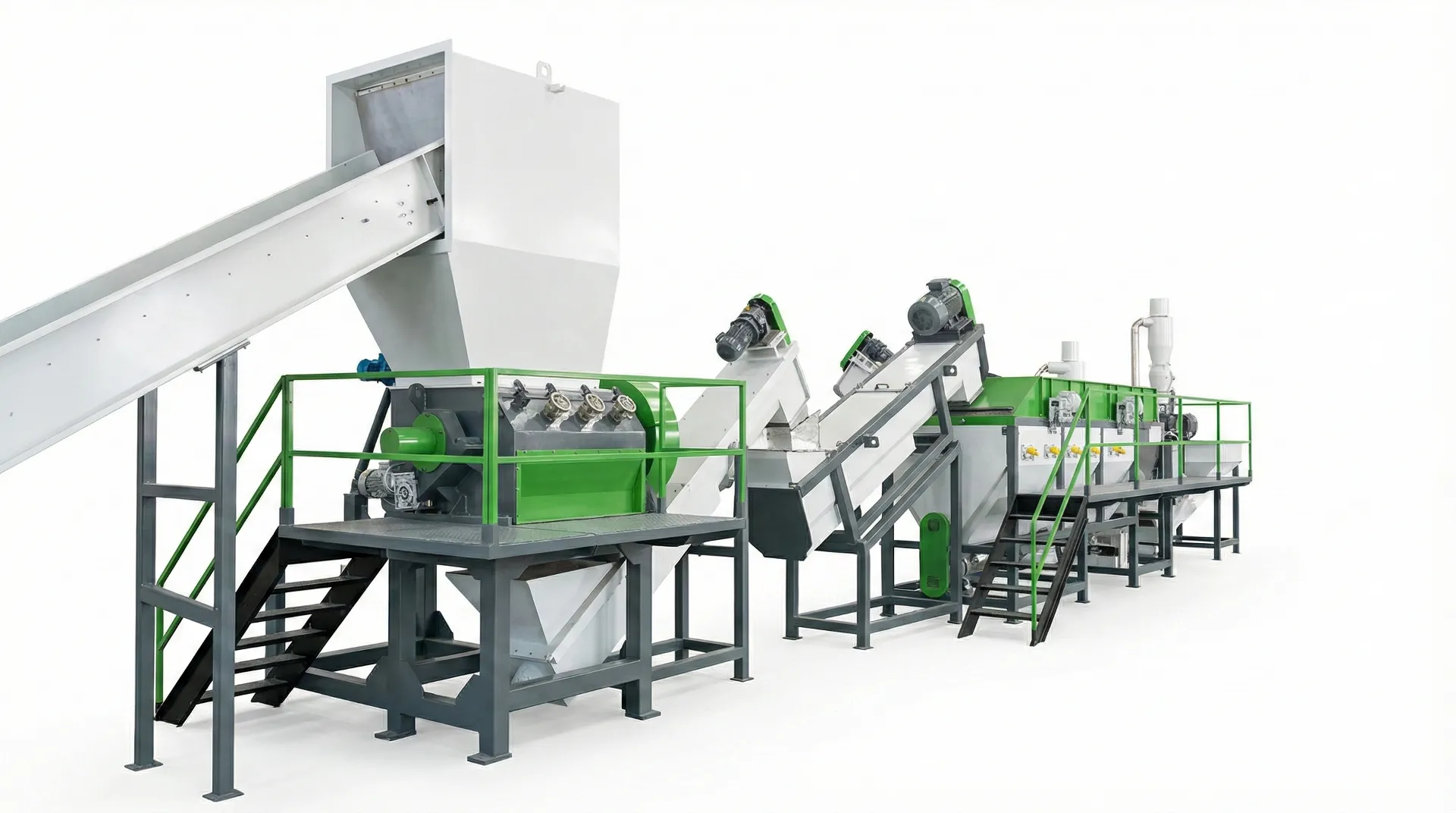
A compact recycling setup fits testing, education, low-volume workshops, and clean sorted scrap. An industrial line fits commercial production, post-consumer waste, higher contamination, repeatable pellet or flake quality, and buyers who require stable specifications.
| Project goal | Better fit | Why |
|---|---|---|
| Teach plastic recycling or run demos | Small machine | Lower space demand, simpler operation, easier visual learning |
| Test a new waste stream before investment | Small machine or pilot setup | Helps confirm shredding, melting, odor, and contamination issues |
| Recycle clean factory trim in-house | Compact industrial setup | Cleaner input can move from crushing to pelletizing with fewer steps |
| Process dirty PET bottles, film, or rigid packaging | Industrial line | Needs sorting, washing, separation, drying, and quality control |
| Sell flakes or pellets to repeat customers | Industrial line | Requires stable throughput, documented quality, and service access |
What Counts as a Small Plastic Recycling Machine?
A small plastic recycling machine is a low-capacity unit or compact set of units that usually handles one process step: shredding, injection, extrusion, compression, or simple pellet making. Buyers often use these machines in schools, design studios, repair workshops, community projects, labs, and early-stage recycling businesses.
Small equipment can make plastic recycling visible and practical. Projects such as Precious Plastic helped popularize small-scale machines by sharing designs for shredding, extrusion, injection, and sheet pressing. Source: Precious Plastic machines overview.
- Typical materials: clean caps, small HDPE/PP parts, sorted flakes, failed 3D prints, and low-volume workshop scrap.
- Typical outputs: flakes, simple molded parts, extruded profiles, small sheets, or test pellets.
- Typical limits: manual feeding, low automation, narrow material range, limited washing, and more operator handling.
What Counts as an Industrial Plastic Recycling Line?
An industrial plastic recycling line is a connected system built for continuous production. It combines material handling, size reduction, washing, separation, drying, extrusion, filtration, pelletizing, controls, and safety features according to the incoming waste stream.
Industrial equipment becomes important when the material is dirty, wet, bulky, mixed, or tied to a buyer specification. According to the U.S. EPA, plastics accounted for 35.7 million tons of U.S. municipal solid waste generation in 2018, and plastic containers and packaging were more than 14.5 million tons. This scale explains why commercial plants need repeatable systems rather than only manual machines. Source: EPA Plastics: Material-Specific Data.
- PET bottle plants need debaling, label removal, crushing, washing, separation, and drying before flakes can meet buyer demands.
- PP/PE film plants need stable feeding, friction washing, squeezing or drying, degassing, filtration, and pelletizing.
- Rigid HDPE/PP plants need shredding or granulation, washing, sink-float separation, drying, and sometimes extrusion.
Small Plastic Recycling Machine vs Industrial Line: Core Differences
The main difference is not size alone. The real difference is how much control you need over feedstock, output quality, safety, labor, and daily uptime.
| Factor | Small-scale equipment | Industrial recycling line |
|---|---|---|
| Capacity | Best for tests, batches, and low-volume work | Built around a stable kg/h target |
| Labor | More manual feeding, sorting, and handling | Conveyors, controls, and process flow reduce manual handling |
| Material condition | Works best with clean, sorted, dry plastic | Can include washing, separation, and drying for dirty waste |
| Output control | Good for demos and early samples | Better for repeatable flakes or pellets |
| Safety design | Depends heavily on machine source and local guarding | Can include interlocks, guards, emergency stops, and service platforms |
| Expansion | Limited by manual steps and machine duty cycle | Can add sorting, washing, drying, and pelletizing modules |
| Buying process | Compare unit specs and operator needs | Compare full process scope, utilities, installation, and support |
When a Small Plastic Recycling Machine Makes Sense
A small-scale setup makes sense when learning, testing, or low-volume reuse matters more than commercial throughput. It can help your team understand material behavior before you commit to a larger line.
- You need proof before a bigger purchase. Run clean samples, test melt behavior, check odor, and record feeding problems.
- Your waste stream is clean and narrow. A steady supply of one polymer, such as HDPE caps or PP offcuts, reduces process risk.
- Your output stays inside your own workshop. Internal reuse often allows more tolerance than selling pellets to outside buyers.
- Your site has limited power and space. A small unit can fit where a full washing or pelletizing line cannot.
In our experience, small machines work best when the operator controls the input closely. They struggle when the feed changes every hour, carries water or sand, or includes labels, metal, PVC, multilayer film, or unknown polymers.
When an Industrial Line Is the Better Choice
An industrial line is the better choice when you need saleable output, documented quality, and steady production. It also protects your project from hidden costs caused by washing, moisture, filtration, labor, and downtime.
- Your feedstock is post-consumer. Bottles, film, drums, and mixed packaging usually need washing and separation.
- Your buyer sets quality limits. Moisture, color, PVC, ash, odor, melt flow, and pellet size can all affect acceptance.
- You need a defined output target. A 300 kg/h, 500 kg/h, or 1,000 kg/h line needs different feeding, drying, and control design.
- You plan to run shifts. Continuous work requires blade access, spare parts, control alarms, maintenance schedules, and operator training.
If you are already close to a commercial decision, read our plastic recycling machine selection guide. It explains how to match polymer type, contamination, feed form, target output, and supplier quotations.
Material Fit: Clean Scrap, Bottles, Film, and Rigid Plastics
Material fit should decide the equipment path before price does. Compact equipment can handle narrow clean streams, but industrial lines handle the extra steps needed for dirty or mixed plastic.
| Material | Small machine fit | Industrial line fit | Key concern |
|---|---|---|---|
| Clean HDPE or PP scrap | Good for tests and small reuse | Good for in-house pelletizing | Metal, melt flow, and size consistency |
| Failed 3D prints | Good for shredding and trials | Useful if volume becomes steady | Polymer separation and additives |
| PET bottles | Poor unless already clean and sorted | Strong fit for washing and flake output | Labels, PVC, moisture, color, and glue |
| LDPE/PP film | Limited unless clean and dry | Strong fit for washing, squeezing, and pelletizing | Water, sand, ink, feeding, and degassing |
| Rigid crates, drums, caps | Possible at small volume after cutting | Strong fit with shredder, washer, dryer, and pelletizer | Bulk density, labels, dirt, and mixed polymers |
Packaging details can change the whole process. The Association of Plastic Recyclers explains that labels, inks, adhesives, and closures affect PET recycling because they can carry contamination into the wash and flake stream. Source: APR Design Guide for PET Rigid Packaging.
Capacity and Cost: How to Think Beyond the Purchase Price
Purchase price tells only part of the story. You should compare cost per usable kilogram, not just the machine invoice.
- Labor: Small machines often need more operator time for feeding, sorting, cleaning, and handling.
- Utilities: Industrial washing and drying need power, water, compressed air, and wastewater planning.
- Consumables: Blades, screens, filters, heaters, belts, bearings, and oil affect real operating cost.
- Downtime: A cheaper machine can cost more if blade changes, screen cleaning, and repairs stop production often.
- Rejected output: Dirty flakes, wet pellets, odor, or unstable melt flow can erase savings from a low purchase price.
Use a simple payback check before buying: monthly usable output x margin per kilogram, minus labor, power, water, consumables, and maintenance. For a wider cost breakdown, see our plastic recycling machine cost guide.
Safety and Compliance Checks Before Buying
Safety checks matter for both small machines and industrial lines because plastic recycling equipment includes cutters, rotating shafts, hot barrels, electrical panels, hydraulic systems, and pinch points. A low-cost unit can become expensive if it lacks guards, emergency stops, or safe cleaning access.
According to OSHA, plastics machinery can expose workers to moving parts, nip points, high voltage, and high temperature hazards, and employers should use guarding, lockout/tagout, and personal protective equipment. Source: OSHA Machine Guarding: Plastics Machinery.
- Check fixed guards, interlocks, emergency stops, and lockout points.
- Ask for wiring diagrams, manuals, spare parts lists, and maintenance schedules.
- Confirm local electrical standards, voltage, frequency, cabinet layout, and component access.
- Review cleaning points for shredders, granulators, washers, dryers, filters, and pelletizers.
A Practical Decision Framework
This framework helps you choose the right path before asking suppliers for quotes. Answer each question with your real material, not an ideal sample.
| Question | Choose small equipment if… | Choose an industrial line if… |
|---|---|---|
| How much material do you process? | Batches, demos, or low daily volume | Defined kg/h target and shift schedule |
| How dirty is the material? | Clean, dry, sorted input | Labels, sand, oil, food residue, or mixed polymers |
| Who uses the output? | Your own workshop or testing team | Outside buyers or production lines |
| How stable must quality be? | Samples and basic reuse are acceptable | Moisture, color, melt flow, and contamination limits matter |
| What support do you need? | Basic spare parts and operator skill may be enough | Installation, commissioning, training, and long-term service matter |
In our project reviews, the common mistake is buying a small shredder or extruder for a waste stream that actually needs washing and drying first. If the input is wet or dirty, spend time on process design before machine shopping. Our plastic recycling plant layout guide can help you map that process.
What to Send a Supplier Before You Ask for a Quote
A supplier can recommend the right setup faster when you send specific material and project details. A vague request for a small unit often produces a vague quote.
- Photos and videos of the plastic before sorting, after sorting, and after any existing crushing.
- Polymer types and percentages, such as 80% LDPE film and 20% PP woven bags.
- Contamination notes: labels, glue, sand, food residue, oil, metal, paper, water, and mixed colors.
- Target output: flakes, pellets, molded parts, sheet, strand, or in-house regrind.
- Expected capacity in kg/h or kilograms per day.
- Available floor space, power supply, water supply, compressed air, and wastewater plan.
- Preferred scope: single machine, pilot setup, or complete recycling line.
If your target is clean pellets, compare plastic pelletizing lines. If your first bottleneck is size reduction, review our plastic shredders and plastic crushers.
FAQ About Small Plastic Recycling Machines
Is a small plastic recycling machine enough to start a business?
A small plastic recycling machine can help you test a product idea or collect early samples, but it may not support a full recycling business. Commercial buyers usually need steady volume, cleaner output, and documented quality.
Can a small machine recycle PET bottles?
A small machine can shred clean PET bottles for testing, but bottle recycling usually needs label removal, washing, separation, and drying. A dedicated PET bottle recycling system fits better when you need saleable flakes.
What is the biggest risk when buying a small unit?
The biggest risk is expecting one small unit to solve sorting, washing, drying, extrusion, and quality control at the same time. Define your output first, then choose the process steps.
When should I move from a small machine to an industrial line?
Move to an industrial line when your material supply becomes steady, your buyer requires a quality specification, and your target output needs continuous kg/h production. At that point, process control matters more than the lowest machine price.
What is the first machine most projects should test?
Most projects should test size reduction first because feeding problems appear early. A shredder or crusher trial shows whether the material bridges, wraps, melts, creates dust, or wears blades too quickly.
Next Step: Choose by Waste Stream, Not Machine Size
A starter setup is useful when you need learning, testing, or low-volume reuse. An industrial line is the better choice when you need steady production, cleaner flakes or pellets, safe maintenance access, and a process that matches real post-consumer or post-industrial waste.
To move from comparison to equipment planning, review our industrial plastic recycling machine categories or send Rumtoo your material photos, target capacity, plant space, and output goal for a practical line recommendation.
