


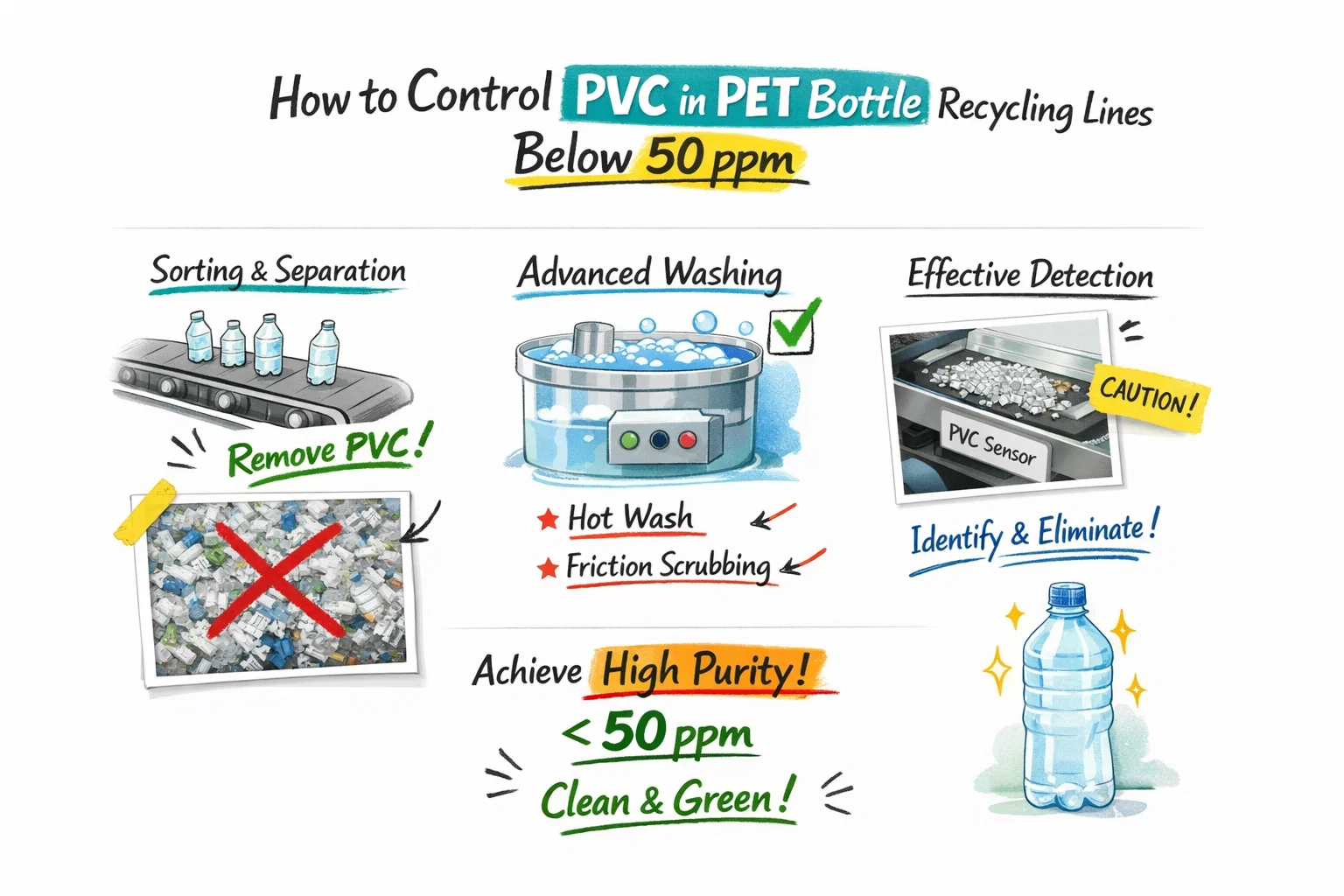
Controlling PVC contamination is one of the toughest challenges in PET bottle recycling, especially when you target high-end applications and food-grade rPET. Even at concentrations around 50 ppm, PVC can damage PET quality, causing brittleness, yellowing and unwanted by-products during extrusion. For PET recyclers, keeping PVC as low as possible is not just a technical requirement – it directly impacts selling price, customer acceptance and long-term profitability.
In this article, we look at where PVC comes from in a typical PET bottle line, what “good” looks like in terms of ppm levels, and how a combination of front-end sorting, washing and dry electrostatic separation can help you reliably stay below 50 ppm.
TL;DR (for plant managers & buyers)
- PVC can cause serious PET degradation even around 50 ppm.
- The most effective strategy is prevent PVC before grinding, then use washing + float-sink for bulk cleaning, and a dry polishing step (often electrostatic) to remove trace PVC.
- Prove performance with routine testing + trend monitoring, not one-off samples.
Why 50 ppm PVC matters so much
Multiple industry sources point out that PVC contamination at or even below 50 ppm can already trigger quality issues in PET flakes when they are remelted. PVC degrades and releases chlorine-containing compounds at PET processing temperatures, which can:
- Promote chain scission and embrittlement in the PET resin.
- Cause yellowing or off-color in pellets and final products.
- Corrode processing equipment and complicate exhaust gas treatment.
For high-end applications such as food-contact rPET, bottle-to-bottle recycling and premium polyester fibers, buyers often require PVC levels below 50 ppm – and in some cases below 30 ppm – as part of their specifications. This means PET recyclers need a process that consistently delivers this quality, not just in lab samples but in full-scale, 24/7 operation.
Typical sources of PVC in PET bottle streams
In a PET bottle recycling line, PVC can enter the system from several sources:
- Whole PVC bottles and containers that slip through front-end sorting.
- Shrink sleeves, labels and safety seals made from PVC or PETG.
- Cap liners, multilayer components and residual films in the bale mix.
Even when PVC is only a small fraction of the incoming bales, its impact on the final flake quality is disproportionate. A contamination level of 50 ppm corresponds to only about 0.05 kg PVC per 1,000 kg of PET flakes – a tiny amount in mass, but enough to compromise high-spec applications.
What “below 50 ppm” looks like in practice
Technical datasheets and buyer specifications for high-quality rPET flakes often list maximum PVC limits in the range of 10–50 ppm, combined with tight limits on other polymers. For example, some clear rPET flake specs call for:
- PVC below 10–50 ppm.
- Total foreign polymers below 80–100 ppm.
- Overall flake purity >99.8% on a mass basis.
Reaching these numbers reliably requires more than one single “magic” machine. Instead, successful plants design their lines as a sequence of complementary steps:
- Bale inspection and pre-sorting.
- Manual and/or automated bottle sorting.
- Label removal and size reduction.
- Cold and hot washing.
- Flotation and density separation.
- Drying and final dry-cleaning / polishing stages.
Electrostatic separation sits at the very end of this chain as a dry polishing technology, removing the last traces of PVC and other polymers from already-washed, dried PET flakes.
Front-end: keeping as much PVC out as possible
The first line of defense against PVC is simply not to let it enter the flake stream. Common strategies include:
- Manual sorting with UV or visual aids: Experienced operators can identify PVC bottles and labels, and UV illumination can enhance contrast between PET and PVC.
- NIR-based bottle sorters: Near-infrared optical sorters classify bottles by polymer type and eject PVC, PETG and other undesired materials before shredding.
- Mechanical and label removal steps: De-labelling systems and pre-wash stages strip sleeves and labels, reducing downstream PVC load.
These technologies are highly effective on whole bottles and large pieces, and they can dramatically reduce the amount of PVC arriving at the grinding and washing sections. However, they are not perfect and do not fully address small fragments and mixed flakes.
Washing, float-sink and what they can (and can’t) do
Most PET bottle lines rely on a combination of hot washing, friction washing and float-sink separation to remove glues, paper, organics and low-density contaminants. In a typical process:
- Wet grinders reduce the bottles into flakes.
- Friction washers and hot wash tanks clean off labels, dirt and adhesives.
- Float-sink tanks separate polyolefins (PP/HDPE) from PET based on density.
These steps are excellent at reducing overall contamination and separating PET from caps and labels. But density differences between PET and PVC are relatively small, and many density-based systems are not optimized specifically for PVC removal. This is why even well-designed washing lines may still deliver PET flakes with PVC levels above 100–200 ppm if no additional polishing step is used.
What each step can realistically remove (quick reference)
| Step | Best at removing | Limits for PVC control |
|---|---|---|
| Front-end sorting (manual / optical) | Whole PVC containers, obvious off-spec items | Small fragments and mixed flakes can slip through |
| De-labelling / sleeve removal | Sleeves, labels, seals before they become fragments | Less effective once material is shredded into small pieces |
| Hot wash + friction wash | Glue, dirt, organics; improves overall cleanliness | Cleaning does not equal polymer separation; PVC can remain |
| Float-sink | PP/HDPE vs PET separation (caps/labels) | PET vs PVC density separation is not consistently sharp |
| Dry polishing (often electrostatic) | Trace PVC and other polymers in dry flakes | Requires tight moisture and particle-size control |
Why dry electrostatic separation is needed as a polishing step
To push PVC levels below 50 ppm, many recyclers add a dry electrostatic separation stage after drying. Electrostatic separators exploit differences in electrical properties between PET and PVC:
For a practical equipment overview, see: Plastic Electrostatic Separator
- Flakes are exposed to a charging mechanism (corona or triboelectric charging), which induces different polarities on different polymers.
- Charged flakes pass through an electric field between electrodes or a charged drum.
- Based on their charge and conductivity, PET and PVC follow different trajectories and are collected as separate fractions.
Case studies and equipment suppliers report that, when properly integrated, electrostatic separation can reduce PVC contamination from around 1,000 ppm to values below 50 ppm in PET flakes, while also removing other polymer contaminants. This makes the technology particularly attractive as the final refining step before quality control and packaging.
Process conditions that influence electrostatic performance
To achieve reliable separation and stay below 50 ppm, several process parameters need to be controlled:
- Moisture content: Electrostatic separators generally require dry feed, often with residual moisture below about 0.5–0.8%, to prevent charges from dissipating.
- Particle size and shape: Flake size should be within a defined range (for example below 10–12 mm), with limited fines, to maintain stable trajectories in the electric field.
- Blend composition: Feed composition should be relatively stable, or the machine should be adjusted for different PVC/PET ratios to keep middling and reject fractions under control.
- Voltage, electrode configuration and splitter settings: Optimizing these parameters is critical to balance PVC removal efficiency with PET yield and minimize losses.
In practice, many plants implement a two-stage strategy: a first electrostatic pass to separate a high-PET product and a high-PVC reject, followed by a second pass on middling material to further reduce PVC and recover PET.
Role of integrated PET bottle washing lines
End-to-end system suppliers show that combining a well-designed PET bottle washing line with a final electrostatic polishing stage can deliver flake purities above 99.8%, with very low PVC levels. Typical design elements include:
- Bale opening, metal removal and pre-sorting.
- Automated bottle sorting (NIR) plus manual quality control.
- High-efficiency label removal, hot wash and friction cleaning.
- Multi-stage float-sink and density separation for polyolefins.
- Low-residue drying to reach the required moisture level for electrostatic separation.
- One or more electrostatic separators for PET/PVC and other mixed plastics.
When these stages are properly engineered and tuned, the result is a stable output of clean PET flakes ready for food-grade or high-performance applications, with PVC well below the 50 ppm threshold.
Monitoring, testing and continuous improvement
Reaching a PVC target once is not enough – recyclers need to demonstrate consistent performance over time. This usually involves:
- Regular laboratory testing of PVC content, often using oven tests or specialized analytical methods, against defined ppm limits.
- Process monitoring on key variables such as bale quality, sorting reject rates, wash performance and electrostatic separator settings.
- Periodic audits of the line to identify new contamination sources or drift in performance.
Plants that formalize this into a quality management system are better positioned to meet brand-owner requirements and secure long-term contracts for high-value rPET.
Acceptance & QA: how to prove you can hold < 50 ppm
To make “PVC < 50 ppm” defensible for buyers, define your acceptance plan and stick to it:
- Sampling plan: specify where and how often samples are taken (e.g., after drying / after polishing / before packaging).
- Trend, not snapshots: track results over time and tie excursions to inbound bales, sleeve types, moisture drift, or separator settings.
- Process KPIs to log: inbound bale quality, optical-sorting reject rates, dryer moisture, flake size distribution (fines), electrostatic voltage/splitter settings, and PET yield losses.
- Escalation rules: what happens when you see a spike (hold lot, reprocess middlings, adjust settings, audit bale source).
Multi-Barrier Control Map (Bottle to Finished Flake)
Use more than one PVC barrier. Each stage catches a different form of contamination; no single machine is a complete plan.
| Process point | PVC risk | Control to evaluate | What to verify |
|---|---|---|---|
| Bale opening & presort | Whole PVC containers, obvious sleeves | Manual or sensor bottle sorting | Feed presentation & reject accuracy |
| Label removal | PVC shrink sleeves and labels | Mechanical label remover + air separation | Sleeve removal across bottle sizes |
| Before grinding | Missed bottles, seals, labels | QC sorting pass | Reject checks by shift |
| After washing/drying | PVC flakes mixed with PET | Flake sorter + lab identification | Sampling method & detection limit |
| Finished product | Residual contamination | Release test vs buyer spec | Lot traceability & hold procedure |
Flake Sampling & Lab Checks (Before Release)
| Check | Question for the supplier or laboratory |
|---|---|
| Sample collection | How are increments taken across time, bags, or silos? |
| Sample preparation | Is the sample dry, size-controlled, and representative? |
| Identification method | What method identifies PVC (e.g. ASTM D5991-related practices) and what can interfere? |
| Detection capability | Can the method reliably judge the buyer’s limit (e.g. ≤50 ppm)? |
| Release decision | Who holds, retests, reworks, or rejects an out-of-spec lot? |
What to Include in a PET Line RFQ (PVC Control)
- Incoming bale composition and known PVC formats in your market
- Target finished-flake specification and end application (bottle-to-bottle, fiber, sheet)
- Required bottle and flake throughput
- Label-removal test sample and acceptance method (include hard sleeve formats)
- Sensor-sorter feed presentation, belt width/layer depth, and reject test protocol
- Sampling plan, laboratory method, and lot traceability
- Space for QC stations and rejected material handling
- Commissioning trial on local feedstock—not only clean demonstration bottles
Putting it all together
Controlling PVC in PET bottle recycling lines below 50 ppm is achievable, but it requires a system-level view:
- Keep as much PVC out of the line as possible through bale control and front-end sorting.
- Use robust washing and density separation to remove bulk contaminants.
- Add dry electrostatic separation as a final polishing step to capture the last PVC and foreign polymers.
- Back everything up with testing and process control to prove that you consistently meet the specification.
By combining these strategies, PET recyclers can produce higher-quality flakes, access more demanding end markets and improve the overall economics of their operations.
Frequently Asked Questions
Why is even a little PVC such a big problem in PET bottle recycling?
PVC melts at a much lower temperature than PET, so during reprocessing it breaks down and releases hydrochloric acid. That acid degrades the surrounding PET, causing yellowing, black spots and loss of strength in the recycled flake. A single PVC bottle hiding among thousands of PET bottles can spoil a whole batch, which is why buyers treat PVC as the number-one contaminant.
Where does the “below 50 ppm” limit come from?
It comes from the specifications of high-end rPET buyers, especially those making bottle-to-bottle or food-contact pellets. At 50 ppm (0.005%), the PVC level is low enough that acid degradation stays invisible in the finished product. Some brands set even tighter internal limits, but 50 ppm is the widely accepted commercial threshold for premium flake.
Can’t NIR sorters just remove all the PVC at the front end?
NIR is excellent at ejecting whole PVC bottles and large pieces, and it should always be the first barrier. The problem is small PVC fragments — labels, shrink sleeves and broken pieces — that slip through optical sorting or arrive after the sorter. That is why NIR is step one, not the whole solution: you still need density and electrostatic separation downstream.
How much PVC can a sink-float tank actually remove?
Sink-float separation is very effective on PVC bottle pieces, which sink while PET flakes float — removal rates above 95% are realistic for that fraction. But it struggles with PVC labels and thin films whose density sits close to the flotation medium, and with very fine particles. Treat sink-float as a strong bulk-removal stage, then polish the remaining stream electrostatically.
What does hot washing do for PVC control?
Hot washing with caustic removes glue, organics and surface dirt, and it loosens labels so downstream separation works better. It does not remove PVC itself — PVC survives the wash chemically intact. Its real contribution is cleaning the flake surface so density and electrostatic separators can tell the polymers apart accurately.
How should a recycling line be designed to reliably hold PVC below 50 ppm?
Design in layers: NIR sorting up front for whole bottles, sink-float tanks for bulk density separation, then dry electrostatic separation as the polishing step for the fines. Keep the feed to the electrostatic unit dry and consistent — moisture and fines are the two things that kill its performance. And put testing points after each stage so you can see exactly where an excursion starts instead of guessing.
How do you test for PVC and prove food-grade compliance?
For routine control, X-ray fluorescence (XRF) or chlorine-content testing on finished flake gives you a fast ppm reading. For food-contact rPET, buyers usually require third-party lab analysis plus documentation of the whole process — challenge tests or EFSA/FDA-style dossiers depending on the market. Keep batch records from your in-line testing points; auditors want to see the data trail, not just a final certificate.
