


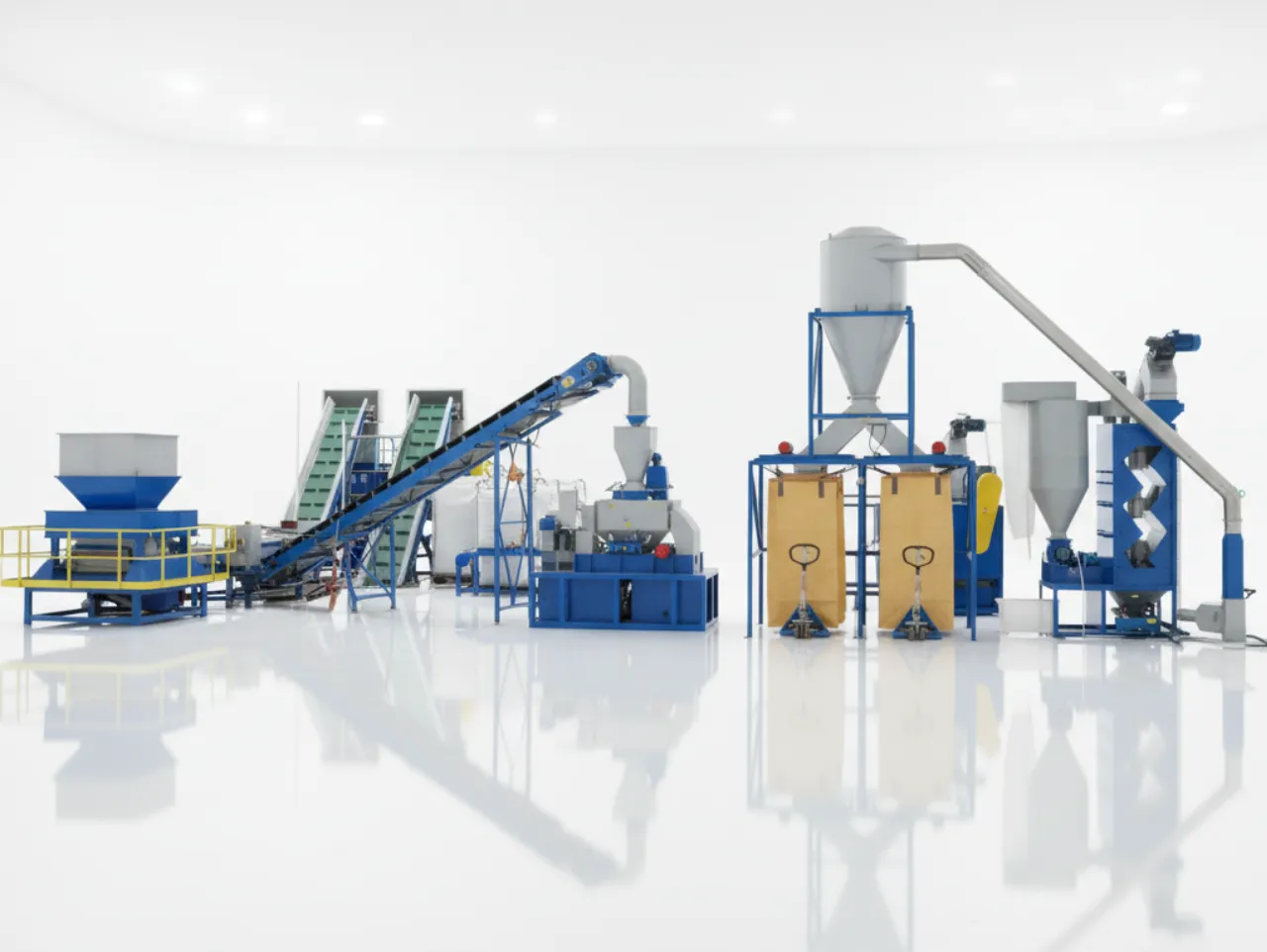
1000-1500 kg/h PET bottle washing recycling line — the complete equipment list with detailed specifications. This high-efficiency line turns baled PET bottles into clean, dry flakes ready for pelletizing, sheet, fiber, or food-grade applications. Total installed power: 310 kW. Production capacity: 1,000 to 1,500 kg/h.
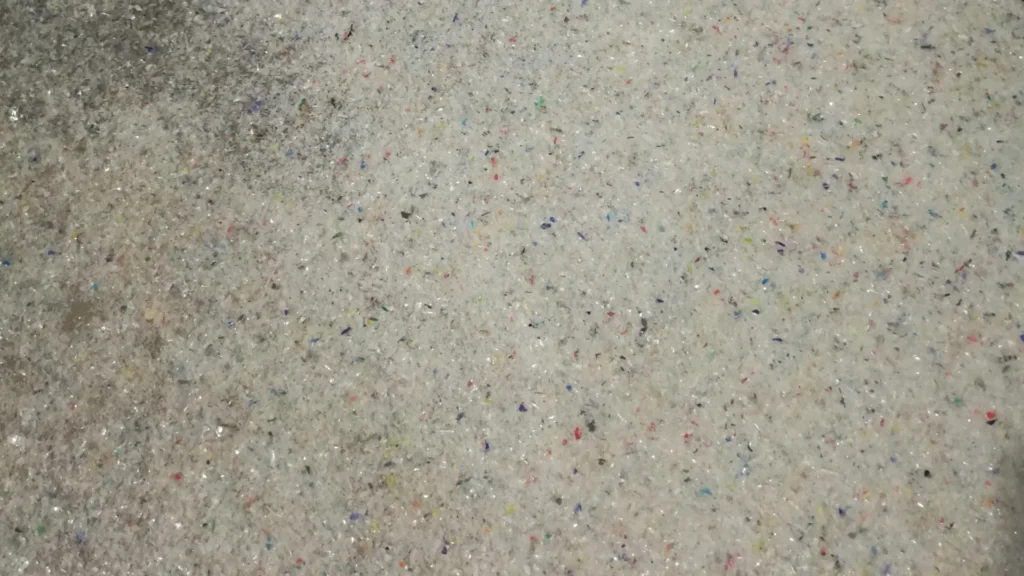
Line Overview: 1000-1500 kg/h PET Washing Line
This is a full-scale industrial PET bottle recycling line designed for plants processing 8,000-12,000 tons of bottles per year. Baled bottles enter at the belt conveyor; clean, dry PET flakes discharge from the finished product silo. The 16-machine configuration below covers every stage: conveying, size reduction, label separation, cold washing, two-stage hot washing, friction washing, dewatering, and thermal drying.
Process Flow: From Bale to Clean Flakes
The process follows a fixed sequence, and each stage prepares the material for the next. Skipping or under-sizing any stage shows up immediately in flake quality.
- Feeding and conveying — bales are opened and bottles metered onto the belt conveyor for a steady, controlled feed.
- Granulating — the granulator cuts bottles into flakes (45 kW main motor, 1000-1200 kg/h capacity matched to the line).
- Label separation — the film-and-flake separator and wind-sending system remove labels and light fractions by air.
- Cold washing — washing tanks (2 units) rinse off dirt, sand, and loose contaminants.
- Hot washing — two hot washers (60 kW heating each) with caustic and detergent dissolve glue and grease at 85-90°C.
- Friction washing — the high-speed friction washer (960 rpm rotor) scrubs flake surfaces clean.
- Dewatering and drying — the de-watering machine (75 kW) spins off surface water; two thermal dryers bring moisture below 1%.
- Collection — the cyclone separator and finished product silo collect and store the clean flakes.
Key Equipment in the Line
The table below lists every machine in the standard 1000-1500 kg/h configuration with its key specifications. Quantities and specifications can be adjusted to your bottle quality, water conditions, and target flake grade.
| Machine Description | Specifications | Qty (piece) |
| 1. Belt Conveyor 1 | 1) belt width: 800㎞2) belt material: PVC3) motor power: 2.2KW4) reduction ratio: 1: 305) drive roll diameter: φ273㎞6) belt linear velocity: 0.63m/s7) driven roller diameter: φ323㎞ | 1 |
| 2. Granulator | 1) main motor: 45KW2) cutter head rotary diameter: φ630㎞3) cutter head width: 1150㎞4) No.of rotating knife: 10 pcs5) No.of stating knife: 4 pcs6) cutter material: SKD117) cutter head rotating speed: 462rpm8) cutter head material: 45 steel9) screen mesh: φ95㎞10) hydraulic open feeding hopper/ hydraulic screen changer11) hydraulic station power: 2.2KW12) capacity: 1000-1200kg/h13) transmission power: 3KW14) gear reducer model: NMRV130-3015) screw conveyor rotating speed: 20-72.5rpm adjustable16) screw vane diameter: φ250㎞17) screw space: 200㎞18) screw material: stainless steel | 1 |
| 3. Screw Conveyor 1 | 1) motor power: 3.7KW2) screw conveyor rotating speed: 20-72.5 rpm3) screw vane diameter: φ390㎞4) screw stroke: 300㎞5) screw material: stainless steel6) frame material: carbon steel | 1 |
| 4. Film and Flake | 1) material: stainless steel2) frame material: carbon steel | 1 |
| 5. Wind-Sending System | 1) blower motor: 5.5KW2) pipe diameter: φ159㎞3) pipe material: stainless steel | 1 |
| 6. Storage For Labels | 1) storage material: stainless steel2) volume: 2m3 | 1 |
| 7. Screw Conveyor 2 | 1) motor power: 3.7KW2) screw conveyor rotating speed: 20-72.5 rpm3) screw vane diameter: φ390㎞4) screw stroke: 300㎞5) screw material: stainless steel6) frame material: carbon steel | 1 |
| 8. Washing Tank | 1) Width inside: 1500㎞2) Total length: 5000㎞3) Material: stainless steel4) Frame material: carbon steel5) Bottom screw motor: 5.5KW6) Discharge material screw motor: 3.7KW7) Lifting dirt screw motor power: 3KW8) Main motor power: 3KW | 2 |
| 9. Hot (Boiler) Washer | 1) motor power: 7.5KW2) reducer model: BLD5-71-7.53) agitating shaft rotating speed: 20rpm4) heating power: 60KW5) boiler material: stainless steel6) transmission power: 3.7KW7) reducer model: NMRV110-208) screw rotating speed: 20-72.5rpm, adjustable9) screw vane diameter: φ290㎞10) screw spacer: 200㎞11) screw material: stainless steel | 2 |
| 10. High Speed Friction Washer | 1) rotor rotary diameter: φ524㎞2) rotor material: carbon steel3) rotor rotating speed: 960rpm4) No. of rotor vane: 24 pcs5) washer body: stainless steel6) effective washing length: 2800㎞7) motor power: 37KW8) conveying angle: 15°9) driving way: belt drive | 1 |
| 11. Screw Conveyor 3 | 1) motor power: 3.7KW2) screw conveyor rotating speed: 20-72.5 rpm3) screw vane diameter: φ390㎞4) screw stroke: 300㎞5) screw material: stainless steel6) frame material: carbon steel | 1 |
| 12. De-watering Machine | 1) main motor power: 75KW2) machine inside material: stainless steel3) rotor rotary diameter: φ850㎞4) rotor material: carbon steel | 1 |
| 13. Thermal Dryer | 1) pipe diameter: φ159㎞2) blower power: 5.5KW3) pipe material: stainless steel4) blower model: 9-19 NO.4X55) heating power: 30KW | 2 |
| 14. Cyclone Separator | 1) separator diameter: φ1000㎞2) material: stainless steel | 1 |
| 15. Finished Product Silo | 1) silo material: stainless steel2) silo volume: 2.5m3 | 1 |
| 16. Electric Panel | 1 | |
| Totals | Installed Power: 310KWCapacity: 1,000 – 1,500 KG/h |
Washing Technology: Why Hot Wash Matters
Cold washing removes dirt and sand; it does not remove glue, oil, or labels stuck to the bottle. That is the job of the hot wash: caustic soda (NaOH) and detergent at 85-90°C dissolve hot-melt glue, strip oil films, and sanitize the flakes. This line runs two hot washers in series — the first does the heavy chemical work, the second polishes — followed by the friction washer that mechanically scrubs every flake surface at 960 rpm.
The payoff is flake grade. Single-stage cold-wash flakes sell at a discount and suit only low-end applications. Two-stage hot-wash flakes with friction scrubbing reach the cleanliness needed for sheet extrusion, fiber spinning, strapping — and, with proper sorting and certification, food-grade rPET.
Drying: Dewatering and Thermal Drying
Wet flakes cannot be pelletized or stored — moisture causes hydrolysis in the extruder and mold in storage. Drying happens in two steps. First, the 75 kW de-watering machine uses centrifugal force to spin surface water off the flakes. Then two thermal dryers use hot air to bring residual moisture below 1%. The cyclone separator at the end recovers fine particles from the drying air stream so nothing of value is lost.
Utilities and Installation Requirements
Plan the plant around the line, not the other way around. The key requirements:
- Power: 310 kW installed — size the transformer and switchgear for this, with headroom for the water treatment system.
- Water: washing consumes significant water; a recirculation and treatment system cuts fresh-water demand dramatically and is effectively mandatory at this scale.
- Space: 1,500-2,000 m² of workshop for the line itself, plus bale storage, wastewater treatment, and flake storage areas.
- Steam/heat: the two hot washers need 120 kW of heating — electric in the standard configuration; boiler steam is an option for plants with existing steam capacity.
- Labor: sorting and bale opening are the labor-intensive steps; the washing line itself typically needs 3-5 operators per shift.
1000-1500 kg/h vs. 500 kg/h: Which Capacity?
Bigger is not automatically better. A 1000-1500 kg/h line needs roughly 8,000-12,000 tons of baled bottles per year to run at economic utilization — plus the working capital to hold that inventory. If your bottle supply is 3,000-5,000 tons per year, the smaller line earns more per ton because it actually runs full.
For the smaller configuration, see our 500 kg/h PET bottle recycling washing line guide, which covers equipment, layout, and pricing for the compact line. Either way, we offer custom design of complete PET recycling facilities based on your application, capacity, and specifications.
Frequently Asked Questions
What equipment is included in a 1000-1500 kg/h PET washing line?
The line includes 16 machines: belt conveyor, granulator, screw conveyors, film-and-flake separator, wind-sending system, label storage, washing tanks, hot washers, high-speed friction washer, de-watering machine, thermal dryers, cyclone separator, finished product silo, and the electric control panel. The full equipment list with specifications is in the equipment table below.
How much power does a 1000-1500 kg/h PET washing line need?
This configuration has a total installed power of 310 kW. In practice, not all machines run at full load simultaneously, so actual consumption is lower — but the 310 kW figure is what your electrical infrastructure and transformer must support.
Why is hot washing necessary for PET bottles?
Hot washing (with caustic soda and detergent at 85-90°C) dissolves glue, removes oil and grease, and kills bacteria. Cold washing alone cannot reach food-grade flake quality. This line includes two hot washers for a thorough two-stage hot wash.
What flake quality can this line produce?
With proper sorting and the two-stage hot wash plus friction washing, the line produces clean PET flakes with moisture below 1% after drying — suitable for sheet, fiber, strapping, and food-grade applications (subject to your local certification requirements).
Should I choose 1000-1500 kg/h or a smaller line?
It depends on your bottle supply and market. A 1000-1500 kg/h line needs roughly 8,000-12,000 tons of bottles per year to run economically. If your supply is smaller, consider our 500 kg/h PET washing line guide, which covers the smaller configuration and pricing.
How much space does the line need?
A 1000-1500 kg/h PET washing line typically needs 1,500-2,000 square meters of workshop space, plus areas for bale storage, wastewater treatment, and finished flake storage. The exact layout depends on your building dimensions — we provide a customized layout drawing for every project.
Does the line include wastewater treatment?
The washing process generates wastewater containing labels, glue, and caustic. We recommend a water recycling and treatment system sized to your local discharge regulations — ask our engineering team for a configuration matched to your plant.
Planning a PET recycling plant? Contact our engineering team with your bottle supply, target flake grade, and available utilities for a tailored line configuration and quotation.
