


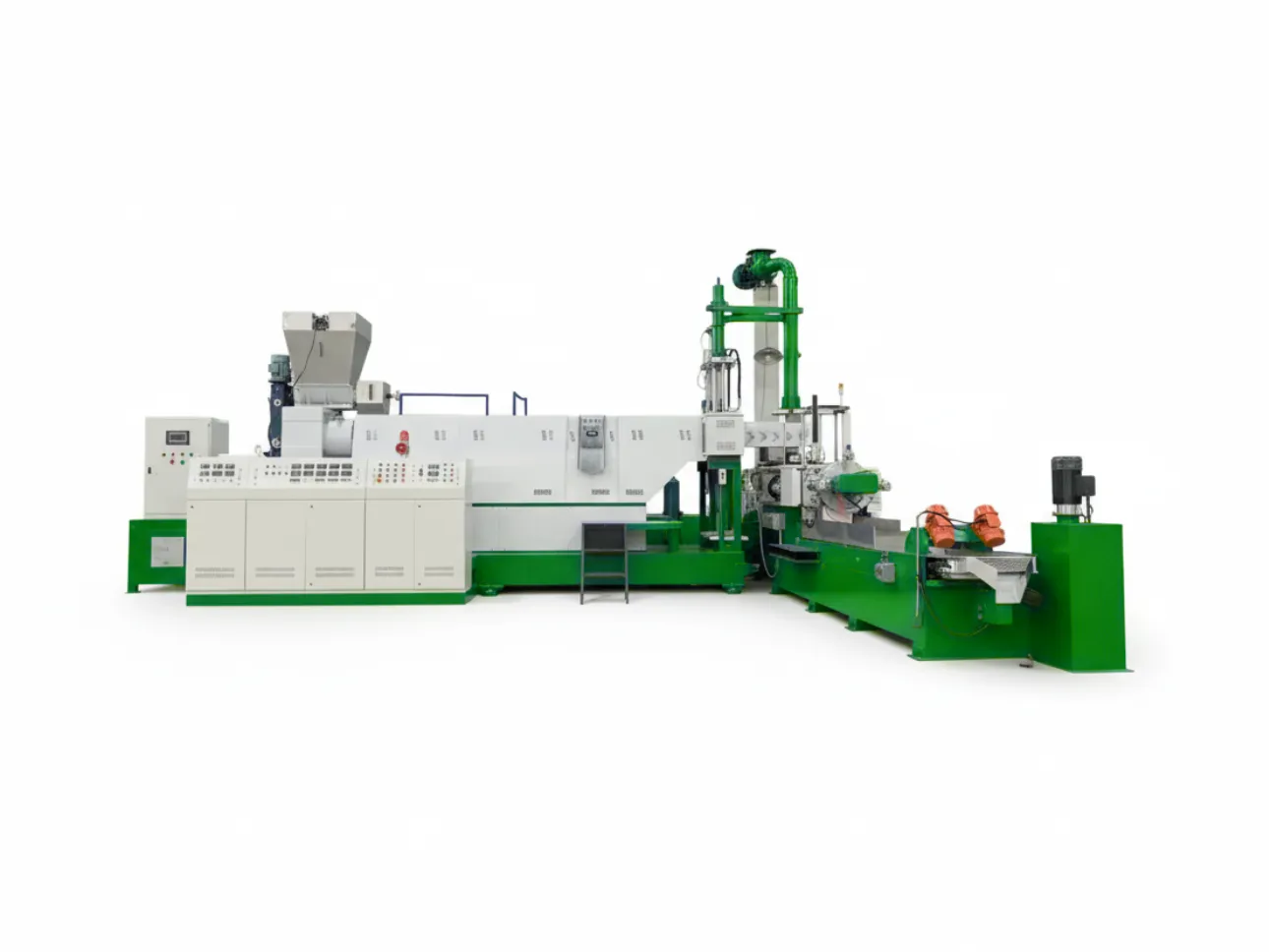
Rigid PP/HDPE Two-Stage Pelletizing Line
Convert washed rigid PP and HDPE flakes into dense, reusable pellets with a line designed for stronger degassing, finer filtration, and more stable long-run performance.
- Two-stage extrusion improves melt filtration and pellet purity.
- Dual-zone vacuum degassing reduces moisture and residual volatiles.
- Water-ring pelletizing supports dense, uniform finished pellets.
Maximize Purity & Efficiency
The two-stage design is built to raise pellet quality, reduce contamination carryover, and improve line stability across demanding rigid flake streams.
Superior Pellet Quality
Produces denser, more uniform pellets with improved melt stability for higher-value downstream applications.
Automated & Stable Operation
Controlled feeding and process logic help reduce blockages and keep throughput more consistent.
Advanced Two-Stage Filtration
Primary and secondary filtration stages help remove both coarse and fine contaminants.
Maximum Degassing Efficiency
Dual-zone vacuum design improves removal of moisture, residual inks, and volatiles from washed flakes.
Streamlined Process: Flakes to Pellets
A controlled four-step workflow converts washed rigid flakes into cleaner, reusable pellets with stronger degassing and more reliable melt conditioning.
Consistent Feeding
Washed flakes are delivered into the extruder through controlled feeding for more stable load conditions.
Plasticizing & Degassing
The first extruder melts the plastic and removes moisture and volatiles through vacuum degassing.
Two-Stage Melt Filtration
The second stage refines the melt and improves cleanliness before pellet formation.
Pelletizing & Drying
The water-ring pelletizer cuts the melt into pellets which are then cooled and dried for packaging or reuse.
Two-Stage vs. Single-Stage Performance
The additional extrusion, degassing, and filtration stages improve pellet consistency and reduce downtime in more demanding rigid flake applications.
| Feature | Traditional Single-Stage Pelletizer | Advanced Two-Stage Pelletizer |
|---|---|---|
| Degassing Efficiency | Limited; residual moisture and volatiles remain more easily. | Stronger dual-zone vacuum degassing improves melt stability. |
| Melt Filtration | Basic single-screen filtration with more frequent clogging. | Coarse and fine filtration stages reduce contamination carryover. |
| Final Pellet Quality | More prone to voids, gels, or visible impurities. | Denser, more uniform pellets suitable for higher-value reuse. |
| Operational Stability | More sensitive to feed variation and unstable material quality. | Improved feeding control and staged processing support steadier throughput. |
Precision-Engineered Core Components
VFD Screw Conveyor
Provides more controlled feeding to help the extrusion stages run smoothly.
Primary Extruder
Melts and homogenizes the flakes while carrying out the initial degassing and filtration work.
Secondary Extruder
Improves melt purity and stability before final pelletizing.
Dual-Zone Vacuum Degassing
Supports more effective removal of moisture, residual volatiles, and trapped gases.
Water-Ring Pelletizer
Transforms the molten polymer into more consistent granules with stable cutting performance.
Centrifugal Drying System
Removes surface water from the pellets to prepare them for storage or direct reuse.
Equipment Overview
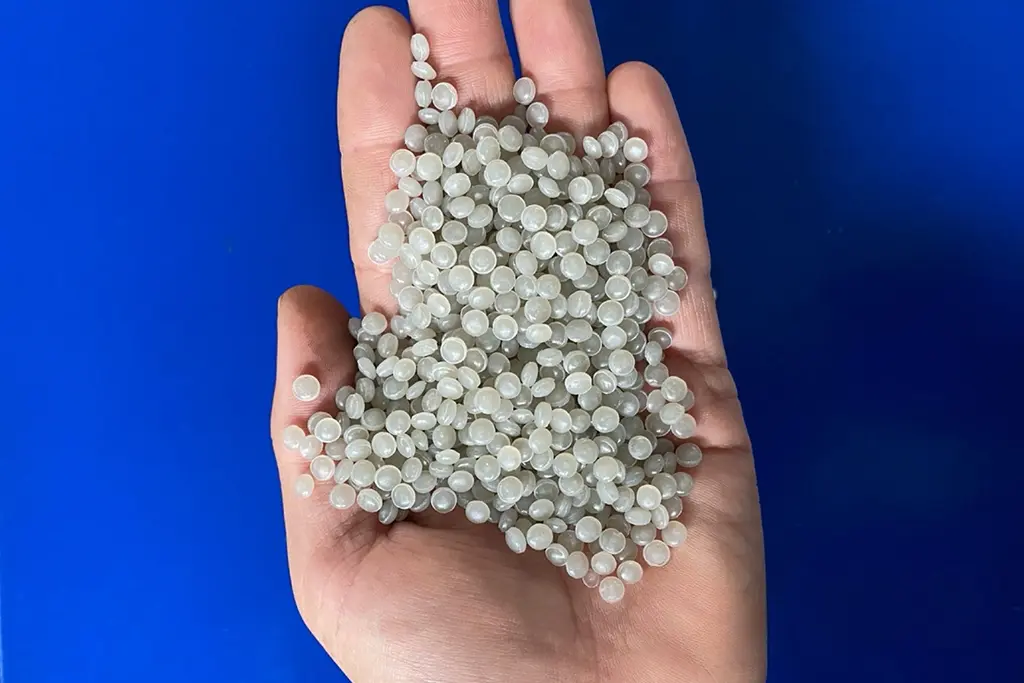
Complete Two-Stage Pelletizing Layout
This configuration integrates feeding, two-stage extrusion, melt filtration, water-ring pelletizing, and drying in one practical production layout.
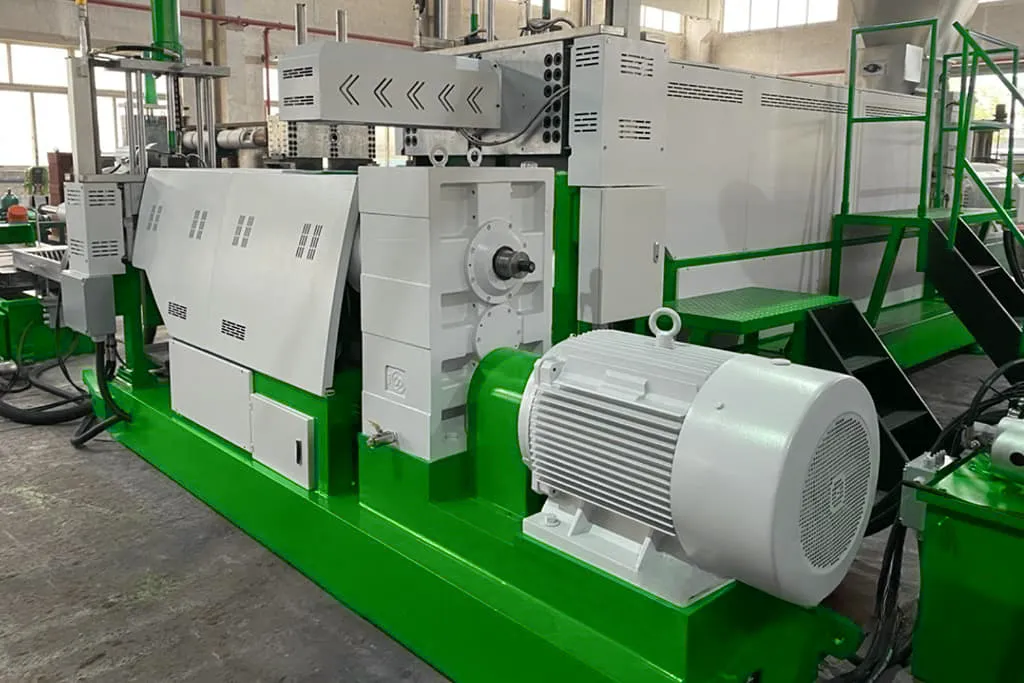
Stable Pellet Formation and Drying
The die-face pelletizing and drying section is arranged to support consistent cutting, fast moisture removal, and easier pellet collection.
Technical Specifications
| Parameter | Details |
|---|---|
| Applicable Materials | Rigid PP, HDPE, HIPS, ABS flakes (<12 mm) |
| Output Capacity | 300-1000 kg/h (varies by model and material) |
| Primary Extruder Screw Diameter | 120 mm – 180 mm |
| Secondary Extruder Screw Diameter | 110 mm – 170 mm |
| Main Motor Power | 90 kW – 250 kW |
| Degassing System | High-efficiency dual-zone vacuum degassing |
| Filtration Method | Two-stage plate-type hydraulic screen changer |
| Pelletizing Method | Die-face water-ring pelletizing |
| Cooling Method | Recirculating water cooling system |
| Safety & Compliance | CE-certified configuration with interlocks and emergency stops. |
Technical Specifications & Models
| Model | Capacity (kg/h) | Primary Extruder (mm) | Secondary Extruder (mm) | Main Motor Power (kW) |
|---|---|---|---|---|
| TSS-300 | 300-400 | 120 | 110 | 90 |
| TSS-500 | 500-600 | 150 | 140 | 160 |
| TSS-800 | 800-1000 | 180 | 170 | 250 |
TSS-300
TSS-500
TSS-800
Client Success: Superior Pellet Quality
“The two-stage pelletizing line helped us improve final pellet quality and reduce screen change frequency. We now achieve more stable output for higher-value rigid HDPE applications.”
Operations Manager, European Plastics Recycler
See the Pelletizing Line in Action
Complete Washing & Pelletizing Line
This machine is one stage of a full recycling line. A typical wet line runs in this sequence, and the equipment below covers each stage:
- Friction Screw Washer — scrubs off oil, labels, and surface dirt before separation.
- Sink-Float Separation Tank — separates plastics by density, floating light polyolefins off the heavier resins.
- Centrifugal Dryer — spins off free surface water mechanically after washing.
- Thermal Dryer — hot-air drying to below 1% moisture before pelletizing.
- Rigid PP/HDPE Flake Pelletizer — pelletizes clean rigid HDPE and PP flake into uniform pellets. (this machine)
- Single-Screw Pelletizing Line — water-ring or strand single-screw pelletizing at production throughput.
See the full rigid plastic washing line, or our guide on plastic recycling washing line cost.
FAQ
This line is designed for washed rigid PP and HDPE flakes, and it can also be adapted for rigid plastics such as HIPS and ABS depending on the material condition.
A two-stage system offers stronger degassing and finer melt filtration, helping improve pellet purity, reduce contamination carryover, and lower screen change frequency.
Yes. Installation, commissioning, and operator training are available to help the line reach stable production faster.
New recycling machines typically include a 12-month warranty for manufacturing defects and supported components, with ongoing technical support and spare parts service available.
Warranty
-
12-Month Warranty Support
Warranty coverage is available for manufacturing defects and supported components under standard service terms.
-
Commissioning & Training
On-site installation guidance, startup support, and operator training can be arranged according to project needs.
Get a Quote
Share your material type, hourly output target, and pellet quality requirements. We will recommend the right two-stage pelletizing configuration for your project.
