


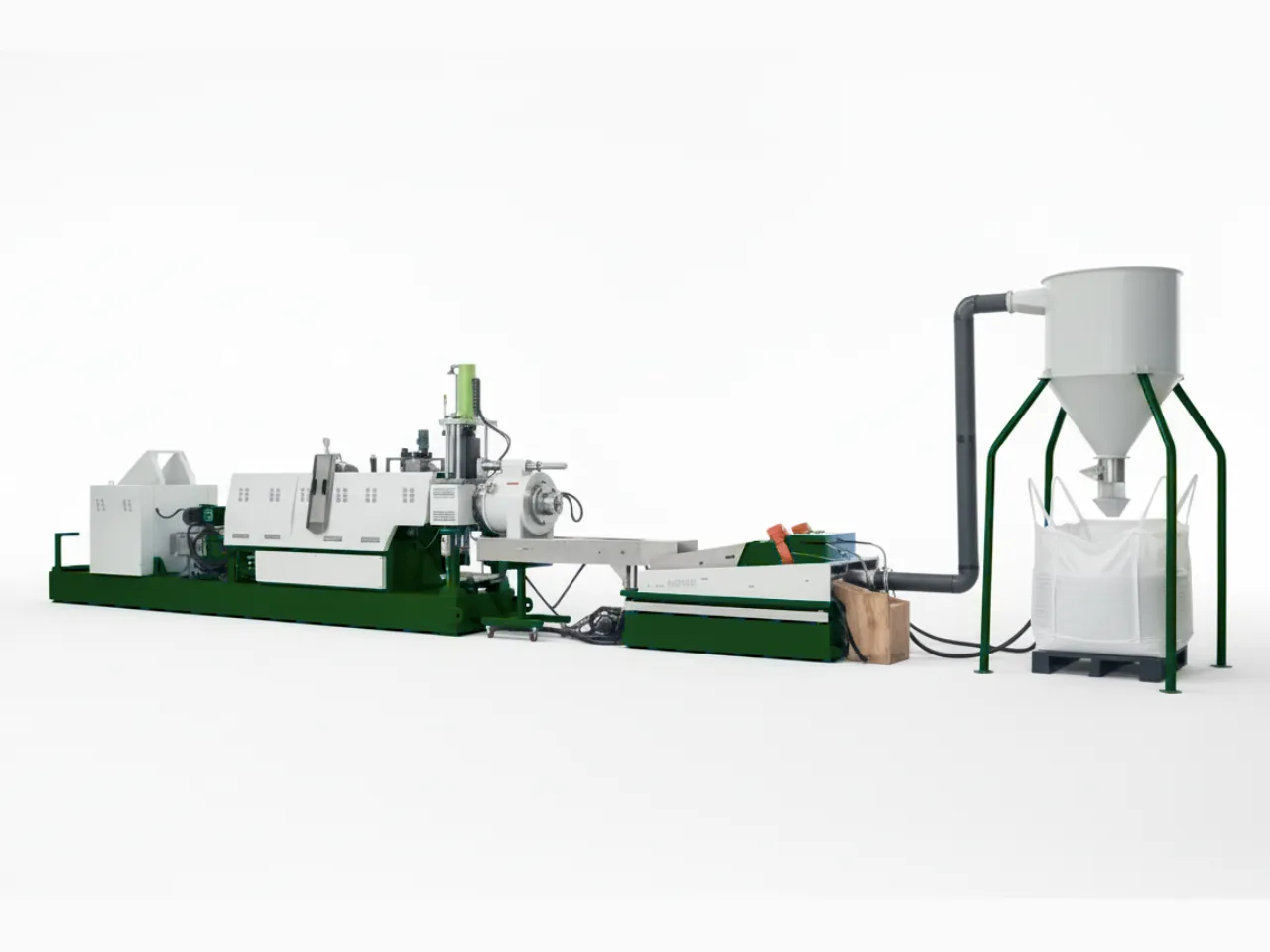
PET Bottle Flake Single Screw Pelletizing Line
A compactor-fed single-screw extruder line with 2-zone vacuum degassing and underwater pelletizing — converting washed PET bottle flakes into uniform rPET pellets at 300–1,200 kg/h while limiting intrinsic viscosity (IV) drop to ≤0.05 dL/g.
- Compactor pre-heats and densifies flakes for stable, consistent extruder feed.
- 2-zone vacuum degassing removes residual moisture and volatiles to preserve IV.
- Underwater pelletizing produces uniform 3–5 mm cylindrical pellets for fiber, sheet, and injection molding.
- 300–1,200 kg/h Output Range
- ≤0.05 dL/g IV Drop (Preserved Viscosity)
- 4-Stage Process: Compact → Extrude → Filter → Pelletize
- 1-Year Limited Warranty on Key Components
PET Flake Single-Screw Pelletizing Line Overview
Continuous production layout engineered specifically to protect PET polymer chains from moisture-induced degradation while delivering uniform pellet output.
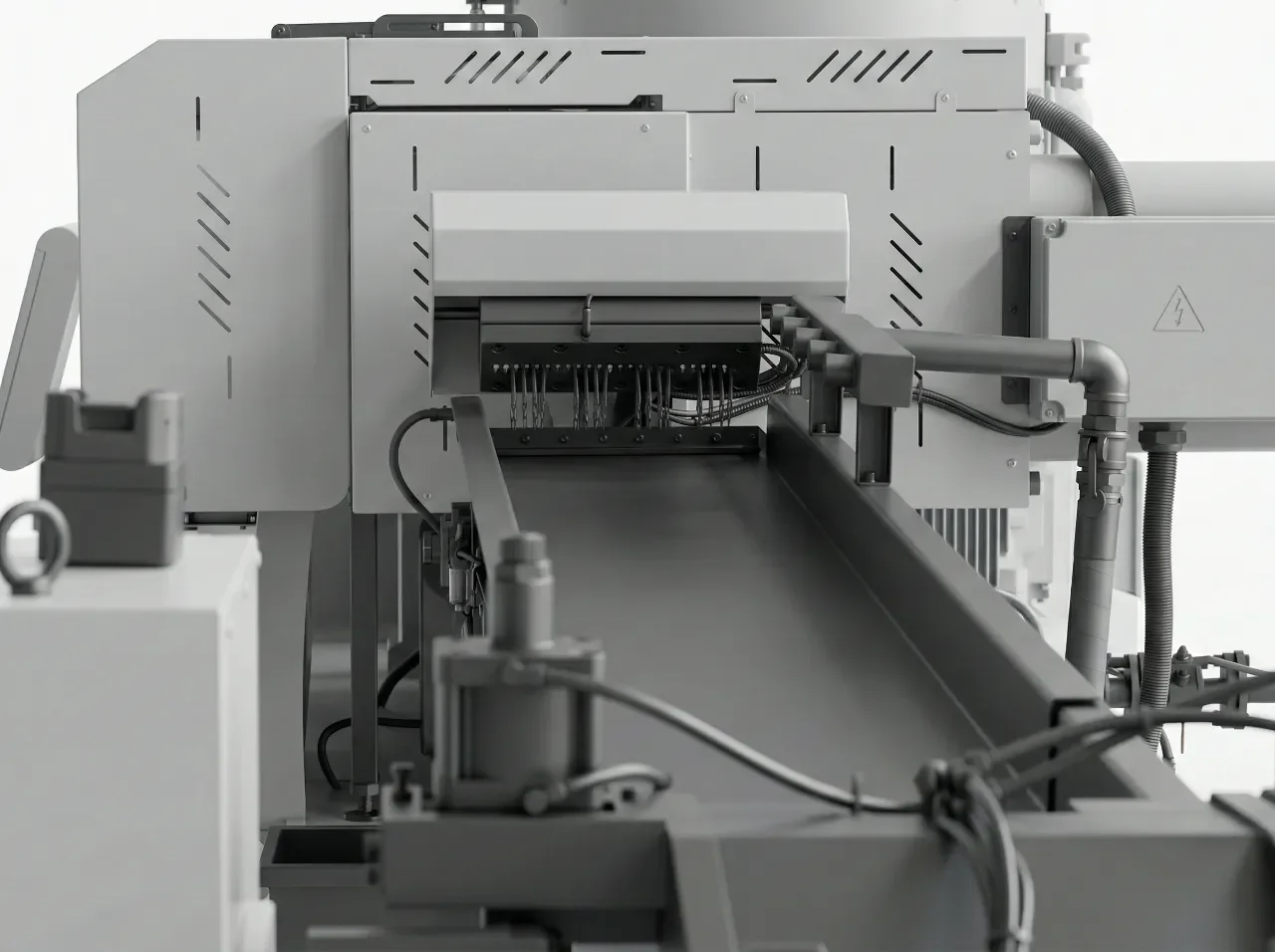
Complete Pelletizing Layout
The line integrates a compactor/pre-heater, single-screw extruder, 2-zone vacuum degassing, melt filtration, underwater pelletizing head, and centrifugal dryer in one continuous production layout. PET bottle flakes enter one end; dry, uniform rPET pellets exit the other.
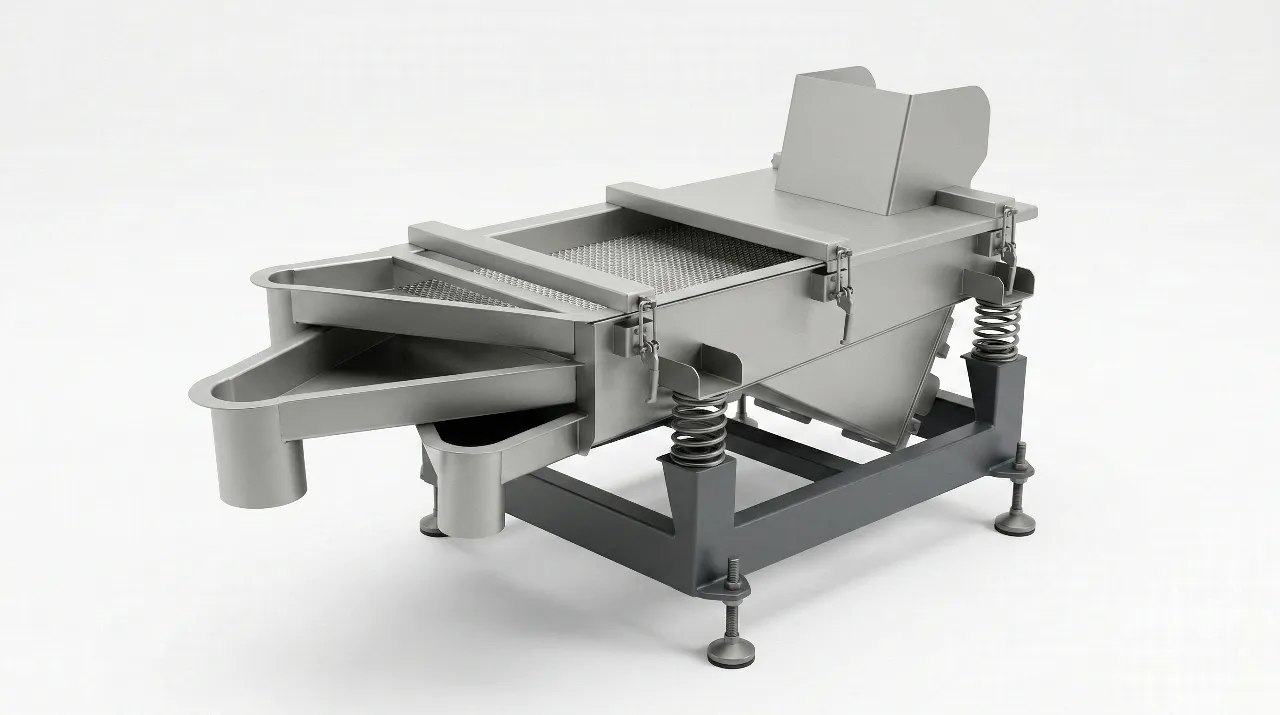
Underwater Pelletizing & Drying Sub-System
The underwater pelletizer cuts the melt into 3–5 mm cylindrical pellets, which are immediately quenched in circulating water to prevent agglomeration. A centrifugal dryer then removes surface moisture, and a vibration sieve separates fines before the pellets are conveyed for bagging.
Core Extruder Components & Vacuum Degassing
Each stage of the line is purpose-engineered for the specific thermal and rheological demands of recycled PET.
Compactor / Pre-Heater
Densifies loose PET flakes via friction heat, reducing bulk volume and expelling surface moisture before the material enters the extruder barrel. This critical step stabilises feed rate and enables consistent melt pressure.
Single-Screw Extruder (Nitride Steel)
A precision-ground nitride steel screw (L/D 30:1–36:1) melts and homogenises PET with controlled shear — low enough to limit chain degradation and IV loss. Operating temperature is typically 265–285 °C depending on melt quality.
2-Zone Vacuum Degassing
Two independent vacuum ports draw out residual moisture vapour, acetaldehyde, and other low-molecular-weight volatiles from the melt. Together with the compactor pre-drying, this limits IV drop to typically ≤0.05 dL/g.
Melt Filtration (Auto Screen-Changer)
A hydraulic automatic screen-changer (back-flush type) continuously removes solid contaminants from the melt stream without stopping production. Filter fineness is selectable (40–150 µm) depending on output purity requirements.
Underwater Pelletizing Head
The die-face cutter operates submerged, instantly quenching each strand into uniform 3–5 mm cylindrical pellets. Water-cooled pelletizing prevents deformation and agglomeration, yielding a consistent, dust-free product.
Centrifugal Dryer + Vibration Sieve
A centrifugal dryer removes surface water from pellets to <0.5% moisture. A downstream vibration sieve separates fines and oversize pieces before the on-spec pellets are conveyed to bulk-bag filling or silo storage.
PET Flake Extrusion & Pelletizing Principle
Our PET pelletizing line follows a precise multi-stage process to convert PET flakes into high-grade pellets.
-
Feeding & Moisture Removal
An automated system controls feeding speed, while a compactor removes moisture from the flakes.
-
Single Screw Extrusion
The PET material undergoes compacting, melting, and homogenization in the high-performance extruder.
-
Barrel Processing
The nitride steel barrel heats the plastic with precise temperature control for consistent melting.
-
Vacuum Degassing
This step removes low molecular weight materials and residual moisture from the melted PET.
-
Melt Filtration
A dedicated filtration stage improves the purity of the melted plastic before pelletizing.
-
Underwater Pelletizing
The underwater pelletizing system transforms the melted PET flakes into uniform, high-quality granules.
-
Drying & Bagging
Pellets are dried via a vibration sieve and centrifugal dryer, then bagged for distribution.
Single-Screw vs. Twin-Screw PET Extrusion Comparison
For standard PET bottle flake recycling, a single-screw extruder is the preferred choice. Here is how it compares.
| Factor | Single-Screw Extruder | Twin-Screw Extruder |
|---|---|---|
| Mechanical Shear | Lower shear stress on the melt — reduces risk of thermal and mechanical chain scission in PET. | Higher shear — advantageous for dispersive mixing but can accelerate IV degradation in PET if not carefully managed. |
| IV Preservation | Better suited for preserving intrinsic viscosity in standard rPET recycling applications. | Requires careful temperature and residence time control; more suitable when chain extenders are added to rebuild IV. |
| Compounding Capability | Limited — mainly for melting, degassing, and filtration of clean flakes. | Superior — preferred when adding fillers, colorants, flame retardants, or chain extenders to the melt. |
| Cost & Complexity | Lower capital cost, simpler mechanical design, easier operator maintenance. | Higher capital and operating cost; more complex screw geometry and wear parts. |
| Best Suited For | Standard post-consumer PET bottle flake → fiber, sheet, or injection molding pellets. | Reactive compounding, colour masterbatch incorporation, or specialty rPET alloys. |
If your process requires twin-screw compounding capability — such as adding chain extenders or colour masterbatch to the melt — see our twin-screw compounding line for comparison.
PET Flake Pelletizing Applications & Resins
The IV and purity of output pellets from this line meet the requirements for these four major end markets.
-
Polyester Fiber & Staple Fiber
IV range: 0.40–0.65 dL/g. rPET pellets from this line are widely used as feedstock for regenerated polyester staple fiber, used in textiles, non-wovens, and filling materials. This is the largest volume outlet for post-consumer rPET globally.
-
PET Sheet & Thermoforming
IV range: 0.70–0.85 dL/g. Suitable for A-PET or RPET packaging sheet used in food trays, blisters, and clamshells. The melt filtration stage in this line removes gel particles and impurities that would otherwise show as defects in transparent sheet.
-
Injection Molding
IV range: 0.72–0.85 dL/g. rPET pellets are suitable for injection molding of non-food containers, strapping, closures, and engineering parts. Consistent pellet geometry from underwater cutting ensures stable feed into injection moulding machines.
-
Bottle-Grade rPET (with SSP)
IV range: >0.80 dL/g. For food-contact bottle applications (bottle-to-bottle recycling), the pellets from this line can be directed to a downstream Solid State Polymerization (SSP) reactor to rebuild IV. This is the highest-value rPET outlet and requires IV ≥0.80 dL/g.
PET Flake Pelletizing Line Specifications
General line parameters. Exact configuration is specified per order based on feedstock quality and target output grade.
| Parameter | Specification |
|---|---|
| Applicable Material | Washed post-consumer PET bottle flakes, ≤14 mm |
| Input Moisture | ≤3% (w/w) recommended at infeed |
| Output Pellet Form | Cylindrical, 3–5 mm diameter |
| IV Preservation | Typical IV drop ≤0.05 dL/g (input IV 0.72–0.80 → output IV 0.68–0.76 dL/g) |
| Screw Diameter | 100 mm – 160 mm (varies by model) |
| L/D Ratio | 30:1 – 36:1 |
| Barrel Zones | 6–8 independently controlled temperature zones |
| Degassing System | 2-zone vacuum degassing (dual-port) |
| Melt Filtration | Hydraulic auto screen-changer (back-flush type); 40–150 µm selectable |
| Pelletizing Method | Underwater pelletizing |
| Control System | PLC + HMI colour touchscreen |
| Output Capacity Range | 300 – 1,200 kg/h |
Available Models & Output Capacities
| Model | Screw Diameter | Main Motor Power | Output (kg/h) |
|---|---|---|---|
| CT-100 | 100 mm | 90 kW | 300 |
| CT-130 | 130 mm | 132 kW | 600 |
| CT-140 | 140 mm | 160 kW | 900 |
| CT-160 | 160 mm | 250 kW | 1,200 |
Frequently Asked Questions
Pelletizing transforms washed PET flakes into uniform, dense granules (typically 3–5 mm). This standardised form unlocks higher-value downstream reuse — including polyester fiber spinning, PET sheet extrusion, and injection molding — where flake feedstock would not be directly usable. Pellets also flow more reliably through downstream processing equipment and are easier to transport and store than flakes.
PET is highly hygroscopic. Even 300–500 ppm of residual moisture in the melt triggers hydrolytic chain scission — breaking the long polymer chains and dropping the intrinsic viscosity (IV). A lower IV means weaker mechanical properties and reduced suitability for demanding applications. This line addresses moisture on two fronts: the compactor provides initial pre-drying and densification, and the 2-zone vacuum degassing system pulls residual vapours from the melt, keeping the typical IV drop to ≤0.05 dL/g.
Yes. The melt filtration system can be configured with different screen fineness (40–150 µm) and filter change mechanisms to suit the contamination level of your input stream. Post-industrial or well-sorted post-consumer flakes may use a standard screen pack, while heavily contaminated streams benefit from a hydraulic auto screen-changer (back-flush type) to maintain output rate without production stops.
Post-consumer PET bottle flakes typically enter the line at IV 0.72–0.80 dL/g. With proper compaction, vacuum degassing, and controlled barrel temperatures, the output pellets typically retain an IV of 0.68–0.76 dL/g. This meets the specification for polyester fiber (0.40–0.65 dL/g) and is at or near the threshold for PET sheet and injection molding grades (0.70–0.85 dL/g). For bottle-to-bottle grade requiring IV >0.80 dL/g, a downstream Solid State Polymerization (SSP) stage would be required.
A single-screw extruder applies lower mechanical shear to the melt, which better preserves IV in standard PET bottle flake recycling. Twin-screw extruders offer superior distributive mixing and are preferred when compounding additives (chain extenders, colorants, fillers) into the melt — but their higher shear and complexity add cost and risk of greater IV degradation for straightforward flake-to-pellet recycling. Most post-consumer PET pelletizing plants use a single-screw configuration for this reason.
Yes. Remote commissioning guidance and operator training are available for all lines. All machines ship with a 1-year limited warranty covering manufacturing defects on key mechanical and electrical components. Spare parts and ongoing technical support are available beyond the warranty period. Contact us to discuss your installation requirements.
Warranty & Global Installation Support
-
1-Year Limited Warranty
All machines include a one-year limited warranty covering manufacturing defects on key mechanical and electrical components, with spare parts and technical support available after the warranty period.
-
Configurable to Your Requirements
Line configuration — including screw diameter, filter type, degassing intensity, and pelletizing method — is specified per order based on your feedstock contamination level, required output capacity (kg/h), and target pellet grade (fiber, sheet, or injection molding).
-
Remote Commissioning & Training
Installation guidance, line commissioning support, and operator training are available to help you reach stable production output as quickly as possible.
-
Complete PET Recycling Line Integration
This pelletizing line is designed to work as the final stage of a complete PET bottle recycling system. View the full range of plastic pelletizing machines we offer to find the right configuration for your operation.
Get a PET Flake Pelletizing Line Quote
Contact us today to receive pricing, lead times, and a custom layout proposal for your PET pelletizing line.
