


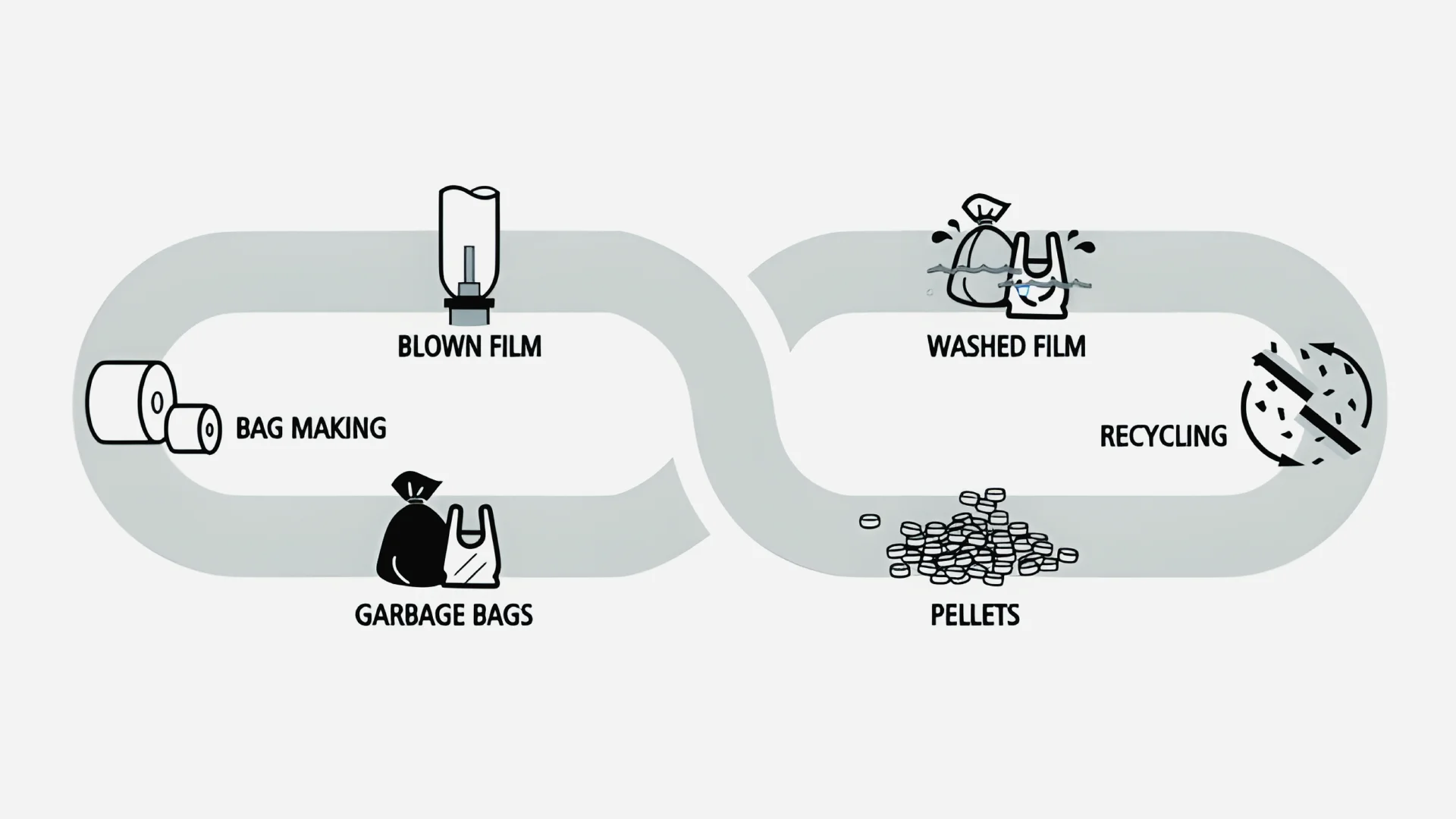
In-plant plastic recycling (also called in-house or post-industrial recycling, PIR) lets a manufacturer recover clean production scrap and return it to the process—instead of paying to store, haul, and dispose of it. For a stable, single-polymer waste stream, the result is usually lower virgin-resin purchases, less handling, and tighter control over recycled-material quality.
This guide is written for injection molders, extruders, film/bag converters, and pipe/profile plants—not for commercial recyclers buying mixed post-consumer bales. It covers which scrap is suitable, what equipment you need, how to estimate savings, and when an in-plant system beats tolling or selling scrap as waste.
For plant-level capital budgeting on full commercial lines, use the separate plastic recycling machine ROI analysis. To compare compact machines vs full lines, see small plastic recycling machine vs industrial line.
What Is In-Plant (Post-Industrial) Plastic Recycling?
In-plant recycling captures off-cuts, trimmings, start-up scrap, rejected parts, and other known production waste before it mixes with outside material. Scrap is sorted by polymer and color, reduced in size, and—where required—washed, dried, and pelletized. Recovered flakes or pellets are then blended back into an approved formulation or sold as a documented industrial stream.
That is different from post-consumer recycling: you already know the resin grade, additive package, and production history. Quality risk is lower—but only if you keep polymers, colors, and degraded material separate.
Which Production Scrap Is Suitable?
| Scrap type | Examples | Typical first process step |
|---|---|---|
| PE film & bags | LDPE/LLDPE/HDPE edge trim, film rolls, bag scrap | Shredder / cutter-compactor → pelletizing |
| PP raffia & woven | Draw tape, woven-bag off-cuts, nonwoven waste | Shred + densify/pelletize |
| Rigid production scrap | Runners, flash, pipe/profile off-cuts, rejected parts | Granulator / crusher → regrind |
| Clean off-spec product | Known resin grades, separable from metal/other polymers | Size reduction ± light wash |
Do not blend different polymers, incompatible additive packages, or heavily degraded start-up purge into a stream you plan to reuse in-spec. A clean, documented waste stream is far easier to reintroduce than mixed floor scrap.
Four Business Benefits of Recycling Production Scrap
1. Cut disposal, transport, and storage cost
Bulky scrap occupies floor space and creates repeated handling and hauling cost. Processing near the production line reduces outbound loads and the need to buy recycled material back from a third party.
2. Replace part of the virgin resin requirement
When product specs allow, verified regrind or pellets can be blended with virgin resin. The allowable percentage must come from trials, QC, and customer requirements—not from a generic “X% is fine” assumption.
3. Control recycled-material quality
You know the original resin, color masterbatch, and process history. That traceability makes color, moisture, contamination, and melt behavior easier to manage than when purchasing unknown mixed recyclate.
4. Support circularity and recycled-content reporting
Recovering manufacturing scrap keeps material in productive use and creates measurable data for waste-reduction and recycled-content targets. Surplus that meets a converter’s spec can also be sold.
What Equipment Does an In-Plant System Need?
Match the line to scrap form, contamination, moisture, peak kg/h, and the quality your process will accept.
| Waste condition | Typical equipment | Output |
|---|---|---|
| Clean rigid runners, parts, profiles | Granulator / crusher, metal protection, dust control | Size-controlled regrind |
| Clean film, raffia, woven bags | Shredder or cutter-compactor + pelletizing line | Reusable pellets |
| Dirty or printed film | Washing line, squeezer/dryer, pelletizing | Washed flakes or pellets |
| Large hollow / thick-wall rigid scrap | Shredder → crusher → optional wash | Uniform flakes |
Size the system from measured peak and average scrap rates—not only the nameplate output of the production machine. Leave space for safe feeding, buffer storage, dust control, and maintenance access.
A Simple In-Plant ROI Model
Start with annual recoverable scrap, then calculate value created and costs avoided:
Annual benefit = avoided virgin-resin purchases + avoided disposal/transport costs + sale value of surplus recyclate − annual power, labor, maintenance, and consumables.
Simple payback (years) = installed project cost ÷ annual benefit.
Use conservative recovery yields. Include sorting losses, screen changes, blades, filters, utilities, floor space, and quality testing. For a broader commercial-line framework, see the cost-benefit analysis guide.
Worked example (illustrative only)
| Assumption | Illustrative value |
|---|---|
| Recoverable production scrap | 180,000 kg/year |
| Net material value created | $0.30/kg → $54,000/year |
| Avoided hauling & disposal | $12,000/year |
| Power, labor, maintenance, consumables | −$24,000/year |
| Estimated annual benefit | $42,000/year |
| Installed project cost | $105,000 |
| Simple payback | 2.5 years |
Run at least three scenarios: conservative, expected, and high-utilization. If the project only works under the most optimistic resin price or uptime assumption, the risk is too high.
When In-Plant Recycling Makes Sense
- The plant generates a predictable volume of separable plastic scrap.
- Recovered material has a defined internal use or a reliable external buyer.
- QC can verify polymer, color, moisture, and contamination.
- There is space for safe feeding, storage, dust control, and maintenance.
- Projected savings remain attractive under conservative resin-price and utilization assumptions.
If volumes are irregular, polymers are mixed, or the finished product cannot tolerate recycled content, toll processing or a specialist recycler may be more economical.
RFQ Checklist: What to Send Before You Ask for a Quote
- Polymers, colors, and additive packages that must stay separate
- Average and peak scrap rates in kg/h (photos of piece size help)
- Contamination, printing, labels, oils, and moisture present
- Desired output: regrind for hopper blend, pellets for internal use, or sale
- Quality tests and maximum recycled-content % allowed in the finished product
- Available floor space, power supply, and operating hours
- Representative scrap samples for a trial run
FAQ
Does clean production scrap need washing?
Not always. Clean, single-polymer runners or edge trim may only need size reduction and metal protection. Printed, dusty, oily, or floor-contaminated material may need washing and drying.
Should in-plant scrap be reused as regrind or pellets?
Regrind is simpler when the process can feed it consistently. Pelletizing improves bulk density, mixing, and filtration—but adds capital, energy, and maintenance cost.
How should equipment capacity be selected?
Measure peak kg/h, bulk density, piece size, moisture, and operating hours. Ask the supplier to test representative scrap and state complete-line output—not only the crusher or extruder rating.
What is the biggest ROI mistake?
Using gross resin value while ignoring yield loss, labor, utilities, maintenance, screen changes, quality testing, and periods when the line is not fully utilized.
In-plant recycling vs buying a full recycling plant?
In-plant systems target your clean production scrap. A commercial plant is designed for mixed external feedstock, higher contamination, and saleable flake/pellet specs. Choose based on waste origin and end use—not only machine size.
Next Step
Planning an in-plant recycling project? Send material photos, polymer type, peak kg/h, and desired output for a line-level recommendation. Explore related equipment guides: plastic pelletizer selection, plastic granulator guide, and plastic recycling machine cost.
