


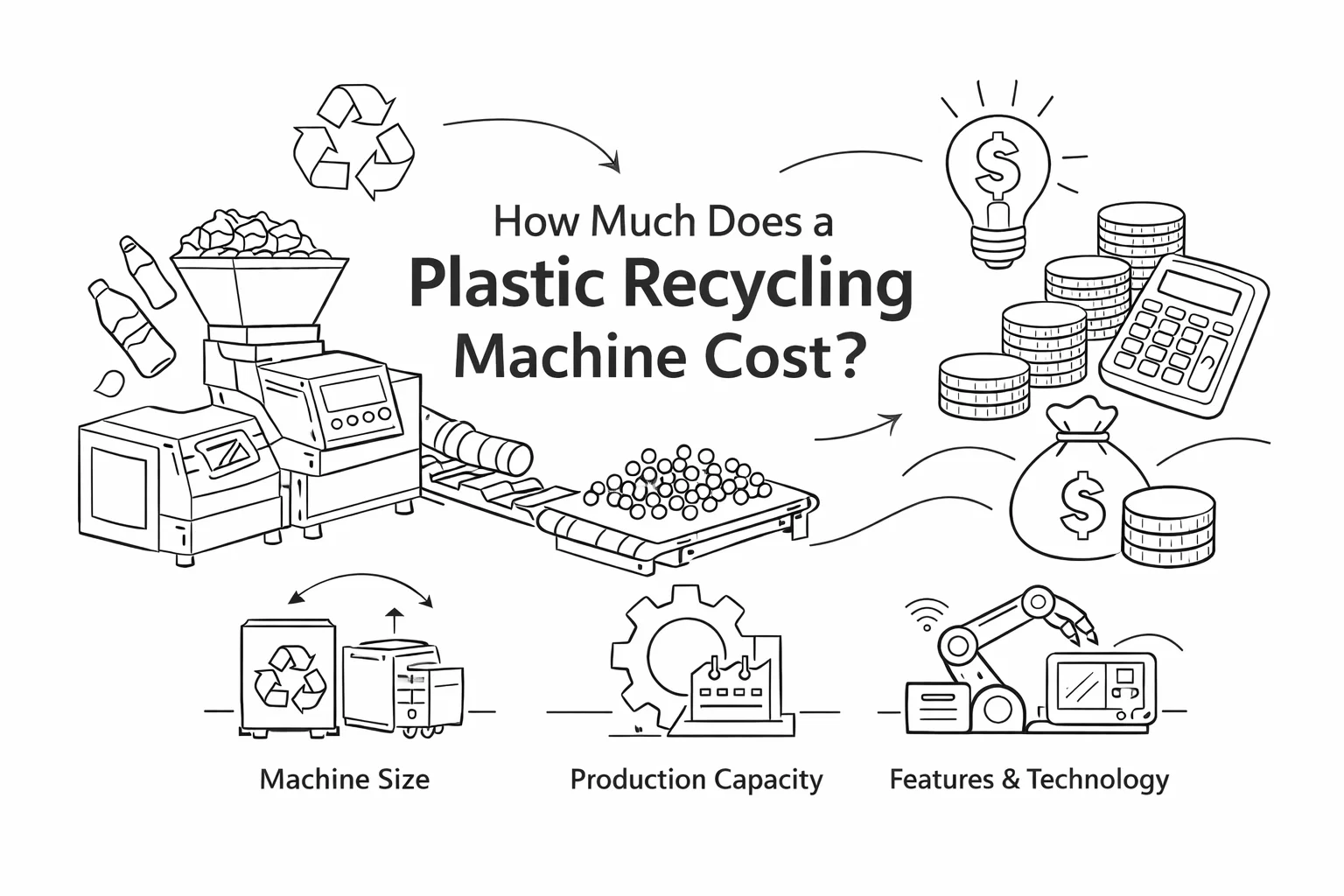
Wie viel kostet eine Kunststoffrecyclingmaschine im Jahr 2026?
Real price ranges, machine types, and budget planning tips—written from a manufacturer & project-implementation perspective.
Investing in plastic recycling equipment in 2026 is not just about “machine price.” The true investment depends on your material (rigid vs. film vs. PET), contamination level, target output (flakes or pellets), automation needs, and local power standards. This guide helps you budget accurately and avoid common purchasing mistakes.
What Determines the Cost of a Plastic Recycling Machine?
1) Machine Type (Process Stage)
- Size reduction: Kunststoff-Schredder, granulator
- Cleaning: Wäscheleine aus Kunststoff
- Pellet production: Kunststoffgranulieranlage
- Turnkey lines: Complete Recycling Solution
2) Capacity (kg/h) & Duty Level
- 200–300 kg/h: workshop scale
- 500–1,000 kg/h: mainstream industrial
- 2,000 kg/h+: plant scale (heavier frames & motors)
3) Automation & Control
- Manual/semi-auto: lower initial cost
- PLC + auto feeding + interlocks: higher investment, lower labor
- Stable output quality often improves ROI
4) Material Type & Contamination
- Rigid PP/HDPE: simpler processing, lower cost
- LDPE film/woven bags: needs enhanced drying/squeezing
- PET bottles: washing-intensive, higher system cost
Plastic Recycling Machine Price Ranges (2026)
These ranges reflect common industrial configurations in 2026. Exact pricing depends on your material, capacity, and required output.
Kunststoffzerkleinerer
| Aktenvernichtertyp | Typical Price Range (USD) | Am besten für |
|---|---|---|
| Small-scale shredders | $3,000 – $10,000 | Small workshops, clean scrap |
| Medium industrial shredders | $15,000 – $60,000 | General rigid plastics, moderate throughput |
| Heavy-duty shredders | $80,000 – $300,000+ | High-volume, bulky materials, demanding duty |
Related: Plastic Shredder models & configurations
Kunststoffgranulatoren
| Granulator Type | Typical Price Range (USD) | Am besten für |
|---|---|---|
| Entry-level granulators | $5,000 – $20,000 | Small-scale recycling, pre-shredded feedstock |
| Medium-capacity granulators | $20,000 – $80,000 | Industrial operations, consistent flake size |
| Large industrial granulators | $100,000 – $300,000 | Heavy-duty processing & high throughput |
Related: Plastic Granulator options
Wäscheleinen aus Kunststoff
| Washing Line Scale | Typical Price Range (USD) | Am besten für |
|---|---|---|
| Small washing lines | $20,000 – $60,000 | Light contamination, smaller volumes |
| Medium washing lines | $60,000 – $200,000 | Most PP/PE post-consumer materials |
| Large industrial washing lines | $250,000 – $1,000,000+ | High-capacity, heavily contaminated feedstock |
Related: PP/PE Plastic Washing Line solutions
Kunststoff-Pelletieranlagen
| Pelletiersystem | Typical Price Range (USD) | Am besten für |
|---|---|---|
| Small pelletizing machines | $10,000 – $30,000 | Lab / small business, basic pellet output |
| Medium pelletizing lines | $50,000 – $150,000 | Moderate production, stable quality targets |
| Industrial extrusion lines | $200,000 – $800,000+ | High-volume pellet production, automation-ready |
Related: Plastic Pelletizing Line configurations
Komplette Kunststoffrecyclinganlagen
| Plant Scale | Typical Price Range (USD) | Am besten für |
|---|---|---|
| Small plants | $80,000 – $200,000 | Clean industrial scrap, limited process steps |
| Medium plants | $250,000 – $1,000,000 | Most commercial recycling operations |
| Large industrial plants | $1,000,000 – $5,000,000+ | Turnkey, high throughput & complex materials |
Typical Investment Scenarios (Real-World Examples)
These project-level estimates help you budget beyond single-machine pricing.
| Scenario | Typical Capacity | Estimated Budget (USD) |
|---|---|---|
| PP/HDPE rigid recycling line | 500 kg/h | $100,000 – $180,000 |
| PET bottle washing + pelletizing line | 1,000 kg/h | $300,000 – $600,000 |
| LDPE film washing + pelletizing system | 500–800 kg/h | $200,000 – $450,000 |
| Turnkey recycling plant (full process) | Variiert | $500,000 – $3,000,000+ |
How to Budget Smart in 2026
Start with the material
- Rigid PP/HDPE: often starts with granulation
- Film/woven: needs enhanced drying and stable feeding
- PET bottles: washing is usually the biggest cost driver
Define the end product
- Flakes: simpler systems, lower investment
- Pellets: requires extrusion and pelletizing equipment
- Stable quality targets improve resale value & ROI
Right-size capacity
- Oversizing increases CAPEX and energy costs
- Undersizing bottlenecks output
- Balanced line design = stable operation
Choose a system, not just a machine
- Matching equipment prevents feeding/throughput issues
- Ask for process flow + layout + configuration list
- Turnkey planning reduces integration risk
FAQ
What is the cheapest way to start plastic recycling?
For clean industrial scrap, a starter setup using a shredder and/or granulator can often begin under $50,000, depending on capacity and material.
Can I recycle plastic without a washing line?
Yes—if the feedstock is clean factory scrap. Post-consumer plastics typically require washing and drying to reach acceptable output quality.
How long does it take to recover the investment?
Many recycling projects aim for a 12–36 month ROI, depending on local electricity/labor costs, throughput, and the market value of flakes or pellets.
Is buying used plastic recycling equipment worth it?
Used equipment can reduce upfront cost but may increase downtime, maintenance, and quality risks. For long-term stable production, new machines often provide better total value.
Does plastic type affect machine price?
Yes. Film, PET, and rigid plastics require different process steps (especially washing and drying), which can significantly change total investment.
