


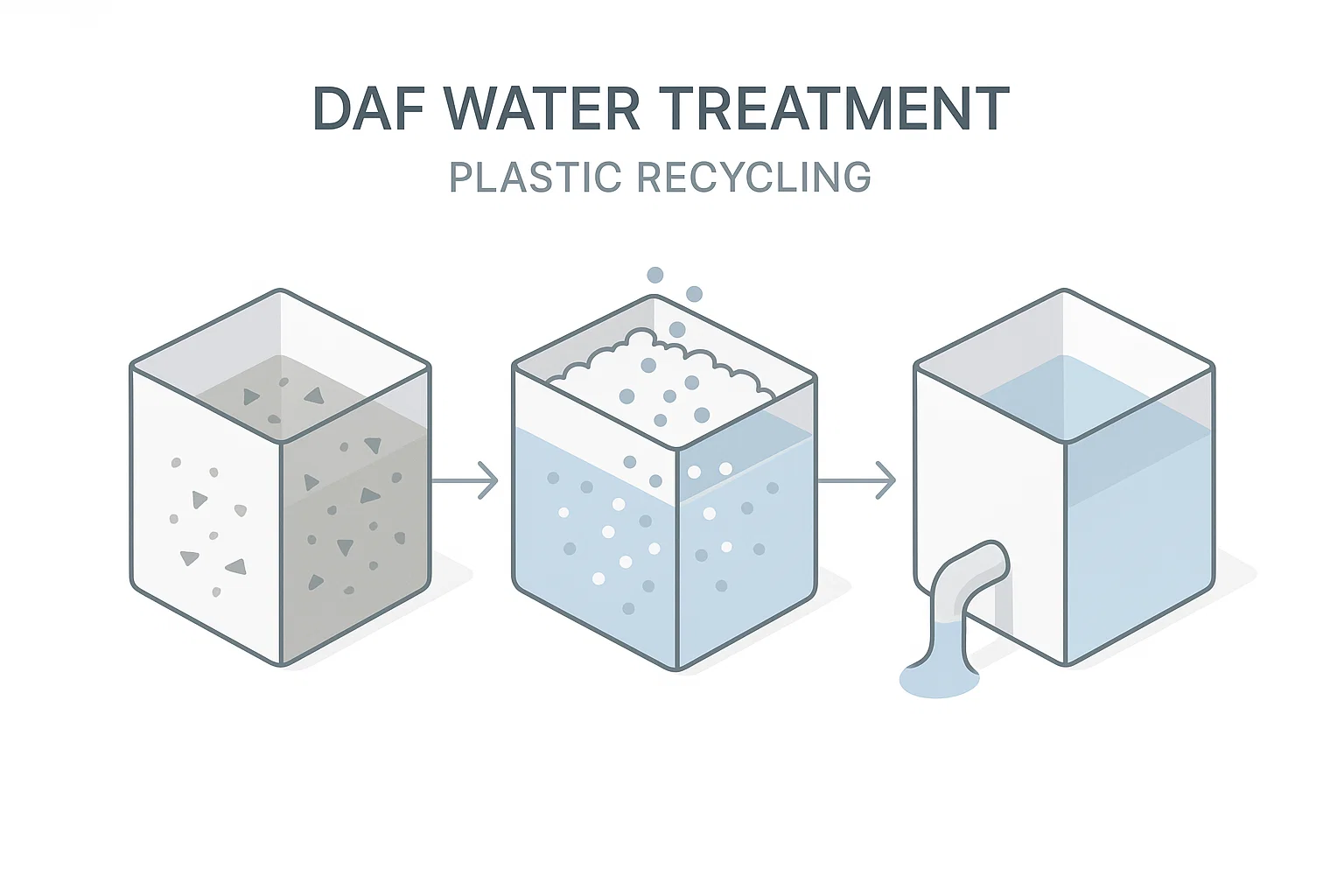
Water is the primary consumable in any washing plant. A standard 2,000 kg/h PET line consumes 4-5 tons of water per hour if not recirculated. Implementing a closed-loop water system using Dissolved Air Flotation (DAF) is a proven way to reduce consumption while maintaining the wash quality required for chemical cleaners.
At Rumtoo, we integrate DAF systems to target the three primary metrics of industrial wastewater: Suspended Solids (SS), Fats, Oils, and Greases (FOG), and Biochemical Oxygen Demand (BOD).
The Engineering Challenge: SS, FOG, and BOD
Wastewater from plastic recycling is not just “dirty”; it carries specific contaminants that defeat standard filtration.
1. Suspended Solids (SS): Micro-plastics and paper fibers (<50 microns) that pass through mechanical screen filters but cloud the water, reducing the efficacy of optical sorters.
2. FOG (Fats, Oils, Grease): Residues from food containers (polypropylene tubs, HDPE milk jugs). These hydrophobic elements coat the plastic flakes, preventing detergents from working.
3. BOD (Biological Oxygen Demand): Dissolved organics like sugars from soda bottles. High BOD leads to bacterial growth and foul odors in the water tanks.
How Rumtoo DAF Technology Works
Dissolved Air Flotation operates on a density differential principle. Unlike sedimentation tanks which rely on gravity (slow and large footprint), DAF uses micro-bubbles (30-50 microns) to float contaminants to the surface.
The 4-Stage Process
- Chemical Dosing: Treating the water with a coagulant (e.g., PAC) and flocculant (PAM) to bind fine particles into larger clusters called “flocs”.
- Micro-Bubble Injection: Water saturated with air at high pressure (5-7 bar) is released into the tank. The sudden pressure drop creates millions of micro-bubbles.
- Adhesion and Rise: Bubbles attach to the FOG and solid flocs, lowering their density below water. They rise rapidly to the surface.
- Skimming: A mechanical scraper removes the floating sludge blanket, while clarified water is drawn from the bottom for re-use in the Plastic Washing Line.
Performance Comparison: DAF vs. Sedimentation
For recycling plants, DAF is superior because plastic fines and oils naturally want to float, not sink.
| Metric | Sedimentation Tank | Dissolved Air Flotation |
|---|---|---|
| SS Removal | 40-60% | > 95% |
| FOG Removal | 50-70% | > 97% |
| Hydraulic Load | Low (Slow settling) | High (Rapid flotation) |
| Footprint | Large Area Required | Compact Design |
Conclusion
Installing a DAF System transforms wastewater from a disposal liability into a reusable asset. With the right chemical program and sizing, DAF can remove 90-95%+ of target contaminants, which can extend wash-water reuse cycles significantly and reduce chemical dosage costs and environmental discharge fees.
