


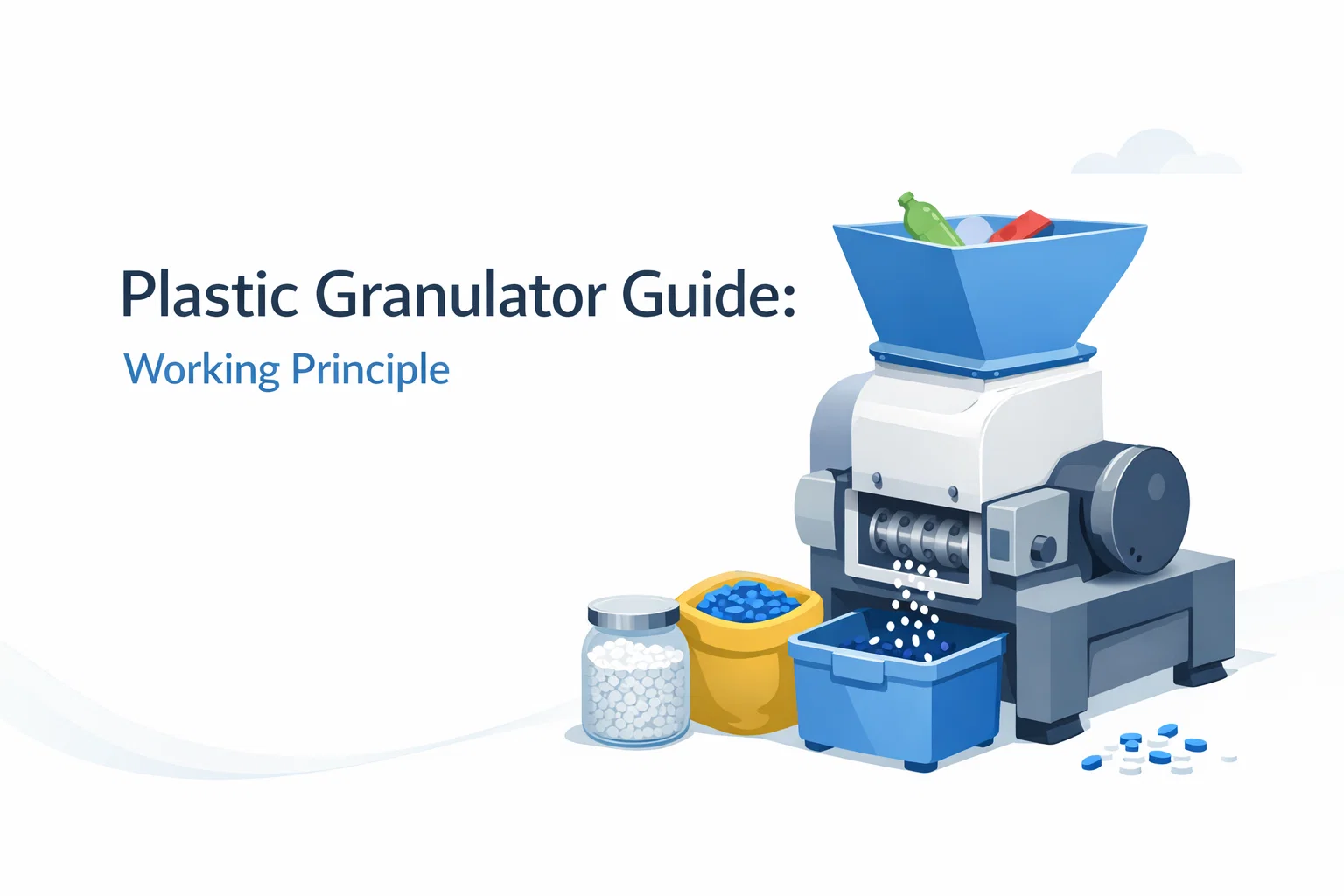
А пластиковый гранулятор is a precision machine used to turn plastic scrap into consistent regrind, typically in the 6-12 mm range. Crushers are used for rough primary reduction, while granulators are used for tighter particle control and cleaner cut quality. For injection molding, extrusion, and recycling plants, granulate quality directly affects processing stability and final product performance.
How a Plastic Granulator Works
A granulator uses a high-speed rotor (commonly 400-800 RPM) with rotating knives passing fixed bed knives in a scissor-like cutting action. Material is cut repeatedly until particles are small enough to pass through the screen below the rotor. This design supports uniform regrind, stable feeding, and lower uncontrolled tearing than bulk reduction equipment.
Rotor Types
- Open rotor: Better airflow and cooling, often preferred for heat-sensitive materials such as PP and HDPE.
- Solid rotor: Higher inertia for denser or thicker scrap such as purgings, runners, and heavy parts.
Screen Function
The screen controls final particle size distribution. Smaller screen holes improve size consistency but increase load and heat. Larger holes increase throughput but may reduce downstream consistency. Screen selection should be based on the next process step, not on granulator preference alone.
Key Specifications That Matter
- Throughput (kg/h): Match stable production demand, not only peak nameplate output.
- Rotor diameter and width: Affect bite, residence time, and effective hourly output.
- Knife geometry: V-cut, staggered, or claw designs should match feedstock shape and wall thickness.
- Motor power and torque reserve: Critical for startup under load and stable operation.
- Screen size range: Defines particle size and downstream feeding behavior.
- Maintenance access: Fast knife and screen access reduces changeover and cleaning downtime.
- Система безопасности: Interlocks, overload protection, and emergency stop integration are mandatory for industrial use.
Where Plastic Granulators Are Used (Industrial and Post-Consumer)
Plastic granulators are used across both manufacturing scrap recovery and post-consumer recycling. Typical use cases include:
1) In-Line Thermoforming Trim Recycling
Edge trim from sheet lines is continuously granulated and conveyed back to extrusion feed systems, supporting closed-loop production and lower virgin resin usage.
2) Injection Molding Runners and Sprues
Beside-the-press granulation allows immediate recovery of runners while keeping material grades separated, which helps maintain part consistency and reduces contamination risk.
3) Blow Molding Flash and Reject Parts
Flash, neck trims, and reject containers are granulated for controlled reuse according to approved blend ratios.
4) Pipe and Profile Extrusion Startup Scrap
Startup lengths, edge cuts, and off-spec profiles are granulated and reused in stable formulations, reducing startup waste losses.
5) Compounding and Masterbatch Off-Spec Material
Off-grade strands, lumps, and purge material can be granulated into manageable regrind for controlled recovery workflows.
6) Bottle and Rigid Packaging Recycling Lines
In plastic bottle recycling systems, granulators are used before or during washing stages to standardize flake size and improve downstream efficiency.
7) Post-Consumer Film and Rigid Reclaim Preparation
After pre-sorting, mixed films and rigid plastics are granulated to improve feeding stability for washing, drying, and pelletizing sections.
How to Select the Right Granulator
- Define feedstock profile: Film, rigid parts, thick lumps, filled plastics, or mixed stream.
- Set output target: Particle size range, fines limit, and downstream process requirements.
- Balance line throughput: Granulator output should align with real upstream scrap generation and downstream consumption.
- Confirm duty cycle: Intermittent operation and 24/7 production require different thermal and mechanical margins.
- Check maintenance plan: Knife change method, setting repeatability, spare part lead time, and service support.
- Validate trial performance: Ask for feedstock-based test data, not only catalog values.
Maximizing Blade Life and Regrind Quality
- Blade material: D2 is common for standard plastics; abrasive compounds may require carbide solutions.
- Knife gap control: Typical precision range is around 0.2-0.3 mm, depending on design and material.
- Contaminant protection: Use upstream metal separation or detection to prevent blade damage.
- Sharpening discipline: Dull knives increase dust, heat, and energy use.
- Stable feeding: Avoid overfeeding and slug loading to reduce vibration and wear.
- Routine inspection: Track knife wear pattern, rotor balance, and bearing condition to prevent unplanned downtime.
Common Mistakes to Avoid
- Choosing by purchase price only without checking knife system, access design, and duty rating.
- Selecting very fine screens without considering heat generation and power draw.
- Ignoring maintenance labor, spare strategy, and knife-setting repeatability.
- Running incompatible feedstocks on one setup without changeover controls.
- Comparing machine offers without aligning scope, testing conditions, and service boundary.
Часто задаваемые вопросы
What is the difference between a crusher and a plastic granulator?
A crusher is typically used for rough primary reduction. A granulator is used for controlled, uniform regrind suitable for stable reprocessing.
What particle size does a granulator usually produce?
A common range is about 6-12 mm, depending on screen size, knife condition, and polymer behavior.
What rotor speed is common in industrial granulators?
Many units operate in the 400-800 RPM range. Optimal speed depends on material sensitivity, target size, and throughput.
How should I choose screen size?
Choose based on downstream process needs. Smaller holes improve uniformity but increase load and heat; larger holes improve throughput.
Why is knife gap important?
If gap is too large, material tears instead of shears, which increases dust, heat, and quality instability.
Can granulators process glass-filled plastics?
Yes, but abrasive materials require upgraded knife strategy, stronger wear management, and stricter preventive maintenance.
Заключение
A plastic granulator is a material recovery asset, not only waste-handling equipment. The right machine improves regrind consistency, lowers raw material loss, and supports stable plant economics. Selection should be based on feedstock behavior, throughput reality, maintenance capability, and verified test performance.
