


Most useful plastic granulator innovations change how the machine grips, cuts, sizes and contains a specific feed. A quieter enclosure, a more efficient motor or a sensor package can help, but only if the cutting chamber, screen, feed method and duty cycle already match the plastic. Marketing language about a revolutionary granulator is not a specification.
This article explains which design changes are worth checking on a new machine or an upgrade. It is not a purchasing checklist and it does not replace a maintenance program. For model selection, use the plastic granulator buying guide. For daily care, see the granulator maintenance guide.
What a Plastic Granulator Actually Changes
In recycling plants, a plastic granulator is a high-speed size-reduction machine. Open or scissor-cut knives on a rotor work against one or more bed knives, and a screen or grate controls the leaving particle size. The output is usually flake or regrind, not finished pellets.
That distinction matters because a granulator cannot correct dirty film, mixed polymers or wet organics by itself. It changes particle size, bulk density, surface area and how the next stage can wash, dry, convey or melt the material. If the feed is wrong for the rotor, screen or hopper, later “smart” features do not recover the process.
- Rigid bottles, crates, thick-wall parts and pipe offcuts
- Injection or blow-molding sprues, runners and rejected parts
- Washed PET, HDPE or PP flakes that need a second size cut
- Selected film, raffia or fiber only when the hopper, rotor and screen are built for flexible material
Compare the cutting action with a shredder versus crusher comparison before treating every size-reduction machine as interchangeable. A low-speed shredder is usually the first stage for bulky or contaminated parts. A granulator is the machine that produces a controlled flake size.
Separate Size Reduction From Pelletizing
Suppliers sometimes use “granulator” for both a crusher and a pelletizing line. The two machines do different work. The granulator cuts solid plastic. A pelletizer melts, filters and reforms plastic into pellets. Mixing the two leads buyers to expect a quieter motor or a sensor kit to raise pellet quality, which it cannot do.
| Machine | Main Change to the Plastic | Typical Output | What Innovation Should Improve |
|---|---|---|---|
| Shredder | Coarse size reduction and feed opening for bulky parts | Strips or coarse pieces | Grip, torque, anti-wrap behavior and safe feeding |
| Granulator or crusher | High-speed cutting to a target flake size | Regrind or flake | Cut quality, screen control, heat, dust, noise and knife life |
| Wet granulator | Size reduction with process water in the chamber | Wetted flake | Dust suppression, pre-wash and reduced heat on selected feeds |
| Pelletizing line | Melting, filtration and pellet forming | Pellets | Melt quality, filtration, pellet shape and energy per kilogram of melt |
If the project already has washed flake and the question is pellet quality, look at the pelletizing line rather than the granulator cabinet. If the problem is oversize pieces, long film tails, dusty fines or high recut heat, the granulator design is the right place to start.
Cutting Chamber and Rotor Changes That Matter
The cutting chamber is where most real performance is won or lost. Useful design work usually changes knife geometry, rotor style, gap control or how material is presented to the knives. These details decide whether the machine shears plastic or hammers it until the screen finally lets pieces through.
- Rotor style: open, closed, staggered, chevron or helical rotors change how material is pulled in and how many cuts occur per revolution.
- Knife count and mounting: more knives can reduce the work per cut, but only if the motor, screen and feed rate are matched.
- Gap setting: a repeatable rotor-to-bed-knife gap is more important than a brochure blade alloy.
- Chamber access: a rotor that can be reached, locked and measured will be maintained; a sealed “advanced” chamber often will not.
- Wear parts: replaceable wear plates, reversible knives and documented torque values reduce the cost of keeping the geometry correct.
Helical or staggered rotors can lower peak noise and spread the cutting load. They do not automatically cut every plastic more efficiently. Flexible film can wrap a rotor that works well on rigid flake. Thick-wall HDPE can stall a chamber that was tuned for thin PET preforms. Ask for a test with the actual part thickness, not a generic “mixed plastic” sample.
For the knife itself, the steel grade matters less than whether the edge can be resharpened, reset and kept in the correct gap. Our recycling machine blade range and the automatic knife grinder are relevant only after the rotor and chamber design are suitable.
Screen, Airflow and Flake-Size Control
The screen or classification grate is the main size-control device. A smaller hole does not simply make a finer, cleaner flake. It increases residence time, recutting, heat, fines and specific energy. A larger hole raises throughput and can leave long tails that jam washers, dryers or feeders.
- Screen hole size, open area and hole pattern
- How quickly the screen can be changed and inspected
- Whether oversize pieces recirculate or escape around worn seats
- Evacuation by gravity, blower, conveyor or water flow
- Separation of fines, dust and film tails after the granulator
Air evacuation can reduce chamber heat and help move light flake. It also moves dust. If the plant has no filter, cyclone or return path, a stronger fan is not an improvement. Check the complete air balance: hopper extraction, chamber evacuation, filter loading and the point where flake is discharged.
Noise Control That Can Be Measured
Granulators are noisy because cutting, impact and air movement happen at high speed. A useful noise claim is a measured sound-pressure or sound-power value at a stated distance, feed, screen size and room condition. “Quiet design” without those conditions is not comparable between suppliers.
| Design Change | What It Can Improve | What to Verify |
|---|---|---|
| Acoustic enclosure or hopper hood | Contains airborne noise around the chamber | Access for knife changes, heat build-up, interlocks and measured dB(A) at operator positions |
| Staggered or helical rotor | Can lower peak impact and tone | Feed behavior on the actual plastic, vibration and whether throughput stays acceptable |
| Isolation pads and rigid base | Reduces structure-borne noise into the floor | Foundation, hopper connections and downstream chutes that can re-radiate noise |
| Feed control | Prevents slam-loading that creates noise spikes | Metering conveyor, hopper geometry and anti-flyback design |
Enclosures help only if operators can still open, clean and lock out the machine. A quieter cabinet that adds 40 minutes to a knife change will be left open. Measure noise during a representative feed, not while the rotor is running empty.
Energy Use Depends on Feed and Duty Cycle
A high-efficiency motor can reduce electrical losses. It does not fix a chamber that recuts flake too many times or a hopper that lets the rotor run on slugs of thick parts. Compare energy as kilowatt-hours per processed tonne at a stated screen size, moisture and bulk density. Nameplate kilowatts are not the same as process energy.
- Empty running load versus loaded current
- How often the machine idles between batches
- Whether a feed conveyor or ram prevents overfilling
- Screen size and the share of fines that were recut
- Start-up method, soft starter or drive, and expected starts per hour
Variable-frequency drives can help when feed rate changes through a shift. They are not automatically useful on a machine that must keep a minimum cutting speed to produce a clean flake. Ask the supplier which speed range still gives an acceptable cut on the trial material.
Wet Granulation and Dust Control
A wet granulator adds process water to the cutting chamber. On selected rigid plastics, water can limit dust, carry heat away and give the flake a first rinse before a washing line. It is not a complete washing process and it is not the default choice for every plant.
Water also adds effluent, corrosion, bearing-protection and downstream dewatering work. If the plant already has a dry dust collector and the feed is clean, closed-loop dry granulation may be simpler. If the feed is dirty PET or HDPE bottles heading into a wash line, a wet plastic crusher can be the better chamber design. Keep that comparison on the dedicated dry versus wet granulator page.
Dust control is part of the machine design, not an accessory to add later. Look at hopper extraction, chamber seals, screen-seat leakage, discharge connections and the filter or wet-capture method. Fine PET and brittle plastics can create airborne dust even when the brochure photograph looks clean.
Sensors and Condition Monitoring
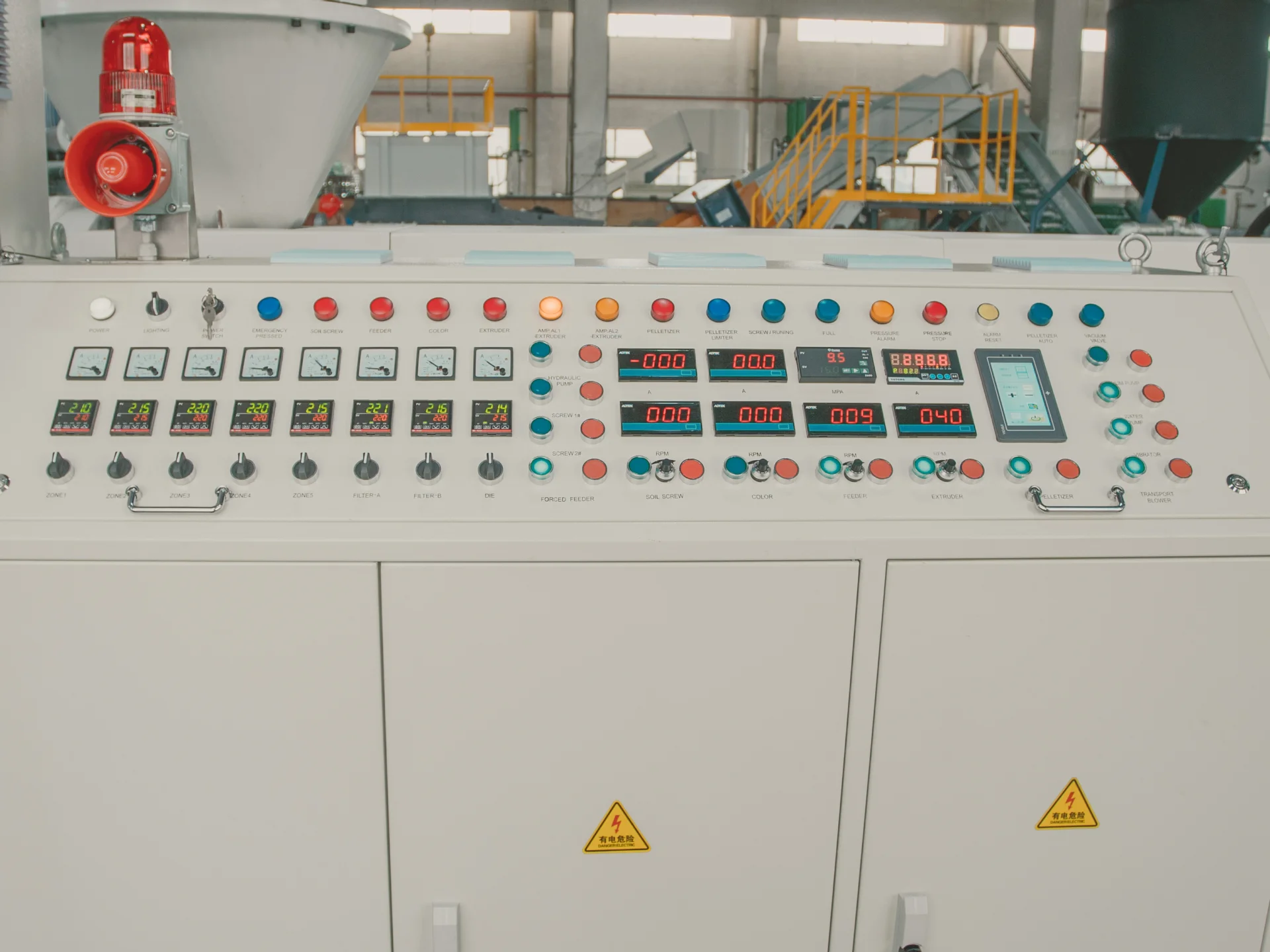
Sensors are useful when they change an operating decision. Bearing temperature, motor current, vibration, hopper level and emergency-stop status can prevent a seizure or an unnoticed overload. Remote dashboards, unused alarms and generic “IoT ready” labels do not.
- Which measurement is recorded, at what interval, and who receives the alarm
- Whether the signal is local on the panel or needs a plant network
- The action the operator is expected to take
- How the system behaves if the sensor or network fails
- Whether knife-gap, screen condition and feed quality are still inspected by people
Predictive maintenance is only as good as the failure mode being watched. A current spike can show a jam. It will not show a dull knife as clearly as a flake-size check and a gap measurement. Use sensors to support, not replace, the inspection and sharpening routine.
How to Test a Supplier’s Innovation Claim
A design change is worth buying when it can be seen in a trial. Ask for a witnessed test on the actual plastic, or on the closest available equivalent, and record the conditions with the result.
| Claim | Minimum Trial Record | Acceptance Check |
|---|---|---|
| Higher throughput | Feed type, part size, screen hole, bulk density, moisture and operating minutes | Stable kg/h without overload, flyback or screen blinding |
| Better flake quality | Screen size, knife gap, rotor style and evacuation method | Target size, fines share, long tails and heat discoloration |
| Lower noise | Measurement position, enclosure status and feed condition | dB(A) at operator stations during loaded running |
| Lower energy use | Loaded kWh, idle time and processed mass | kWh/t versus the current machine on the same feed |
| Longer knife life | Plastic type, contamination, gap and sharpening method | Hours or tonnes between sharpening while flake quality stays inside spec |
| Smarter monitoring | Sensor list, alarm setpoints and network requirements | A documented action for each alarm and a fallback if the system is offline |
Do not accept a clean, dry, pre-sorted sample as proof for dirty post-consumer material. If the plant needs a first-stage shredder, include that machine in the trial. A single-shaft shredder for rigid plastics or an integrated shredder-crusher may be the actual process change, with the granulator only finishing the flake.
When an Upgrade Is Not the First Step
Some plants do not need a new rotor or enclosure. They need the current machine set correctly. Check knife sharpness, gap, screen wear, hopper bridging, uneven feeding and blocked evacuation before buying another “generation” of the same chamber.
- Replace or rotate worn screens and confirm they seat without bypass
- Reset knife gaps after every sharpening
- Stop slam-feeding bulky parts that the hopper cannot meter
- Remove metal and grit that destroy edges in a few hours
- Match screen size to the next washing, drying or extrusion step
- Use a heavier heavy-duty plastic crusher only when the current chamber is mechanically undersized
A plant that already has a suitable plastic crusher platform should treat innovation as a measured change to that platform, not a reason to replace every machine at once.
Granulator Innovation RFQ Checklist
- Plastic type, thickness, moisture, contamination and prohibited items
- Current particle-size problem: oversize, fines, tails, heat or dust
- Required flake size and the next process that receives it
- Average and peak kg/h, batch or continuous duty, and hours per shift
- Dry or wet chamber, water source and effluent limit if wet
- Noise limit at stated operator positions
- Available power, foundation, hopper height and discharge method
- Knife, screen and wear-part access time
- Sensors, alarms and the plant network that will use them
- Witnessed trial protocol and the records the supplier must provide
Frequently Asked Questions
No. A granulator cuts solid plastic into flake or regrind. A pelletizer melts and reforms plastic into pellets. Chamber, knife and screen changes affect flake size and handling; they do not replace filtration or melt control.
Not on every feed. A staggered or helical rotor can spread the cutting load and lower peak noise, but film wrap, thick parts or the wrong screen can erase the gain. Compare loaded noise and kWh/t on the actual plastic.
An enclosure can reduce airborne noise if it stays closed and the feed and discharge openings are treated. Measure dB(A) at operator positions during loaded running, and check that knife and screen access still allows normal maintenance.
No. Motor efficiency is only one loss. Recutting, idle time, slam feeding and a too-fine screen often dominate energy use. Compare kilowatt-hours per tonne at the required flake size.
It can help on selected rigid plastics when dust, chamber heat or a first rinse matter before washing. It adds water handling and is not a substitute for a washing line. Confirm effluent, corrosion protection and downstream dewatering before choosing it.
Send plastic type and thickness, contamination, current flake-size problem, required output size, hourly capacity, dry or wet preference, noise or dust limits, available power, and photos or a short video of the existing hopper and discharge.
Request a Granulator Review
Send the plastic type, current flake-size problem, required output, capacity, noise or dust limits, and whether the chamber should run dry or wet. Rumtoo can review whether a rotor, screen, enclosure or two-stage layout is the change that actually helps.
