


Choosing the right plastic mixer for industrial processing affects extrusion stability, color consistency, additive dispersion, energy use, and the life of downstream equipment. Poor mixing can create streaks, weak mechanical properties, unstable melt flow, and unnecessary scrap—especially when recycled flakes, powders, color masterbatch, or soft compounds are involved.
This guide compares the six most common industrial plastic mixers: vertical silo mixers, horizontal ribbon mixers, high-speed mixers, non-destructive homogenizing mixers, drum-type mixers, and small masterbatch mixers. Use it as a practical selection guide for recycling, compounding, extrusion, injection molding, and color-matching operations.
Quick answer: Vertical silo mixers are best for large batches of pellets or recycled flakes; ribbon mixers are best for powders, additives, and granule blends; high-speed mixers are best for PVC and powder-rich recipes; homogenizing mixers protect soft or shear-sensitive materials; drum mixers suit lab trials; and small masterbatch mixers are useful for quick color changes.
Plastic Mixer Types at a Glance
| Mixer type | Best for | Typical capacity | Main advantage | Main limitation |
|---|---|---|---|---|
| Vertical silo mixer | Recycled flakes, pellets, large-volume granule blending | 500L–20,000L | High capacity with low labor cost | Not ideal for powders or sticky soft materials |
| Horizontal ribbon mixer | Powders, additives, pellets, color masterbatch | 500L–5,000L | Excellent dispersion with moderate shear | Needs proper seal and blade maintenance |
| High-speed mixer | PVC compounds, stabilizers, powder-rich recipes | 50L–1,000L | Fast blending and frictional heating | Higher energy use and stricter safety control |
| Homogenizing mixer | TPE, TPU, EVA, transparent blends, low-shear compounding | 300L–5,000L | Gentle mixing with less material damage | Slower than high-speed mixing |
| Drum-type mixer | Samples, short-run color trials, simple pellet blending | 50L–300L | Simple structure and easy cleaning | Low efficiency for production loads |
| Small masterbatch mixer | Quick color change, low-volume masterbatch testing | 150L–300L | Compact, economical, fast setup | Not designed for large production batches |
1. Vertical Silo Mixers for Pellets and Recycled Flakes
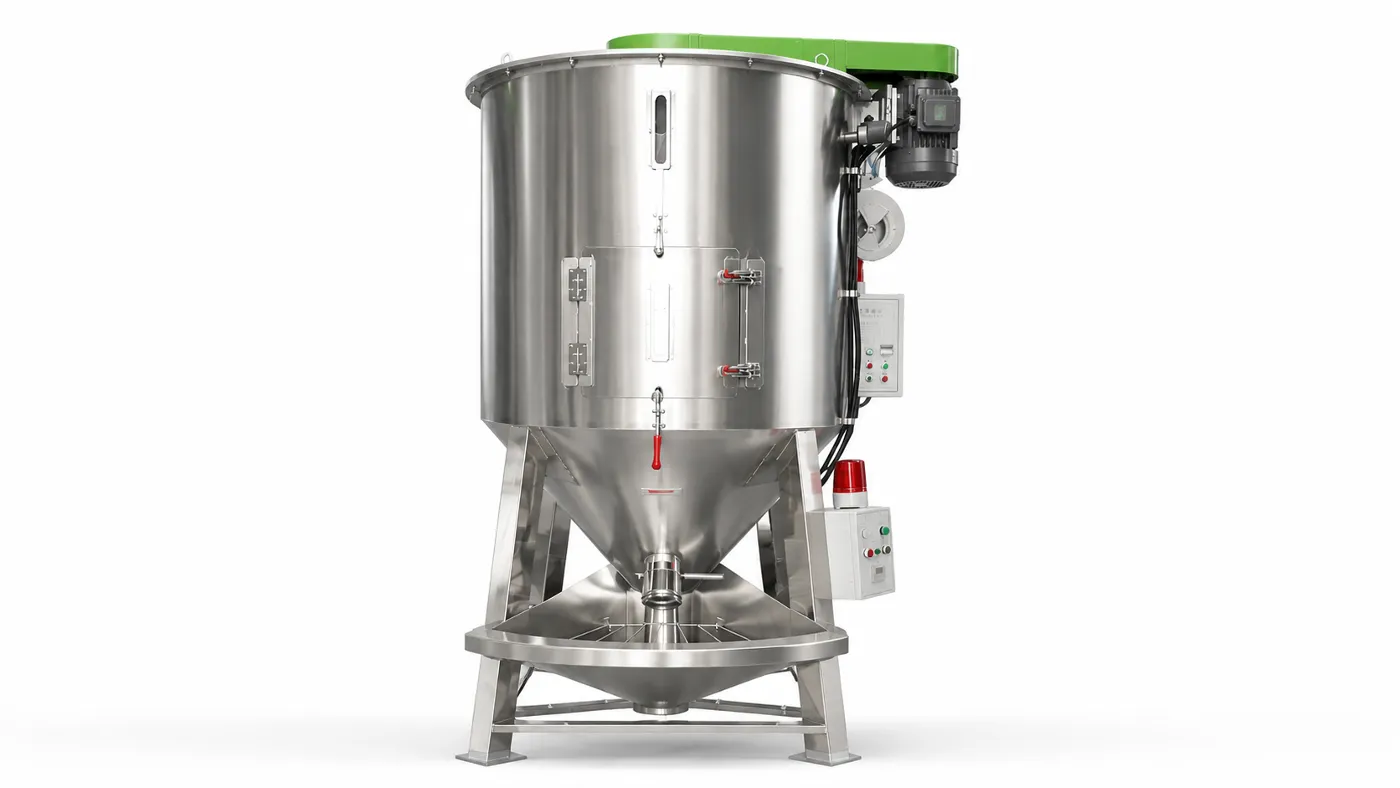
Vertical silo mixers use a screw or spiral circulation path to lift material upward and allow it to fall back through the silo. This repeated circulation creates a practical bulk blend for plastic pellets, regrind, and washed recycled flakes.
For production-scale vertical blending and drying, see Rumtoo’s Vertical Mixing Machine, which is suitable for mixing plastic granules, flakes, color masterbatch, and recycled materials before extrusion or molding.
- Use for: PE/PP pellets, PET flakes, washed regrind, large storage-and-mixing systems.
- Avoid when: the recipe contains heavy powder, sticky TPE, high dust content, or materials that bridge easily.
- Selection tip: match the silo volume to real batch size instead of daily output; overfilling reduces circulation efficiency.
2. Horizontal Ribbon Mixers for Powders, Additives, and Masterbatch
Horizontal ribbon mixers use inner and outer spiral blades to move material in opposite directions. They are one of the most versatile choices for plastic processing because they can blend granules, powders, fillers, stabilizers, pigments, and color masterbatch without excessive heat buildup.
For plants that process powder-plus-pellet recipes, a ribbon mixer is usually safer than a vertical silo mixer because powders do not rely on free gravitational flow. It is also easier to clean between color changes if the machine has large top or side access doors.
3. High-Speed Mixers for PVC and Powder-Rich Formulas
High-speed mixers generate strong vortex flow, friction, and shear. They are commonly used for PVC dry blends, stabilizer packages, calcium carbonate-filled recipes, and other powder-rich compounds that need fast dispersion before extrusion or pelletizing.
- Check motor load and temperature during every cycle.
- Use cooling or jacketed designs when processing heat-sensitive formulations.
- Never open the lid before the rotor stops completely; high-speed mixers require strict interlock and PPE procedures.
4. Non-Destructive Homogenizing Mixers for Soft or Sensitive Plastics
Non-destructive homogenizing mixers are designed for gentle rolling and circulation. They reduce air pockets and minimize shear damage, making them useful for soft TPE, TPU, EVA, transparent materials, and materials that lose performance when aggressively mixed.
If soft material looks mixed in a silo but later shows bubbles or streaks during extrusion, the issue may be poor low-shear homogenization rather than the extruder itself.
5. Drum-Type Mixers for Lab Trials and Small Batches
Drum-type mixers tumble material slowly in a rotating barrel. They are simple, low-cost, and easy to clean, but their mixing energy is limited. Use them for laboratory trials, color sampling, and short-run tests—not for high-volume industrial production where uniformity must be tightly controlled.
6. Small Masterbatch Mixers for Quick Color Change
Small masterbatch mixers are compact units used for quick pigment or masterbatch blending. They are useful near injection molding machines, small extrusion lines, or trial production areas where operators need fast recipe changes with minimal downtime.
How to Match a Plastic Mixer to Your Material
| Material or recipe | Recommended mixer | Why it works | Avoid |
|---|---|---|---|
| Powder + granules | Horizontal ribbon mixer | Strong powder dispersion without excessive heat | Vertical silo mixer |
| PVC dry blend | High-speed mixer | Rapid stabilizer and filler dispersion | Uncooled high-speed operation |
| Soft TPE / TPU / EVA | Homogenizing mixer or ribbon mixer | Low-shear circulation protects material structure | Aggressive high-speed mixing |
| Color masterbatch | Ribbon mixer or small masterbatch mixer | Uniform pigment distribution and easy cleaning | Basic drum mixing for production batches |
| Recycled flakes | Vertical silo mixer | Large-capacity circulation for flakes and regrind | Powder-heavy or sticky feedstock |
| Flame-retardant compounds | Ribbon mixer or high-speed mixer | Even additive distribution and controlled cycle time | Overmixing that creates hotspots |
Cleaning and Maintenance Checklist
Mixer cleaning matters most when switching colors, processing abrasive fillers, or running additive-rich recipes. Residual black masterbatch, flame retardant, or filler dust can contaminate the next batch and create visible defects.
- Before startup: inspect residual material, check access doors, and confirm the discharge valve is closed.
- During operation: monitor vibration, motor load, bearing temperature, and abnormal noise.
- Between color changes: use dry vacuuming, wiping, or air blowing; avoid water unless the machine is specifically designed for wet cleaning.
- Weekly: inspect ribbon blades, shaft seals, silo screws, safety interlocks, sensors, and weighing systems.
- For high-speed mixers: allow full cooling before cleaning and never bypass the lid interlock.
Buying Guide: What to Confirm Before Ordering
- Material form: pellets, flakes, powder, soft compounds, or mixed-density ingredients.
- Batch size: select working volume based on real batch weight; many mixers should not exceed 70–80% of rated capacity.
- Mixing objective: storage homogenization, additive dispersion, pre-heating, color matching, or compounding preparation.
- Cleaning frequency: frequent color changes require better access and simpler internal geometry.
- Downstream process: extrusion, pelletizing, injection molding, washing line discharge, or recycling line storage.
- Integration needs: screw conveyor, vacuum loader, silo, dryer, metal separator, weighing system, or automatic dosing unit.
For a full recycling line, mixers often work together with auxiliary systems such as conveyors, dryers, separators, and storage silos. You can also review Rumtoo’s recycling machine assistive systems to plan how mixing equipment fits into the complete production flow.
Frequently Asked Questions
What is the most versatile plastic mixer for industrial processing?
A horizontal ribbon mixer is usually the most versatile option because it can handle powders, pellets, additives, and masterbatch with reliable dispersion and moderate shear.
Which mixer is best for recycled plastic flakes?
A vertical silo mixer is typically best for large volumes of clean recycled flakes or pellets, especially when the goal is storage homogenization before extrusion or pelletizing.
Can a vertical silo mixer mix powder additives?
It is not recommended. Powders do not flow like pellets or flakes and may bridge, settle, or accumulate in dead zones. A horizontal ribbon mixer is usually better for powder-plus-granule recipes.
How do I choose mixer capacity?
Calculate the real batch volume and leave working space inside the machine. For many plastic mixers, operating at about 70–80% of rated volume gives better mixing than filling the tank completely.
How often should industrial plastic mixers be cleaned?
Clean between color or additive changes, inspect daily, and schedule deeper cleaning weekly or according to operating hours. High-speed mixers and ribbon shaft seals need especially careful inspection.
Conclusion: Select the Mixer Around the Material, Not Only Capacity
The best plastic mixer is the one that matches the material form, recipe sensitivity, cleaning frequency, and downstream process. For large recycled flakes, choose a vertical silo mixer; for powders and additives, choose a ribbon mixer; for PVC or powder-rich formulas, consider high-speed mixing; and for soft or shear-sensitive plastics, use a gentle homogenizing design. Correct mixer selection improves product consistency, reduces scrap, and makes the entire plastic processing line easier to control.
