


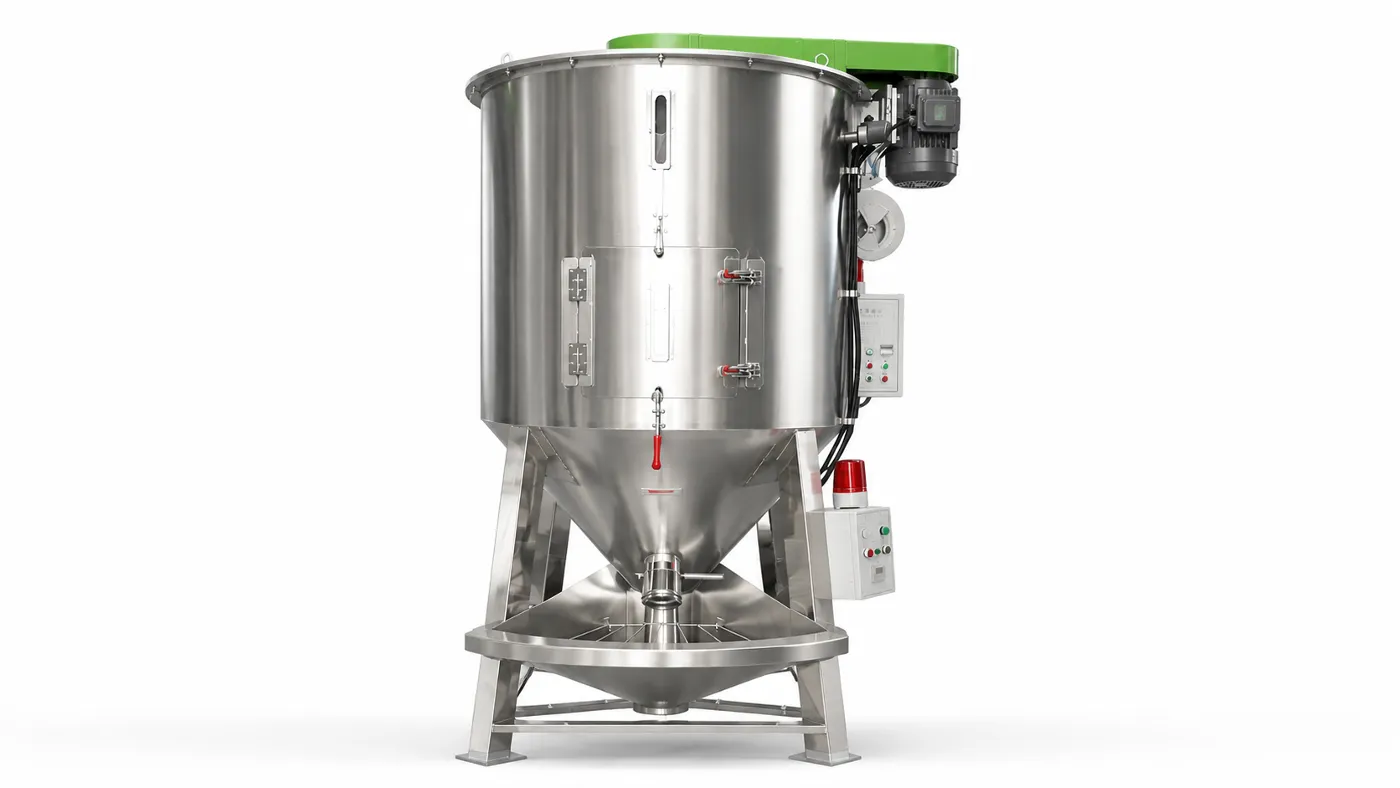
Memilih yang benar mixer plastik untuk pemrosesan industri memengaruhi stabilitas ekstrusi, kepadatan warna, penyebaran bahan tambahan, penggunaan energi, dan umur peralatan berikutnya. Campuran yang buruk dapat menimbulkan garis-garis, sifat mekanik yang lemah, aliran larut yang tidak stabil, dan sampah yang tidak perlu—terutama ketika bahan serat karet yang telah direkayasa kembali, bahan baku warna, atau campuran lembut terlibat.
Panduan ini membandingkan enam mesin campur plastik industri paling umum: silo mixer vertikal, ribbon mixer horizontal, mixer cepat, mixer homogenisasi tidak merusak, mixer jenis drum, dan mixer masterbatch kecilGunakannya sebagai panduan pilihan praktis untuk operasi pengolahan kembali, komposisi, ekstrusi, inokusi, dan pengaturan warna.
Jawaban singkat: Vertical silo mixers are best for large batches of pellets or recycled flakes; ribbon mixers are best for powders, additives, and granule blends; high-speed mixers are best for PVC and powder-rich recipes; homogenizing mixers protect soft or shear-sensitive materials; drum mixers suit lab trials; and small masterbatch mixers are useful for quick color changes.
Jenis-jenis Mesin Campur Plastik Secara Ringkas
| Campur tipe | Paling cocok untuk | Kapasitas standar | Keunggulan utama | Kekurangan utama |
|---|---|---|---|---|
| Silo mixer vertikal | Flakes kembali, bungkil, campuran granulat volume besar | 500L–20,000L | Kapasitas tinggi dengan biaya tenaga kerja rendah | Tidak ideal untuk bahan kering atau bahan lembut berlebihan |
| mixer berjalan lurus horizontal | Bahan kering, bahan tambahan, bolas, campuran pewarna utama | 500L–5,000L | Persebaran yang sangat baik dengan gesekan yang moderat | Perlu perawatan penutup dan pisau yang tepat |
| mixer mesin cepat | Bahan baku PVC, penstabilis, resep kaya bahan baku powdery | 50L–1,000L | Campur cepat dan pemanasan gesek | Lebih tinggi penggunaan energi dan kontrol keselamatan yang lebih ketat |
| Campur mixer homogenisasi | TPU, TPE, EVA, campuran transparan, kompositan rendah geser | 300L–5,000L | Campur yang lembut dengan kerusakan bahan yang lebih sedikit | Lebih lambat dari pengaduk berkecepatan tinggi |
| mixer berbentuk drum | Contoh, percobaan pewarnaan jangka pendek, campuran granulasi sederhana | 50L–300L | Struktur sederhana dan mudah dibersihkan | Efisiensi rendah untuk beban produksi |
| Pengaduk campuran masterbatch kecil | Pemanggian warna cepat, pengujian campuran masterbatch bervolume rendah | 150L–300L | Kompak, ekonomis, setup cepat | Tidak dirancang untuk batch produksi besar |
1. Silo Mesin Campur Vertikal untuk Pellets dan Flakes Beku
Silo mesin campur vertikal Gunakan jalur peredaran screw atau spiral untuk mengangkat bahan ke atas dan membiarkan bahan turun kembali melalui silo. Peredaran berulang ini menciptakan campuran kubik praktis untuk plastic pellets, regrind, dan flake kembali yang sudah dicuci.
Untuk penggabungan dan pengeringan skala produksi vertikal, lihat Rumtoo’s Mesin Pencampur Vertikal, yang cocok untuk menggabungkan granulat plastik, flake, campuran pewarna (masterbatch), dan bahan kembali sebelum ekstrusi atau formasi.
- Digunakan untuk: Bulat plastik PE/PP, serat PET, regrind yang sudah dibersihkan, sistem penimbunan dan campuran besar.
- Avoid when: bahan baku dalam resep mengandung bahan kering, TPE yang lembab, kandungan debu tinggi, atau bahan yang mudah menempel.
- Panduan pilihan: sesuaikan volume silo dengan ukuran batch yang sebenarnya, bukan output harian; pengisian berlebih mengurangi efisiensi циркуляции.
2. Mesin Campur Tali Horizontal untuk Bahan Baku, Tambahannya, dan Campuran Masterbatch
mixer berjalan horizontal Menggunakan bilah spiral dalam dan luar untuk memindahkan bahan dalam arah yang berlawanan. Ini adalah salah satu pilihan yang paling beragam untuk pengolahan plastik karena dapat menggabungkan granulat, bahan baku, penstabil, pewarna, dan campuran pewarna tanpa pembentukan haba yang berlebihan.
Untuk pabrik yang memproses resep campuran bubuk-dan-kubis, mesin campur tali biasanya lebih aman daripada mesin campur silo vertikal karena bubuk tidak bergantung pada aliran gravitasi bebas. Ini juga lebih mudah untuk membersihkan antar perubahan warna jika mesin memiliki pintu akses atas atau sisi yang besar.
3. Mesin Campur Kecepatan Tinggi untuk PVC dan Bahan Campuran Kaya Bahan Butiran
mixer pemecah cepat Menghasilkan aliran vortex yang kuat, gesekan, dan geseran. Mereka umumnya digunakan untuk campuran kering PVC, paket penstabil, resep yang diisi dengan kalsium karbonat, dan campuran kaya bahan butiran lain yang memerlukan dispersi cepat sebelum extrusi atau pelletisasi.
- Periksa beban motor dan suhu selama setiap siklus.
- Gunakan desain pendingin atau dengan jubah saat memproses formulasi yang sensitif terhadap panas.
- Tidak boleh membuka tutup sebelum rotor sepenuhnya berhenti; mixer berkecepatan tinggi memerlukan interlock yang ketat dan prosedur PPE.
4. Mesin Campur Homogenisasi Non-Destructif untuk Plastik Lembut atau Sensitif
Pengaduk homogenisasi tidak merusak dirancang untuk gerak penjerut dan penumpukan yang halus. Mereka mengurangi pocket udara dan mengurangi kerusakan penjerut, sehingga mereka berguna untuk TPE lembut, TPU, EVA, material transparan, dan material yang kehilangan kinerja saat diaduk dengan cara yang agresif.
Jika material lembut terlihat dicampur di silo tetapi kemudian menunjukkan benda-benda berbubur atau garis-garis selama ekstrusi, masalahnya mungkin disebabkan oleh homogenisasi rendah penjerut yang buruk daripada mesin ekstruder sendiri.
5. Mesin Penjerut Tipe Drum untuk Uji Lab dan Batch Kecil
Mesin penjerut tipe drum menggulingkan material lambat di dalam tangki berputar. Mereka sederhana, biaya rendah, dan mudah dipembersihkan, tetapi energi penjerut mereka terbatas. Gunakan mereka untuk uji lab, penamplikan warna, dan tes lari yang pendek—not untuk produksi industri ber volume tinggi di mana uniformitas harus dikendalikan dengan ketat.
6. Mesin Penjerut Masterbatch Kecil untuk Perubahan Warna Cepat
Mesin penjerut masterbatch kecil adalah unit yang kecil digunakan untuk campuran pigment atau masterbatch yang cepat. Mereka berguna dekat dengan mesin pengecatan injeksi, jalur ekstrusi kecil, atau area produksi uji, tempat operator memerlukan perubahan resep yang cepat dengan waktu berhenti yang minimal.
Cara untuk Memadankan Mesin Penjerut Plastik dengan Material
| Bahan atau resep | Penyusun campur | Mengapa ini bekerja | hindari |
|---|---|---|---|
| Batu + Pellet | mixer berjalan lurus horizontal | Distribusi serupa bubuk tanpa panas yang berlebihan | Silo mixer vertikal |
| Bentuk campuran PVC kering | mixer mesin cepat | Penyebutan stabilizer dan dispersi bahan penimbun cepat | Operasi berkecepatan tinggi tanpa pendingin |
| Soft TPE / TPU / EVA | Campur homogenizer atau campur pita | Penjerut rendah penjerut melindungi struktur material | Campur aduk kecepatan tinggi agresif |
| Bahan pewarna masterbatch | Pengaduk rantaian atau pengaduk campuran masterbatch kecil | Distribusi pigment yang uniform dan mudah dipembersihkan | Campuran drum dasar untuk batch produksi |
| Flakes karet ulang | Silo mixer vertikal | Kapasitas penumpukan besar untuk serupa dan rebond | Bahan penuh serupa atau lekat |
| Kompound penghalang api | Mixer pita atau mixer tinggi kecepatan | Distribusi penambahan yang adil dan waktu siklus yang terkendali | Overmixing yang menciptakan hotspot |
Daftar Pemeriksaan Pembersihan dan Perawatan
Pembersihan mixer paling penting saat pergantian warna, pemrosesan pengisian serupa, atau menjalankan resep kaya penambahan. Residu masterbatch hitam, penghalang api, atau serupa debu dapat kontaminasi batch berikutnya dan menciptakan gangguan yang terlihat.
- Sebelum peluncuran: pemeriksaan material sisa, periksa pintu akses, dan konfirmasi valesemisi ditutup.
- Selama operasi: monitor getaran, beban motor, suhu pergelangan, dan suara yang aneh.
- Antara pergantian warna: gunakan vakum kering, penggosokan, atau pengembalian udara; menghindari air kecuali mesin disesuaikan untuk pembersihan basah.
- Mingguan: pemeriksaan garis pita, silinder, screw silo, interlock keamanan, sensor, dan sistem berat.
- Untuk mixer tinggi kecepatan: ijinkan penuh penyejukan sebelum pembersihan dan jangan melewati interlock atas.
Panduan Beli: Apa yang Harus Dikonfirmasi Sebelum Memesan
- Bentuk material: pellet, serupa, serupa lembut, atau bahan campuran dengan kepadatan yang berbeda.
- Ukuran batch: pilih volume kerja berdasarkan berat batch nyata; banyak mixer yang tidak boleh melebihi 70-80% kapasitas yang dianggarkan.
- Tujuan pemixing: homogenisasi penyimpanan, penyebaran penambahan, pemanasan, penyesuaian warna, atau persiapan penggabungan.
- Frekuensi pembersihan: perubahan warna yang sering memerlukan akses yang baik dan geometri internal yang sederhana.
- Proses turun: ekstrusi, penggilingan pellet, pemodelan injeksi, pengeluaran jalur pembersihan, atau penyimpanan jalur pengelolaan.
- Kebutuhan integrasi: screw conveyor, vacuum loader, silo, dryer, metal separator, weighing system, atau unit dosing otomatis.
Untuk jalur pengelolaan pengeluran penuh, mesin penjerut sering bekerja bersama dengan sistem bantu seperti konveyor, keringan, pemisah, dan silo penyimpanan. Anda juga dapat meninjau Rumtoo’s sistem bantuan mesin pengolahan ulang untuk merancang bagaimana peralatan penjerut masuk ke dalam alur produksi penuh.
Pertanyaan yang Sering Diajukan
Apa yang menjadi pemadat plast yang paling beragam untuk pemrosesan industri?
Sebuah mixer pita horizontal biasanya adalah opsi yang paling beragam karena dapat menangani powder, granul, penambahan, dan masterbatch dengan penyebaran yang dapat dipercaya dan geseran yang menengah.
Yang mana yang terbaik pengaduk untuk serupa plastik pengeluaran?
Silos vertikal penyerbuk biasanya paling cocok untuk volume besar serupa atau granul yang bersih, khususnya saat tujuannya adalah penghomogenan penyimpanan sebelum ekstrusi atau granulasi.
Dapatkah silo vertikal mixer mengaduk penambahan serupa powder?
Tidak disarankan. Bubuk tidak mengalir seperti granul atau serupa dan dapat membentuk jembatan, menumpuk, atau akumulasi di zona mati. Mesin campur pita horizontal biasanya lebih baik untuk resep bubuk-dengan-granul.
Bagaimana saya memilih kapasitas mixer?
Hitung volume batch sebenarnya dan tinggalkan ruang kerja di dalam mesin. Bagi banyak mesin campur plastik, beroperasi di kisaran 70-80% volume penilaian memberikan pertukangan yang lebih baik daripada mengisi tangki penuh.
Berapa sering harus mixer plast industri dijernihkan?
Bersihkan antara perubahan warna atau penambahan penambahan, periksa setiap hari, dan jadwalkan pembersihan yang mendalam mingguan atau menurut jam operasional. Mesin campur tinggi kecepatan dan pengikat silinder pita memerlukan pemeriksaan yang sangat hati-hati.
Kesimpulan: Pilih Mesin Penjerut Berdasarkan Material, Tidak Hanya Kapasitas
Mesin penjerut plastik terbaik adalah yang cocok dengan bentuk material, ke sensitivitas resep, frekuensi pembersihan, dan proses turunannya. Untuk kotoran pengeluran besar, pilih mesin penjerut silo vertikal; untuk bubuk dan penambahan, pilih mesin penjerut pita; untuk PVC atau formula yang kaya bubuk, pertimbangkan penjerut tinggi kecepatan; dan untuk plastik lembut atau yang sensitif terhadap penjerut, gunakan desain homogenisasi yang halus. Pemilihan mesin penjerut yang benar dapat meningkatkan konsistensi produk, mengurangi sampah, dan membuat jalur pengolahan plastik seluruhnya lebih mudah untuk dikendalikan.
