


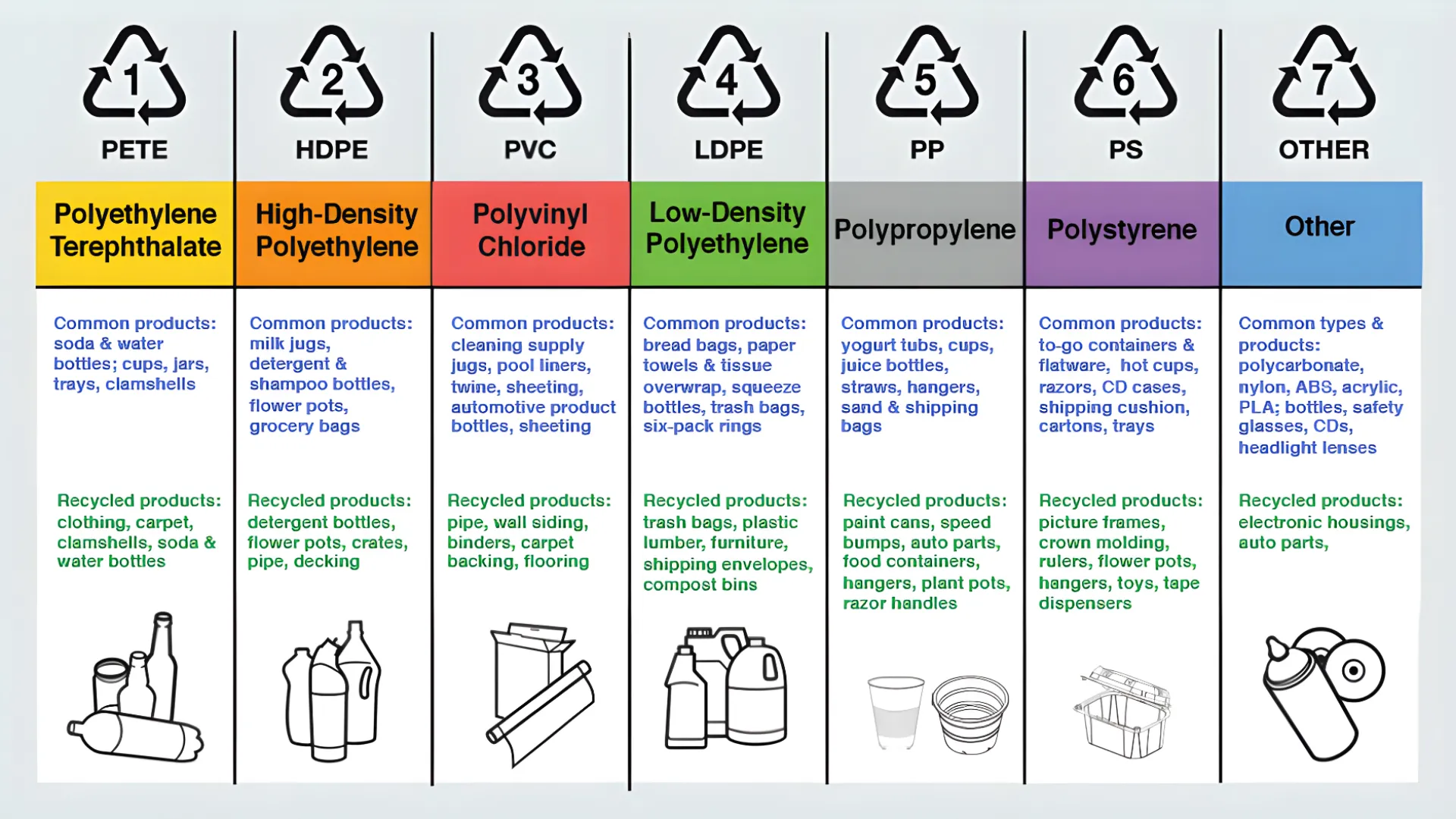
The profitability of a recycling operation depends entirely on the feedstock. Mixing incompatible polymers (e.g., PVC with PET) can catastrophically damage extrusion equipment and render the final rPET flakes unsellable. For plant operators, mastering the ASTM International Resin Identification Coding System (RIC) is the first line of defense against contamination.
This guide analyzes the seven resin codes from an industrial processing perspective — what each plastic is worth, what contaminates it, and the specific recycling machines required for each polymer.
PET (Polyethylene Terephthalate)

- Source: beverage bottles, food trays, polyester textiles.
- Properties: high transparency, solvent resistance, sinks in water (density 1.38 g/cm³).
- Market value: the most widely recycled plastic worldwide; clean rPET flakes and food-grade rPET pellets command premium prices.
- Key contamination risk: PVC. Even small amounts of PVC in a PET stream degrade at PET processing temperatures, releasing hydrochloric acid that yellows the melt and destroys equipment. The industry target is below 50 ppm PVC in rPET flakes.
- Processing requirement: labels and glues are the primary contaminants. A PET bottle washing line with hot caustic wash is mandatory to reach the purity needed for fiber or bottle-to-bottle applications.
HDPE (High-Density Polyethylene)

- Source: detergent jugs, shampoo bottles, oil drums, crates.
- Properties: high strength-to-density ratio, floats in water (density 0.93–0.97 g/cm³).
- Market value: strong demand for recycled HDPE in pipes, lumber, and new containers; natural (unpigmented) HDPE fetches the highest price.
- Key contamination risk: mixed colors and PP closures. Color sorting matters — a single dark bottle in a natural stream downgrades the whole batch.
- Processing requirement: rigid HDPE requires high-torque shearing. A single-shaft shredder handles initial size reduction of thick lumps, followed by sink-float separation tanks that float HDPE away from sinking contaminants like PET and PVC.
PVC (Polyvinyl Chloride)

- Source: pipes, window profiles, cable insulation, blister packs.
- Properties: chlorine content makes it heat sensitive; degradation releases hydrochloric acid (HCl).
- Market value: recycled PVC has solid demand in construction products, but only when processed correctly — degraded PVC is worthless.
- Key contamination risk: PVC is the contamination risk for other streams, especially PET. In its own stream, the danger is thermal degradation during processing.
- Processing requirement: never run PVC through a standard general-purpose extruder. It needs specialized screw geometry and tight temperature control to prevent degradation. Use specialized PVC granulators for size reduction, and keep processing temperatures strictly within the safe window.
LDPE (Low-Density Polyethylene)

- Source: shrink wrap, shopping bags, agricultural film, stretch film.
- Properties: high ductility, low tensile strength, floats in water (density 0.91–0.94 g/cm³).
- Market value: recycled LDPE pellets are widely used in new film and bags; the economics depend heavily on washing quality since films carry surface contamination.
- Key contamination risk: soil and moisture on agricultural film, plus paper labels on commercial wrap. Films also tangle around standard rotors, jamming equipment designed for rigid plastics.
- Processing requirement: use a designated film recycling washing line with an integrated squeezer (varying-diameter screw press) to mechanically dewater the fluff before pelletizing — thermal drying alone is uneconomical for films.
PP (Polypropylene)

- Source: bottle caps, yogurt containers, car bumpers, woven bags.
- Properties: high melting point, chemical resistance, floats in water (density 0.90–0.92 g/cm³).
- Market value: growing demand as brands shift from other resins to PP; automotive PP has a well-established closed loop.
- Key contamination risk: often co-mingled with PE. The two look alike and process similarly, but mixing them downgrades both.
- Processing requirement: sink-float tanks separate PP (floats) from PET and PVC (sink). For bottle caps — the classic PP/PE mix — float-sink separation after granulation gives clean PP flakes.
PS (Polystyrene)

- Source: expanded foam (EPS) packaging, disposable cutlery and cups (HIPS).
- Properties: rigid but brittle; EPS is 98% air.
- Market value: limited but real — densified EPS becomes PS pellets for picture frames, hangers, and construction products.
- Key contamination risk: volume. Uncompacted EPS is uneconomical to transport and jams conventional granulators.
- Processing requirement: densify first using a cold compactor or hot-melt machine, then granulate. Skipping the densification step is the classic EPS recycling mistake.
Other (Code 7)
- Common materials: PC (polycarbonate), ABS, PA/nylon, PMMA (acrylic), PLA (bioplastic), multi-layer composites.
- Recycling reality: Code 7 is a catch-all, not a material. These plastics are frequently incompatible with commodity recycling streams and are rejected unless you have a positively identified, segregated feedstock and a committed end market.
- Key contamination risk: PLA in a PET stream is particularly destructive — it looks like PET, sinks like PET, but melts at a lower temperature and ruins the batch.
- Processing requirement: treat Code 7 as a contamination risk until proven otherwise. NIR optical sorting and strict bale specifications come before any size reduction or extrusion.
How Plants Sort by Resin Code
Knowing the codes is only half the job — a plant must separate them at tons per hour. Manual sorting by the molded code handles large, identifiable items at the front of the line. Near-infrared (NIR) optical sorters identify polymer type automatically as material passes on a conveyor, ejecting off-spec pieces with air jets. Float-sink tanks then separate by density: polyolefins (PE, PP) float while PET, PVC, and PS sink — a cheap, high-throughput step that catches what optical sorting misses.
The three methods stack: manual for the obvious, NIR for speed and accuracy, float-sink for density-based final separation. Plants that skip sorting and shred mixed bales discover the cost downstream — in degraded pellets, damaged screws, and rejected loads.
Processing Compatibility Table
| Plastic | Density (g/cm³) | Float/Sink in Water | Primary Machine |
|---|---|---|---|
| PET | 1.38 | Sink | Hot Washer |
| HDPE | 0.93–0.97 | Float | Shredder |
| PVC | 1.16–1.45 | Sink | Specialized Granulator |
| LDPE | 0.91–0.94 | Float | Film Squeezer |
| PP | 0.90–0.92 | Float | Sink-Float Tank |
| PS | 1.04–1.07 | Sink | Densifier / Hot Melt |
| Other | Varies | Varies | NIR Sorting / Dedicated Line |
Frequently Asked Questions
What do the plastic resin codes mean?
The seven resin identification codes (1–7) identify the base polymer of a plastic item: 1 PET, 2 HDPE, 3 PVC, 4 LDPE, 5 PP, 6 PS, 7 Other. They were designed for sorting, not as a recyclability guarantee — a code 3 item is technically recyclable but rarely recycled curbside.
Which resin codes are most profitable to recycle?
PET (1) and HDPE (2) have the largest, most liquid markets and the best prices for clean material. PP (5) is growing fast. PVC (3) and PS (6) have niche markets that depend on dedicated processing. Code 7 is generally not economical without a specific buyer.
Why is PVC contamination so dangerous?
PVC degrades at PET processing temperatures, releasing hydrochloric acid that discolors the melt, corrodes equipment, and ruins the batch. That is why PET recyclers target less than 50 ppm PVC — and why sink-float separation that sinks PVC away from floating polyolefins is standard practice.
Can different resin codes be processed together?
Only within limits. PE and PP (codes 2/4/5) are sometimes processed together for lower-grade products. But PET with PVC, or PLA with PET, are destructive combinations. When in doubt, sort first — the cost of sorting is always less than the cost of a ruined batch.
How do recycling plants identify resin codes at scale?
Manual sorting by the molded code works for large items; near-infrared (NIR) optical sorters identify polymer type automatically at conveyor speed; float-sink tanks separate by density. Most plants combine all three.
What machines do I need for each resin code?
PET needs a hot-wash bottle line; HDPE/PP need shredders plus sink-float tanks; PVC needs specialized granulators and temperature-controlled extrusion; LDPE film needs a film washing line with a squeezer; EPS needs a densifier first. The recycling machine range covers each configuration.
Does the resin code tell me if something is recyclable?
Not reliably. The code identifies the material, but recyclability depends on local collection, sortability, contamination, and end markets. For plant operators, the code is a sorting input — not a business plan.
At Rumtoo, we design entire turnkey systems around these material properties. Understanding the chemistry of your waste stream lets us configure the correct recycling machine for maximum ROI — contact our engineering team with your material mix for a tailored recommendation.
