


The practical difference between a shredder and a crusher is the job each machine must finish. A plastic shredder accepts bulky, awkward or tough feed and reduces it to manageable pieces. A plastic crusher or granulator usually takes controlled feed and cuts it into smaller, more uniform regrind for washing, separation, drying or extrusion.
The machine name alone is not enough. Suppliers use “crusher,” “grinder,” “granulator” and “secondary shredder” differently across markets. Before comparing quotes, define the largest feed item, required output size, contamination, throughput and downstream process. This guide provides that decision framework. For selecting among shredder types, use the separate industrial shredder buying guide.
Shredder vs Crusher: The Short Answer
| Decision Point | Plastic Shredder | Plastic Crusher or Granulator |
|---|---|---|
| Main duty | Primary size reduction and controlled feeding of bulky material | Secondary or final cutting to a smaller, more uniform particle size |
| Typical feed | Bales, film rolls, pipe, purges, drums, pallets and large molded parts | Pre-shredded pieces, bottles, sprues, runners, thin parts and clean production scrap |
| Cutting behavior | Lower-speed, higher-torque shearing or tearing | Higher-speed knife cutting against fixed bed knives |
| Output | Coarse strips or pieces; uniformity depends on rotor, screen and material | Flake or regrind sized by the chamber, knife gap, screen and evacuation system |
| Feed control | Large hopper, ram, drawer, hook or twin-shaft bite can manage difficult shapes | Needs feed that fits the opening and reaches the rotor at a controlled rate |
| Common position | First machine in a recycling line | After a shredder, or as a stand-alone machine for suitable pre-sized scrap |
This is a process distinction, not a universal naming rule. A heavy-duty “crusher” may accept larger feed than a small granulator, while a screened single-shaft shredder can make a controlled coarse fraction. Always compare the cutting system and trial result, not only the product category.
Why Crusher and Granulator Names Cause Confusion
In plastic recycling, crusher and granulator often describe the same high-speed knife-and-screen principle. Other suppliers use “crusher” for a heavier chamber that handles thicker rigid parts, and “granulator” for a machine that makes finer regrind. The word “granulator” can also be confused with a pelletizer, even though a pelletizer melts and reforms plastic while a granulator only cuts it.
- Ask whether the rotor uses knives, hooks, discs or hammers.
- Confirm whether a screen controls the leaving particle size.
- Request the maximum feed dimensions, not only the hopper opening.
- Confirm whether the quoted output is coarse shred, flake, regrind or melted pellets.
- Ask whether throughput was measured on your polymer, thickness and screen size.
Rumtoo lists knife-and-screen models in the plastic crusher and granulator range. The application and chamber specification decide whether a model fits a project.
How a Plastic Shredder Reduces Material
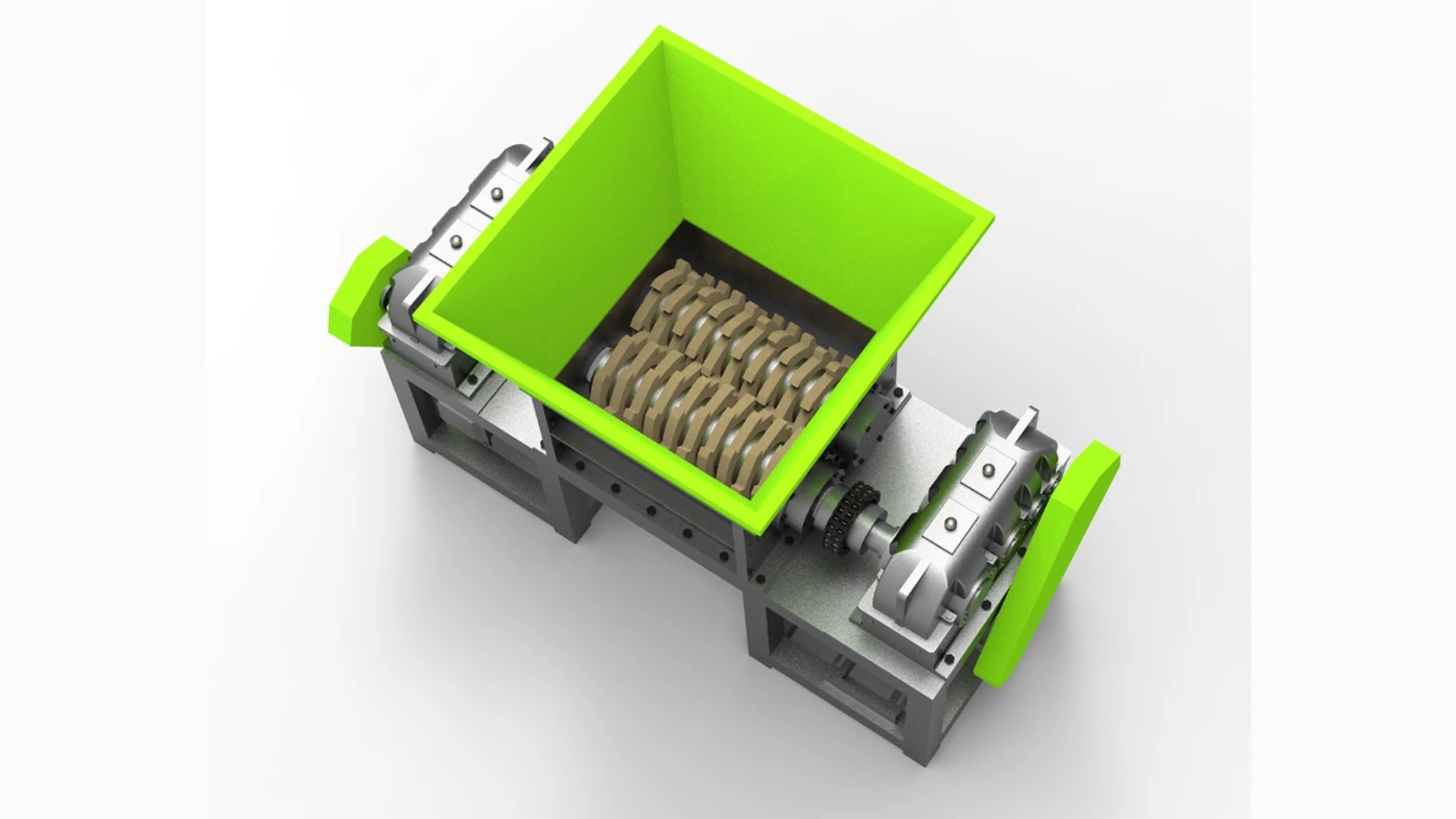
A plastic shredder grips material and pulls it through a slower cutting zone. A single-shaft shredder commonly uses a hydraulic pusher to move material against rotor knives and a bed knife. A double-shaft shredder uses counter-rotating shafts to bite and shear feed between intermeshing cutters.
The lower-speed, higher-torque approach suits bulky parts, thick purges, long profiles, baled film and feed that bridges above a crusher rotor. A screen can control output on many single-shaft designs, but forcing a shredder to make very fine material can cut capacity and increase recirculation. The plastic shredder working-principle guide explains the rotor, pusher and screen in more detail.
How a Plastic Crusher or Granulator Reduces Material
A crusher or granulator cuts material between rotating knives and fixed bed knives at a higher rotor speed. Pieces remain in the chamber until they pass through the selected screen or grate. Knife geometry, gap, screen open area and discharge airflow determine the flake size, fines, heat and throughput.
This machine works well when the feed fits the opening, can be metered safely and is not carrying damaging foreign objects. Clean sprues, runners, bottles, thin molded parts and pre-shredded plastic are common feeds. A heavy-duty plastic crusher can accept thicker rigid scrap, but it still needs a feed trial before replacing a primary shredder.
The U.S. Occupational Safety and Health Administration describes web grinders or granulators as machines with sharp rotating and stationary knives, and stresses guarding plus energy-control procedures during cleaning and knife work. That safety requirement applies regardless of whether a supplier calls the machine a crusher, grinder or granulator. See the OSHA plastics-machinery guidance.
Choose a Shredder When the Feed Is the Main Problem
Choose a shredder first when the incoming form prevents stable crusher feeding. The decision is usually driven by dimensions, bulk density, shape, toughness and how the material arrives at the plant.
- Large or hollow parts: drums, tanks, pallets and molded housings may not fit a crusher opening.
- Long material: pipe, profiles, film rolls, rope and raffia can bridge or wrap without the correct feeder and rotor.
- Heavy purges and lumps: high torque and controlled ram pressure can be more useful than high knife speed.
- Variable batches: a hopper and pusher can buffer uneven loading from a forklift or conveyor.
- Coarse output is acceptable: transport, sorting or a second size-reduction stage may not need final flake yet.
A shredder is not a metal separator. Bolts, stones and heavy contamination can damage cutters, screens and downstream equipment. Specify magnets, metal detection, manual sorting or other protection based on the actual contamination.
Choose a Crusher When Final Flake Is the Main Goal
Choose a crusher or granulator when the feed is already manageable and the next process needs a tighter particle-size range. This includes clean in-house scrap, bottles, pre-cut parts and material leaving a primary shredder.
- The feed fits the chamber without manual cutting or unsafe pushing.
- The required flake must pass through a defined screen.
- A washing, separation, drying or extrusion stage needs consistent feeding.
- The plant can control metal and abrasive contamination before the chamber.
- Dust, sound containment and flake evacuation are included in the layout.
Do not select a smaller screen simply because it produces a finer sample. A smaller opening keeps material in the chamber longer and can raise recutting, fines, heat and energy use. Match flake size to the next machine rather than specifying the smallest possible number.
When a Two-Stage Shredder-Crusher System Is Better
A two-stage system is often the safer choice when the feed is bulky but the final process needs small, uniform flake. The shredder protects the crusher from oversize pieces and meters a more stable feed. The crusher then finishes the particle size.
| Process Stage | Primary Task | Acceptance Check |
|---|---|---|
| Sorting and protection | Remove prohibited items and damaging metal | Defined reject list, magnet or detector position, and safe removal method |
| Shredder | Reduce bulky feed and stabilize the load | No bridging, wrapping or repeated overload on the trial material |
| Buffer or conveyor | Separate the two machine duty cycles | Crusher receives a controlled bed depth rather than surges |
| Crusher or granulator | Produce the required final flake | Target size, fines and long tails remain within the agreed sample limit |
| Evacuation | Move flake without heat or dust build-up | Stable discharge into washing, drying or extrusion equipment |
WEIMA describes an application example in which a shredder makes roughly 40–60 mm pieces before a granulator reduces them to about 3–15 mm. Those sizes are specific to its two-stage examples, not universal targets. Vecoplan also combines a shredder and granulator when large scrap must become a small final fraction. Review the WEIMA two-stage explanation and Vecoplan stacked-system concept as process examples.
Where floor space and controls are limited, an integrated shredder and crusher can combine the stages. Confirm that operators can still access each cutting chamber, isolate stored energy and remove a jam without entering an unsafe area.
Match the Machine to the Plastic and Its Form
| Feed Example | Likely Starting Point | Why |
|---|---|---|
| Clean injection sprues and rejected parts | Crusher or granulator | Pre-sized, predictable scrap can often go directly to the cutting chamber |
| Large HDPE pipe, tanks or thick purges | Shredder, then crusher if fine flake is required | Size and wall thickness make controlled primary feeding important |
| Baled or rolled PE/PP film | Film-capable shredder or cutter-compactor process | Low bulk density, wrapping and bridging decide the feed system |
| Loose PET or HDPE bottles | Crusher, or shredder-crusher for compressed bales and variable feed | Bottle form, bale density and downstream wash-line feed determine the first stage |
| Washed rigid flake needing a smaller cut | Crusher or granulator | The material is already controlled and final particle size is the goal |
| Mixed bulky plastic waste | Sorting plus shredder; validate a second stage | Unknown items and variable shapes require protection before fine cutting |
For a washing line, trace the material beyond size reduction. The HDPE bottle washing line and PP/PE film washing line need different feed preparation, separation and dewatering arrangements.
Compare Operating Cost by Processed Tonne
Nameplate power does not reveal the cost of a shredder or crusher. Compare the complete duty cycle at the agreed particle size. A larger motor can finish a batch faster, while a smaller machine may run longer, recut more material or need more manual preparation.
- Loaded kilowatt-hours per processed tonne, including conveyors and extraction
- Blade rotation, sharpening and replacement interval on the trial material
- Screen wear, access time and spare-screen cost
- Labor needed to pre-cut feed, clear bridges and remove contamination
- Downtime for cleaning between polymers or colors
- Fines, oversize and saleable flake yield
A crusher may have lower purchase cost but become expensive if workers must cut every part by hand. A shredder-crusher line costs more upfront but can reduce manual handling and let each rotor work in its intended range. Use the witnessed trial to compare both layouts.
Safety and Maintenance Must Be Part of Selection
Both machines contain cutting and crushing hazards. Guards, interlocked doors, emergency stops and a documented lockout/tagout procedure must match the installation. Knife or screen work should never rely on a control-panel stop alone.
- Verify how the rotor is mechanically secured before knife work.
- Check access to bed knives, screens, bearings and trapped material.
- Confirm that hydraulic rams and raised covers cannot fall or move during service.
- Provide safe platforms where hoppers or chambers are above floor level.
- Train operators on flyback, bridging and prohibited manual feeding.
OSHA notes that plastics machinery can cause crushing injuries, lacerations and amputations when guards are missing, removed or bypassed. The project review must include the whole feeding and discharge path, not only the rotor cabinet.
Test the Material Before Choosing
A useful equipment trial reproduces the hardest normal feed, not a hand-picked clean sample. Send representative pieces, contamination information and photos showing how the waste arrives. Record the screen, knife gap, feed rate and operating time with the result.
| Trial Record | Why It Matters |
|---|---|
| Polymer, dimensions, wall thickness and bulk density | Defines whether the feed fits, bridges, wraps or requires a pusher |
| Moisture, grit, labels, metal and prohibited items | Sets the protection, wear and cleaning assumptions |
| Screen or grate specification | Connects throughput to the delivered particle size |
| Stable kg/h and kWh/t | Separates rated motor power from process performance |
| Fines, oversize and long-tail sample | Shows whether downstream washing or extrusion can accept the output |
| Jam, overload and restart behavior | Reveals feed-control limits and operator intervention |
| Knife and chamber condition after the run | Identifies impact, abrasion, wrapping and trapped contamination |
Shredder vs Crusher RFQ Checklist
- Plastic type and whether polymers are sorted or mixed
- Largest and smallest feed dimensions, thickness and weight
- Loose, baled, rolled, nested, wet or compacted condition
- Known metal, grit, glass, labels and other contamination
- Required average and peak throughput
- Target particle size and the downstream machine that receives it
- Available loading method, floor space, electrical supply and dust control
- Maximum acceptable manual pre-cutting or intervention
- Knife, screen and wear-part access requirements
- Witnessed trial conditions and acceptance criteria
Frequently Asked Questions
Often, but not always. Both terms commonly describe a high-speed knife-and-screen machine that makes plastic regrind. Some suppliers reserve “crusher” for heavier rigid-plastic models. Compare the rotor, knives, screen, feed limit and trial output instead of relying on the name.
Yes when the feed already fits the opening, can be metered safely and does not overload the cutting chamber. Large pipes, purges, bales and bulky molded parts often need a shredder or another pre-cutting stage before fine crushing.
Use two stages when incoming waste is bulky or variable but washing, separation or extrusion requires small, uniform flake. The shredder stabilizes feed size and load; the crusher finishes the particle size. A trial should confirm the buffer and conveyor between them.
A slower shredder can be less sensitive to awkward shapes, but no standard machine should be treated as a metal or stone separator. Define contamination, remove prohibited objects and specify magnets, detection or wear protection before the cutting chamber.
No. A smaller screen can increase residence time, recutting, fines, heat and energy use. Specify the particle size required by the next washing, drying or extrusion step, then test throughput and flake quality at that screen size.
Send material photos, polymer, maximum dimensions, thickness, bulk condition, contamination, hourly capacity, target particle size, downstream process, loading method, available power and floor space. A representative sample is best for a witnessed test.
Request a Size-Reduction Review
Send the feed dimensions, polymer, contamination, required throughput and target particle size. Rumtoo can review whether the project needs a shredder, crusher, granulator or two-stage layout, then define a representative material trial.
