
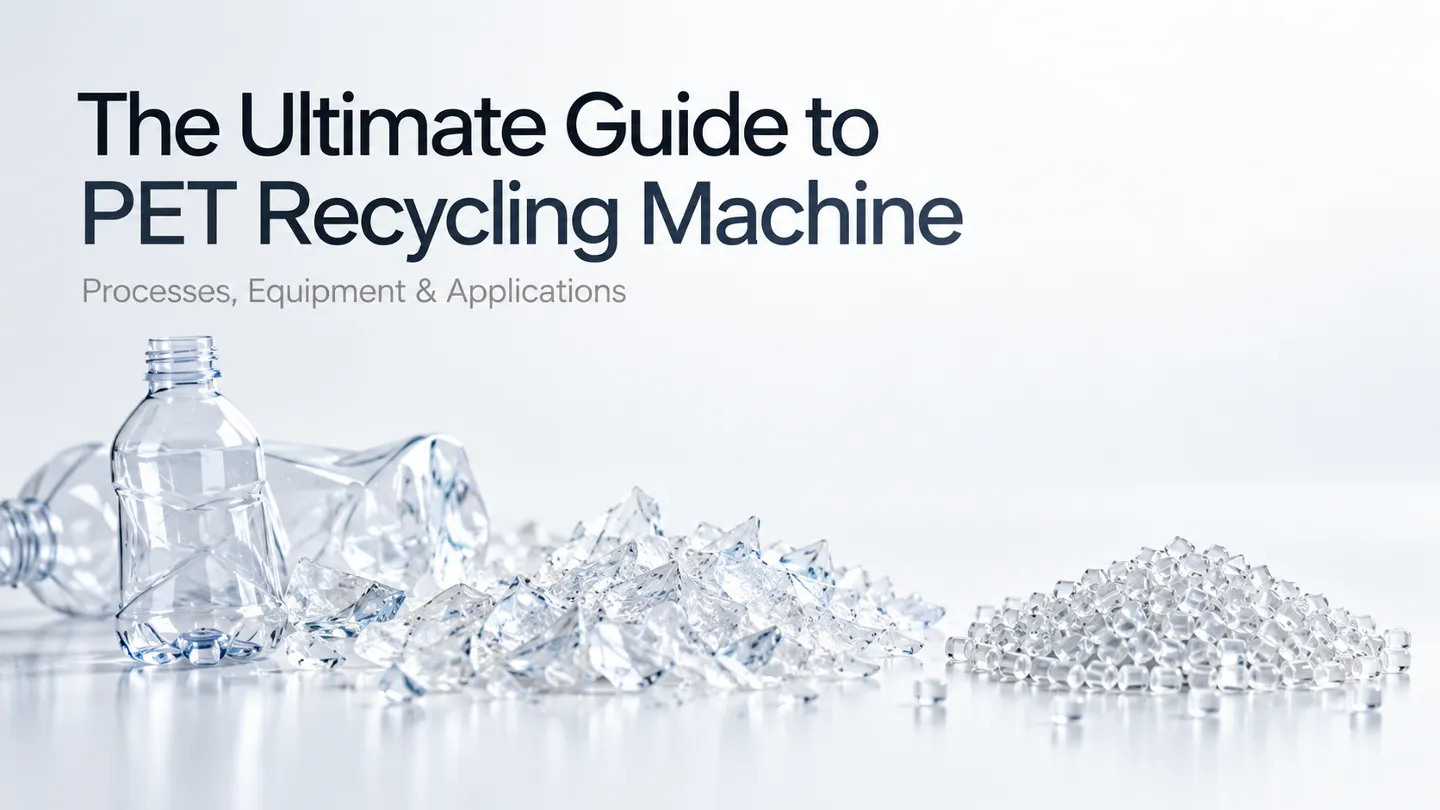
A PET recycling machine is rarely a single machine. When buyers ask for one, they usually need a PET washing line: a sequence of debaling, label removal, crushing, hot washing, friction washing, separation, rinsing, and drying that turns used bottles into clean rPET flake. Quotes go wrong when the scope does not match the feedstock — a crusher alone cannot clean dirty bottles, and a full washing line is wasted on pre-washed flake.
This guide gives you the decision framework: how the standard line works, which configuration fits your feedstock, what decides flake quality and price, how to size capacity, and what to send suppliers so quotes are comparable. For the size-reduction step inside the line, see the shredder vs crusher guide; for the general selection logic across materials, see the ghid de selecție a mașinii de reciclare a plasticului.
Mașină de reciclare PET vs linie de spălare PET: pe scurt
| Term | What it usually means | When it is enough |
|---|---|---|
| Single PET recycling machine | One unit, such as a crusher, label remover, or dryer | Clean, pre-sorted feed, and only one process step is missing |
| PET washing line | Full sequence from bale to dry flake | Post-consumer bottles with labels, caps, and dirt |
| La Rumtoo, ne specializăm în proiectarea și fabricarea de sisteme de reciclare industrială de înaltă calitate care permit afacerilor să îndeplinească aceste cerințe. Acest ghid nu se referă doar la „de ce” a recicla – se referă la „cum”. Vă vom ghida prin întregul proces industrial de reciclare a sticlelor PET, de la procesarea baloților brute până la producerea flăcărilor rPET de grad premium, și vom demonstra cum un sistem de reciclare PET de sticle ales strategic este piatra de temelie a unei operațiuni profitabile. | Washing line configured for whole bottles | Baled or loose bottles as the main feedstock |
| Pelletizing extension | Washing line plus extruder and pelletizer | The buyer wants rPET pellets, not flake |
Define the output first — flake or pellets — then describe the feedstock. The equipment list follows from those two answers.
Cum transformă o linie de spălare sticlele în fulgi
Bottles move through the line in one direction, and each stage removes one class of contamination. Skipping a stage does not save money if the contamination it targets comes back as a price deduction on the flake.
- Debaling and sorting. Bales are opened and non-PET items — PVC bottles, metal, trash — are removed. PVC is the critical reject: it behaves like PET in the wash but ruins the flake.
- Label removal. A dry label remover strips most wrap and paper labels before wet processing, so the washers deal with glue residue instead of whole labels.
- Crushing. A Concasor de plastic cuts bottles to flake, commonly in the 10–14 mm range depending on screen and knife setup. Uniform flake washes and dries more evenly than mixed sizes.
- Hot washing. Flake is washed with heated water and detergent in a hot washer. Heat plus chemistry loosens glue, oil films, and sugar residues that cold water leaves behind.
- Friction washing. A spălător cu fricțiune scrubs flake at high rotor speed — the mechanical complement to the chemical clean of the hot wash.
- Sink-float separation. In a bazin de separare prin flotație, PET sinks while caps and labels made of polyolefins float. This single density step removes most of the cap and label fraction.
- Rinsing. Clean-water rinses remove detergent and suspended fines before drying.
- Dewatering and drying. Mechanical dewatering followed by thermal drying brings moisture down to the level the next process accepts. Dryer choice matters most when flake feeds an extruder directly.
Alegeți linia potrivită pentru materia primă
The feedstock decides the configuration more than any other factor. Four common starting points:
| Your feedstock | Likely configuration | De ce |
|---|---|---|
| Baled post-consumer bottles | Full line: debaler to dryer | Labels, caps, PVC risk, and dirt are all present |
| Loose or pre-sorted bottles | Full wash without debaler | Bale handling is unnecessary; the washing load is the same |
| Purchased dirty PET flake | Wash, separation, and dry; no crusher | Size reduction is already done; pay only for cleaning |
| Pre-washed flake | Dry and sort, or pelletize directly | Washing again adds cost without improving quality |
If the feedstock varies by season or supplier, size the washing stages for the dirtiest expected case, not the average sample.
Calitatea fulgilor: ce stabilește cu adevărat prețul
Flake buyers discount on four measurable properties. Each maps to a line stage — which is why the configuration and the price are the same decision.
- PVC content. Even small PVC fractions discolor rPET. Remove PVC at sorting; no washing stage fixes it afterwards. Confirm how the supplier’s line handles PVC detection and rejection.
- Labels and glue residue. Hot washing plus friction washing handles most adhesive; a label remover upstream reduces the load. Ask what glue residue level the line is rated for, on your label types.
- Moisture. Wet flake loses value and complicates extrusion. Specify the dryer’s outlet moisture on your material, not on a clean test sample.
- Color mix and fines. Clear flake prices above mixed color; fines are yield loss. Sorting effort and screen choices set both.
Get the buyer’s specification sheet before finalizing the line. A line that beats the spec wastes capital; a line that misses it discounts every tonne.
Dimensionați linia fără cheltuieli excesive
Nameplate capacity is quoted under specific conditions — usually clean bottles at a defined moisture and contamination level. Your throughput will differ. When comparing quotes, ask each supplier to state the reference conditions behind the kg/h figure: feed form, contamination, screen size, and operating hours per day.
- Match capacity to real supply. A line rated at 1,000 kg/h needs roughly that much sorted feedstock every operating hour. Idle capacity still costs floor space, power connection, and labor.
- Check utilities, not just the machine price. Washing lines consume water, heat, and power. Ask for water consumption per tonne, installed kW, and expected kWh per tonne at your throughput — installed power and energy cost are different numbers.
- Leave room for the dirtiest week. Size pumps, screens, and dryers for peak contamination, not the trial sample.
- Plan the full layout. Conveyors, water treatment, and flake storage often need as much floor as the machines. Confirm the total footprint including utilities before committing to a building around the line.
Comparați costul de operare per tonă de rPET
Two lines with similar price tags can have very different running costs. Build the comparison per tonne of saleable flake:
- Labor for sorting, feeding, and supervision across shifts
- Water, detergent, and heat for washing
- Blade sharpening and replacement on the crusher
- Screen and wear-part replacement in washers and dryers
- Electrical energy in kWh per tonne, at your tariff
- Yield loss: fines, rejected PVC, and moisture-corrected output weight
A cheaper line that loses two extra points of yield can cost more per tonne than a better-equipped one. Run the numbers on saleable output, not input.
Listă de verificare RFQ pentru linia de reciclare PET
- PET feedstock form: baled bottles, loose bottles, dirty flake, or pre-washed flake
- Polymer mix and known PVC, metal, or trash fraction
- Labels: wrap, paper, or pressure-sensitive; glue type if known
- Required throughput in kg/h and operating hours per day
- Target output: flake or pellets; buyer’s specification if available
- Moisture limit for the next process: storage, sale, or extrusion
- Available utilities: power supply, water source, drainage, floor space
- Water treatment and discharge requirements at the site
- Installation, commissioning, and operator training scope
- Wear-part list with prices and expected service intervals
Întrebări frecvente
Care este diferența dintre fulgii de PET și peletele de rPET?
Flake is the washed, dried output of the washing line. Pellets are made by melting flake in an extruder and pelletizing it. Flake suits buyers with their own extrusion; pellets suit buyers who feed production directly. The washing line is the same either way — pelletizing is an added extrusion stage.
Poate o linie de spălare PET să proceseze sticle HDPE amestecate în materia primă?
The sink-float stage separates them by density: PET sinks, HDPE floats. But separation is not sorting — a high HDPE fraction still costs capacity and yield. Remove as much non-PET as possible before the crusher.
Este necesar un dispozitiv de îndepărtare a etichetelor dacă linia are un spălător cu apă caldă?
They do different jobs. The label remover takes off whole labels dry, before water is involved. The hot washer then deals with glue residue and films. Without the remover, labels consume washer capacity and detergent.
Câtă apă consumă o linie de spălare PET?
It depends on capacity, dirt load, and whether water is recirculated. Ask suppliers for liters per tonne of flake with and without water treatment, and check local discharge rules — water treatment is often a separate budget item.
Ce umiditate ar trebui să atingă fulgii de PET uscați?
It depends on the next step. Flake sold for storage tolerates more moisture than flake fed directly to an extruder, where residual moisture causes hydrolysis and quality loss. Set the target from the extruder or buyer specification, then verify the dryer on your material.
Pot începe cu un concasor și adăuga etapele de spălare mai târziu?
Yes, if the layout allows it. Many plants start with crushing and add washing as feedstock or buyer requirements tighten. Confirm conveyor interfaces, water and power provisions, and floor space for the future stages before placing the first order — retrofitting around a cramped layout costs more than planning ahead.
Vedeți sistemul de reciclare și solicitați o ofertă
Consultați specificațiile complete și configurațiile de linie pe pagina sistemului de reciclare a sticlelor PET, unde puteți solicita și un test de material sau o ofertă.
