


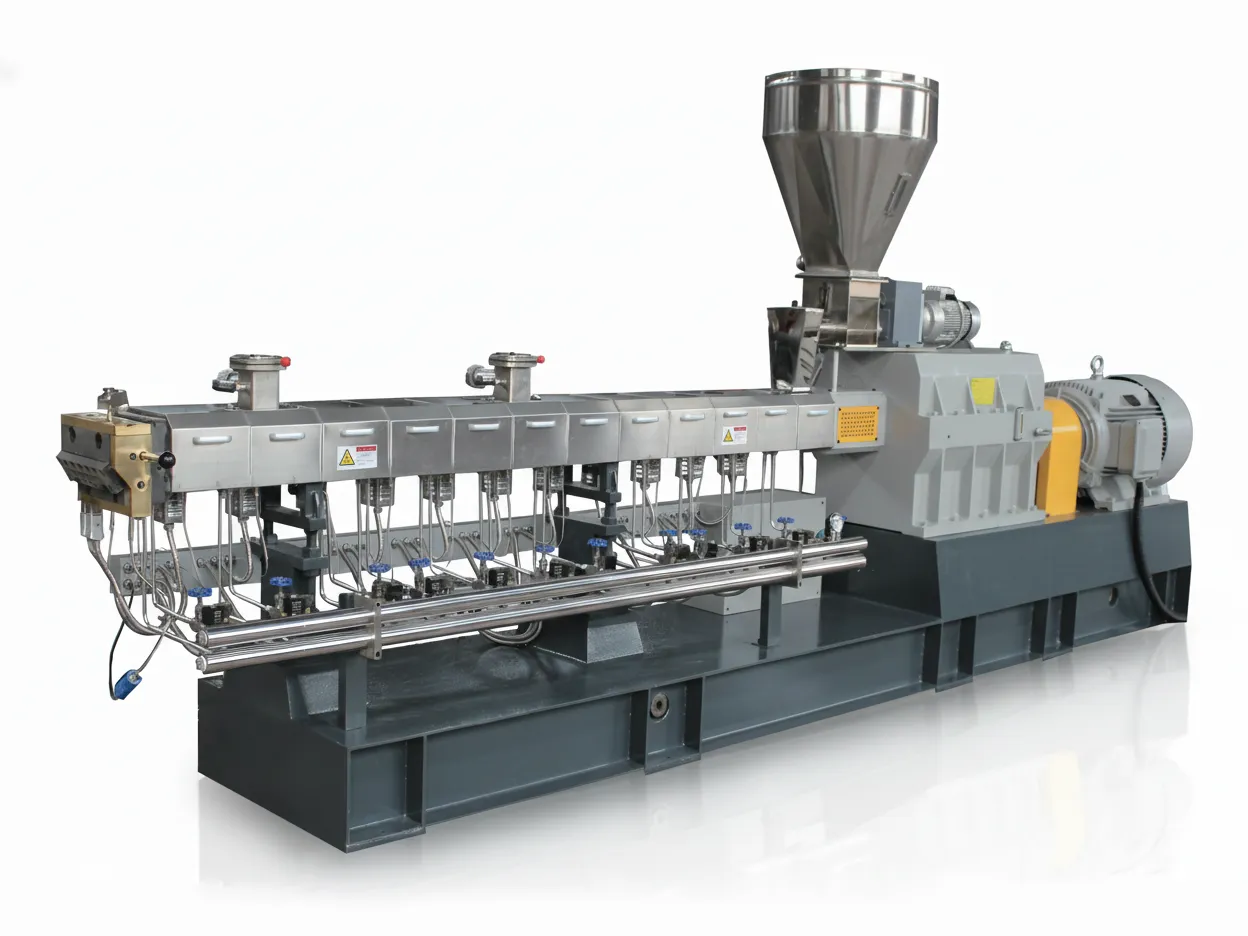
Twin Screw Compounding Extruder for Masterbatch & Fillers
Our co-rotating twin-screw compounding line is a high-torque, modular solution engineered for challenging polymer compounding and plastic pelletizing. It delivers exceptional versatility for mineral filling, color masterbatch preparation, and engineering polymer alloying.
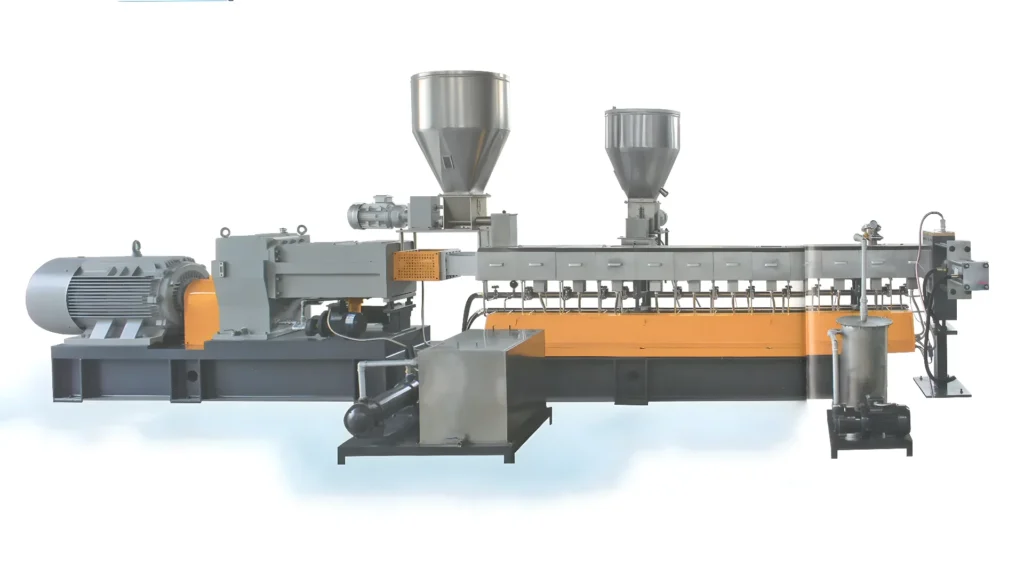
How It Works: Co-Rotating Precision Compounding
Our modular, precision-machined screw elements break down the compounding process into six synchronized, highly controllable thermal and mechanical stages.
-
Step 1Gravimetric Multi-Component Feeding
Loss-in-weight gravimetric feeders precisely meter base resin, color pigments, and functional additives into the main throat.
-
Step 2Gentle Conveying & Controlled Melting
Forward-flighting screw elements convey solid materials into the first kneading block zone, applying progressive shear to melt polymer smoothly.
-
Step 3Side-Feeding of Fibers & Fillers
Twin-screw side-feeders introduce abrasive mineral fillers (CaCO3, talc) or chopped glass fibers downstream into the already-molten polymer matrix.
-
Step 4Intensive Distributive & Dispersive Mixing
Alternating staggered kneading blocks and left-hand mixing elements generate high planar shear to disperse micro-pigments and homogenize fillers.
-
Step 5Multi-Stage Vacuum Degassing
High-vacuum multi-port degas zones extract entrained moisture, trapped air, and residual volatile monomers from the melt stream.
-
Step 6Melt Filtration & Strand / Die-Face Pelletizing
A hydraulic continuous screen changer filters foreign particles before the melt is formed into uniform pellets via water-strand or water-ring pelletizing.
Key Advantages of Twin-Screw Compounding Extruders
-
Building-Block Modular Barrel & Screws
Interchangeable screw elements (kneading, mixing, conveying) and segmented barrels allow precise customization of shear and residence time.
-
High-Torque Bilateral Drive Gearbox
Symmetrical gear distribution with imported SKF/FAG bearings and circulating forced-oil cooling delivers reliable continuous operation.
-
Wear & Corrosion Resistant Metallurgy
Bimetallic liners and WR13/W6Mo5Cr4V2 nitrided tool steel screw elements ensure long service life with up to 80% mineral filler loads.
-
Closed-Loop PID Temperature Control
Each barrel zone integrates cast-copper heaters and independent solenoid-controlled cooling jackets with Omron/Siemens PID regulators.
Engineered for Durability & Continuous Duty
A closer look at the heavy-duty drive, metallurgy, and automated process controls that power our compounding lines.
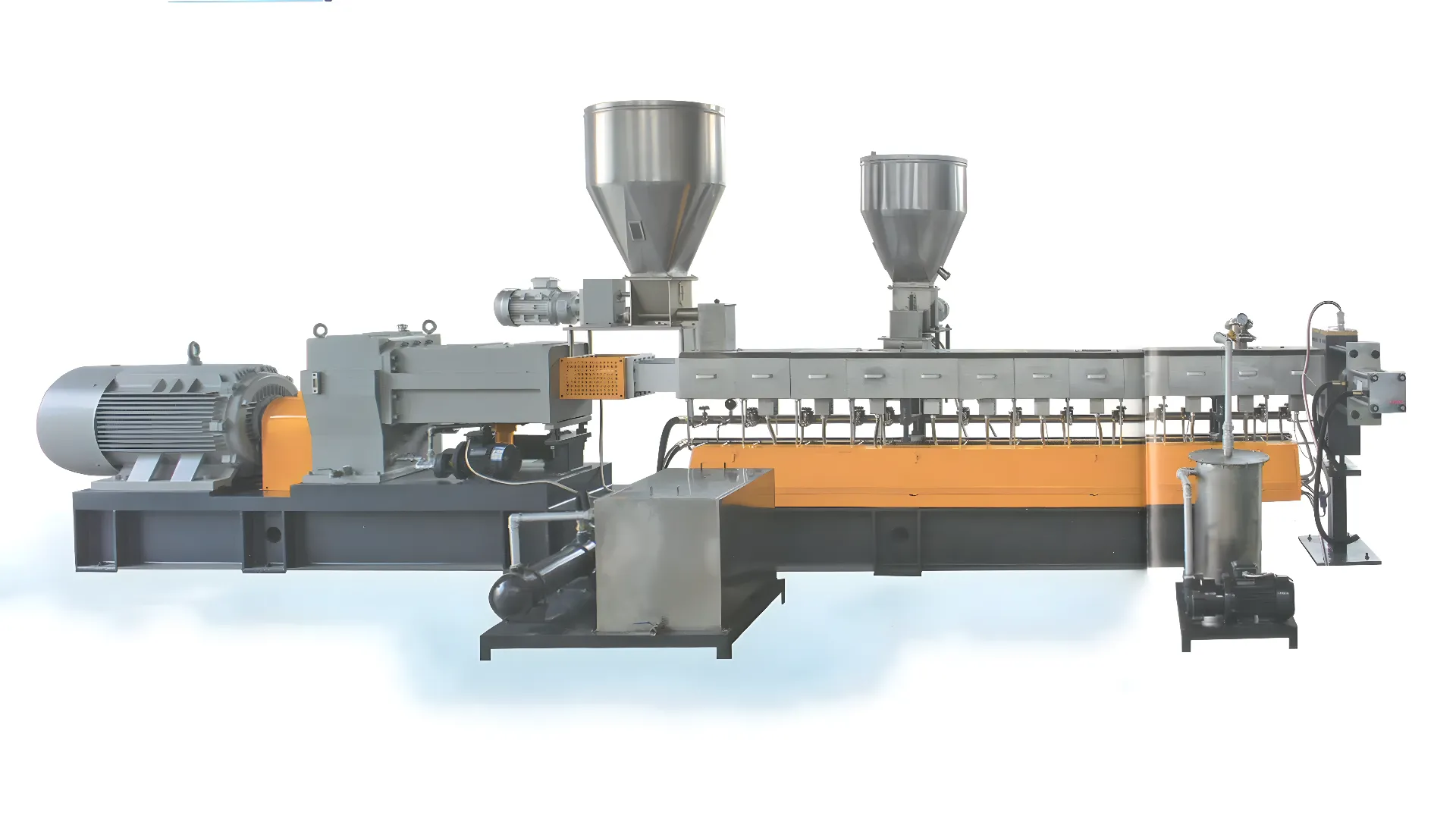
Industrial-Grade Mechanical Engineering
The foundation of our compounding line is a rigid welded steel frame housing a precision-ground, oil-immersed reduction gearbox designed for continuous industrial loads.
- Nitride-hardened and bimetallic internal wear liners
- Integrated vacuum degassing dome with moisture-trap condenser
- Closed-loop deionized water cooling circuit prevents thermal scaling
- Siemens S7 PLC automation touch interface with formulation recipe storage
Twin-Screw Compounding Applications & Formulations
From color masterbatch to engineering bioplastics, our twin-screw line handles demanding formulations across polymer manufacturing.
-
Color & Additive Masterbatch
High-pigment loading (carbon black, TiO2, organic dyes) in PE, PP, PS, and universal carrier resins.
-
Mineral Filled Compounds
High-percentage CaCO3, talc, barium sulfate, and wollastonite filling in polyolefins for stiffness and cost reduction.
-
Glass Fiber Reinforcement
Short and long glass fiber incorporation into PA6/PA66, PBT, PET, and POM for high mechanical strength.
-
Flame Retardant Formulations
Halogen-free (HFFR), phosphorus, and mineral hydrate compounding in electronics-grade plastics.
-
Thermoplastic Elastomers (TPE/TPR/TPU)
Dynamic vulcanization and compounding of SBS, SEBS, and polyurethane elastomers.
-
Biodegradable Polymer Blends
Compounding and reactive modification of PLA, PBAT, PBS, and thermoplastic starch (TPS) formulations.
Twin-Screw Compounding Extruder Specifications
Standard machine configurations. Custom screw profiles, high-torque drives, and side-feeders are engineered to formulation requirements.
| Model | Screw Dia. (mm) | Max L/D Ratio | Max Speed (RPM) | Motor Power (kW) | Output (kg/h) |
|---|---|---|---|---|---|
| RTM52C | 51.4 | 68 | 600 | 90 | 250 – 350 |
| RTM65C | 62.4 | 68 | 600 | 160 | 400 – 600 |
| RTM75C | 71.4 | 68 | 600 | 250 | 700 – 1,000 |
| RTM85C | 81.0 | 68 | 600 | 280 | 800 – 1,200 |
| RTM95C | 93.0 | 68 | 600 | 450 | 1,300 – 2,000 |
| RTM120C | 116.0 | 68 | 500 | 550 | 1,500 – 2,200 |
| RTM135C | 133.0 | 68 | 500 | 1,200 | 3,500 – 5,000 |
What Sets Our Twin-Screw Compounding Apart
Performance comparison between co-rotating twin-screw compounding lines and conventional single-screw extruders.
| Feature | Rumtoo Twin-Screw Compounding Line | Conventional Single-Screw Extruders |
|---|---|---|
| Mixing Performance | Exceptional dispersive & distributive mixing with modular kneading blocks | Weak distributive mixing; relies purely on screw channel drag |
| Process Flexibility | Extremely high; modular barrel segments and reconfigurable screw geometry | Fixed screw profile; limited formulation flexibility |
| Self-Wiping Action | Intermeshing self-cleaning screw flights prevent degradation & speed up color change | Poor self-cleaning; material hangs up in screw dead zones |
| Devolatilization | High-vacuum degassing ports (-0.098 MPa) remove high moisture and monomer gases | Single atmospheric or weak vacuum vent; prone to vent surging |
| Filler Loading Capacity | Handles up to 80% mineral powder (CaCO3, talc) and 50% glass fiber loading | Restricted filler capability; frequent screw slippage and surging |
What Our Global Clients Say
Feedback from compounders and masterbatch producers running Rumtoo extrusion lines worldwide.
Glass-Fiber Reinforced PA Compounder
“We commissioned the RTM75C line for glass-fiber reinforced nylon compounds. The modular screw design enabled us to dial in exact shear rates for dispersion without excessive fiber breakage.”
Masterbatch Manufacturer
“Running high-concentration 70% CaCO3 filler masterbatch on our Rumtoo twin-screw line. The bimetallic barrels have shown virtually zero wear after 14 months of 24/7 continuous operation.”
Engineering Biopolymer Producer
“The multi-stage vacuum degassing performance on our PLA/PBAT line is outstanding. Volatiles are thoroughly eliminated, resulting in zero porosity in downstream blow-molding trials.”
Frequently Asked Questions
Clear answers about polymer formulations, screw design, L/D ratios, and pelletizing options.
Get a Twin-Screw Compounding Extruder Quote
Contact our compounding specialists today. We will configure an optimized twin-screw extruder layout, select appropriate screw metallurgy, and provide an itemized turnkey proposal.
