


Foam packaging fills your dumpster but weighs almost nothing. Plastic film tangles in your baler and clogs your extruder. Washed PE bags hold 40% water and won’t feed into your pelletizer. You pay to haul air and water to the landfill while recyclable material loses value in your yard.
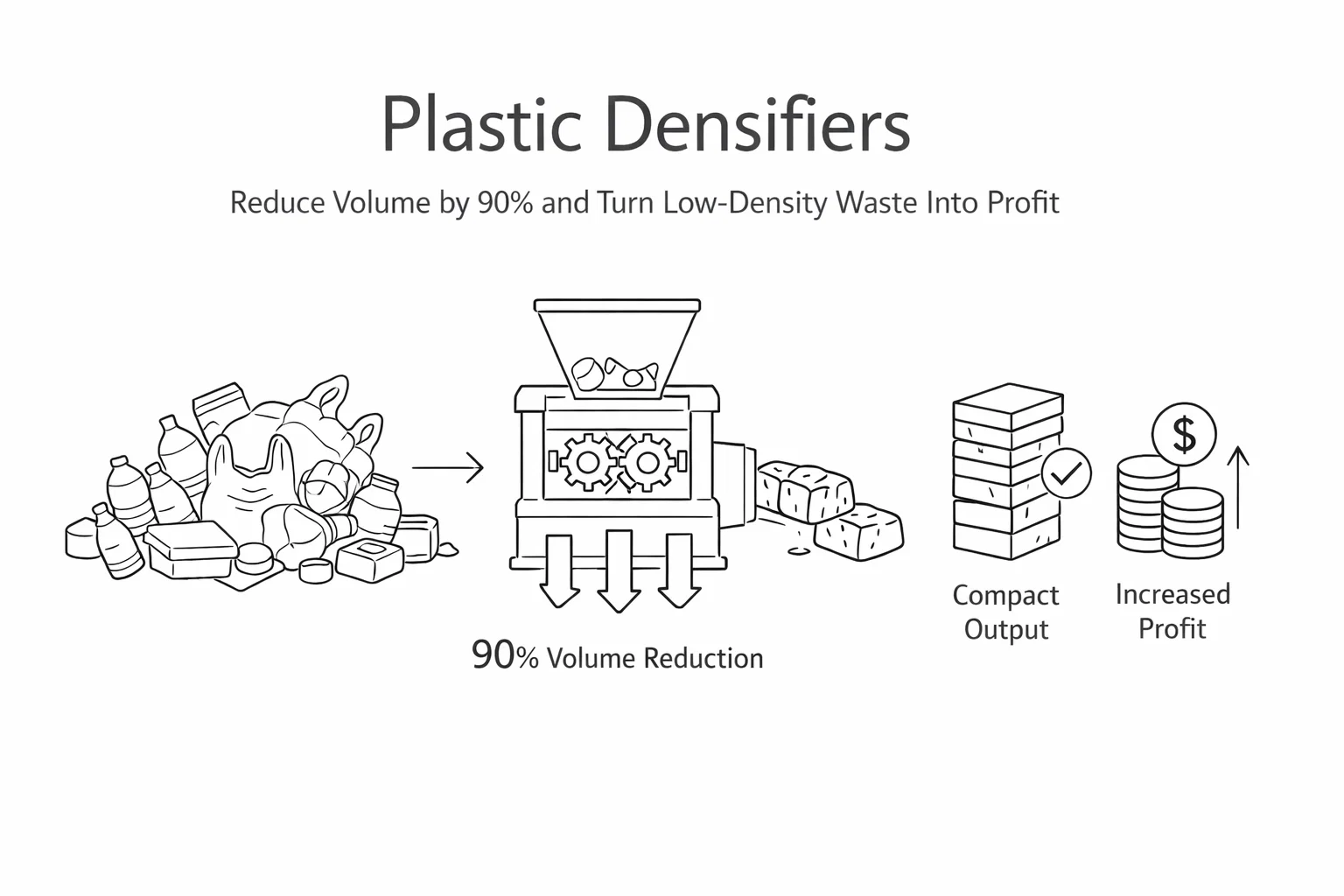
Densifiers solve this. These machines compress expanded polystyrene (EPS) foam, polyethylene film, polypropylene bags, and similar low-density plastics into compact blocks or free-flowing granules. The result: 50:1 to 90:1 volume reduction for foam, 1-5% final moisture for film, lower disposal costs, and material you can sell to reclaimers instead of paying to trash.[1]
What Materials Need Densification?
Expanded Polystyrene and Styrofoam
EPS packaging — the white blocks cushioning appliances and electronics — contains 98% air. Styrofoam, the trademarked blue foam used in construction insulation, has similar density. Both are 100% recyclable but nearly impossible to store or ship in loose form.
Manufacturers use densifiers to reclaim production scrap. Distributors and recyclers run collected material through these machines before transport. Without densification, a full truckload of loose EPS becomes a single pallet of blocks.
The environmental case is clear. EPS accounts for 25-30% of US landfill volume according to EPA estimates, and releases contaminants when exposed to sunlight or burned.[2] Densification makes recycling economically feasible.
Plastic Films
PE and PP films from grocery bags, stretch wrap, and agricultural covers are recyclable but problematic. Shredded film scatters, generates static, and bridges in extruder hoppers. Traditional dryers leave 20-30% moisture after washing, causing steam voids and degraded pellets.[3]
Specialized densifiers called agglomerators shred the film and use friction heat to partially melt the surface. The material fuses into uniform granules dense enough to feed steadily into pelletizing extruders. A plastic film squeezing machine handles the dewatering step before densification, reducing moisture to 1-5%.
Two Core Technologies
Cold Compaction
Hydraulic or screw-driven rams apply extreme pressure to collapse the air cells in foam without adding external heat. The output is a continuous “log” or rectangular blocks that stack on pallets. Compression ratios reach 50:1 for EPS and XPS.[4]
Cold compaction preserves polymer chains. Overheating can break down the molecular structure and reduce the value of recycled resin. These systems work best for consistent-density foam from packaging or manufacturing scrap.
Hot Melt Densification
These units add controlled heat to fully melt foam materials. The molten plastic extrudes through a die into blocks with 90:1 volume reduction. The process works on EPS, EPE, and EPP foams that might be too varied in density for cold compaction.[5]
Hot melt densifiers produce denser output but consume more energy. The choice depends on your material type, throughput needs, and end market requirements.
Agglomerators for Film
Film agglomerators combine shredding, friction heating, and cooling in a single pass. The knife blades generate enough heat to soften thermoplastic film to its melt point. Water or air cooling solidifies the material into granules sized for extruder feeding.
The process increases bulk density from 30-50 kg/m³ to 400-600 kg/m³. Undersized particles recirculate until they reach target size. This creates uniform feedstock that flows consistently and eliminates the bridging problems common with loose film.[6]
Why Densify?
Cut Disposal Costs
A compactor that achieves 50:1 reduction turns 50 truckloads of loose foam into one truck of blocks. At $80-120 per ton for landfill tipping fees, the savings add up fast. A mid-size manufacturer generating 500 kg/day of EPS scrap can recover equipment costs within 12-18 months through avoided disposal fees alone.
Generate Revenue
Recycled EPS blocks sell for $0.10-0.30 per pound to reclaimers who pelletize the material for reuse in picture frames, building materials, and non-food packaging. Film agglomerate commands $0.15-0.40 per pound depending on polymer type and contamination level. Material that was a disposal cost becomes a revenue stream.
Meet Sustainability Goals
EPS and PE films persist in the environment for 500+ years. Recycling these materials keeps petroleum-based polymers out of landfills and waterways. Densification is the practical step that makes collection and recycling programs economically viable.
Stabilize Manufacturing
In-plant recycling of production scrap reduces raw material purchases and waste removal. For film manufacturers, running edge trim and rejected rolls through an agglomerator and back into the extruder cuts material costs by 5-15%. Drying systems prepare washed post-consumer film for this closed-loop process.
Selecting the Right System
Match the machine type to your material. EPS packaging responds well to cold compaction. Mixed-density foam may need hot melt. Plastic film requires an agglomerator with proper die configuration for your polymer type.
Capacity matters. Throughput ranges from 50 kg/h for small retail operations to 1,000+ kg/h for large recycling facilities. Undersize a machine and it becomes a bottleneck. Oversize it and you pay for capacity you don’t use.
Consider the end market. If you plan to sell densified material, check buyer specifications for block size, density, and contamination limits. Some reclaimers prefer cold-compacted logs; others want hot-melt blocks. Match your output to market demand.
Installation requirements vary. Small units need single-phase power and minimal floor space. Large systems may require three-phase electrical, ventilation for hot melt units, and material handling conveyors.
Making It Pay
Calculate your baseline: tons of material per month × disposal cost per ton = monthly waste spend. Add storage and handling labor. That’s your current cost.
Compare to equipment cost plus operating expenses (power, maintenance, labor). Factor in revenue from selling densified material. Most operations see positive ROI within 2-3 years, faster if disposal costs are high or material volume is substantial.
Some US states offer tax credits for recycling equipment. Check your state’s environmental agency for available incentives that can improve project economics.
Final Considerations
Densifiers address a specific problem: low-density plastic waste that’s recyclable but impractical to handle. The technology is mature, proven, and cost-effective for operations that generate consistent volumes.
Don’t expect magic. Contaminated material still needs sorting. Mixed polymers still cause problems in recycling. Densifiers make good material more manageable; they don’t fix bad material.
For packaging-heavy operations, foam manufacturers, and film recyclers, densification equipment often pays for itself through reduced disposal costs alone. Add revenue from material sales and environmental benefits, and the case becomes stronger.
Evaluate your waste stream volume, disposal costs, and available floor space. Request throughput data and material samples from equipment suppliers. Most manufacturers offer trial processing to verify performance with your specific material before purchase.
