


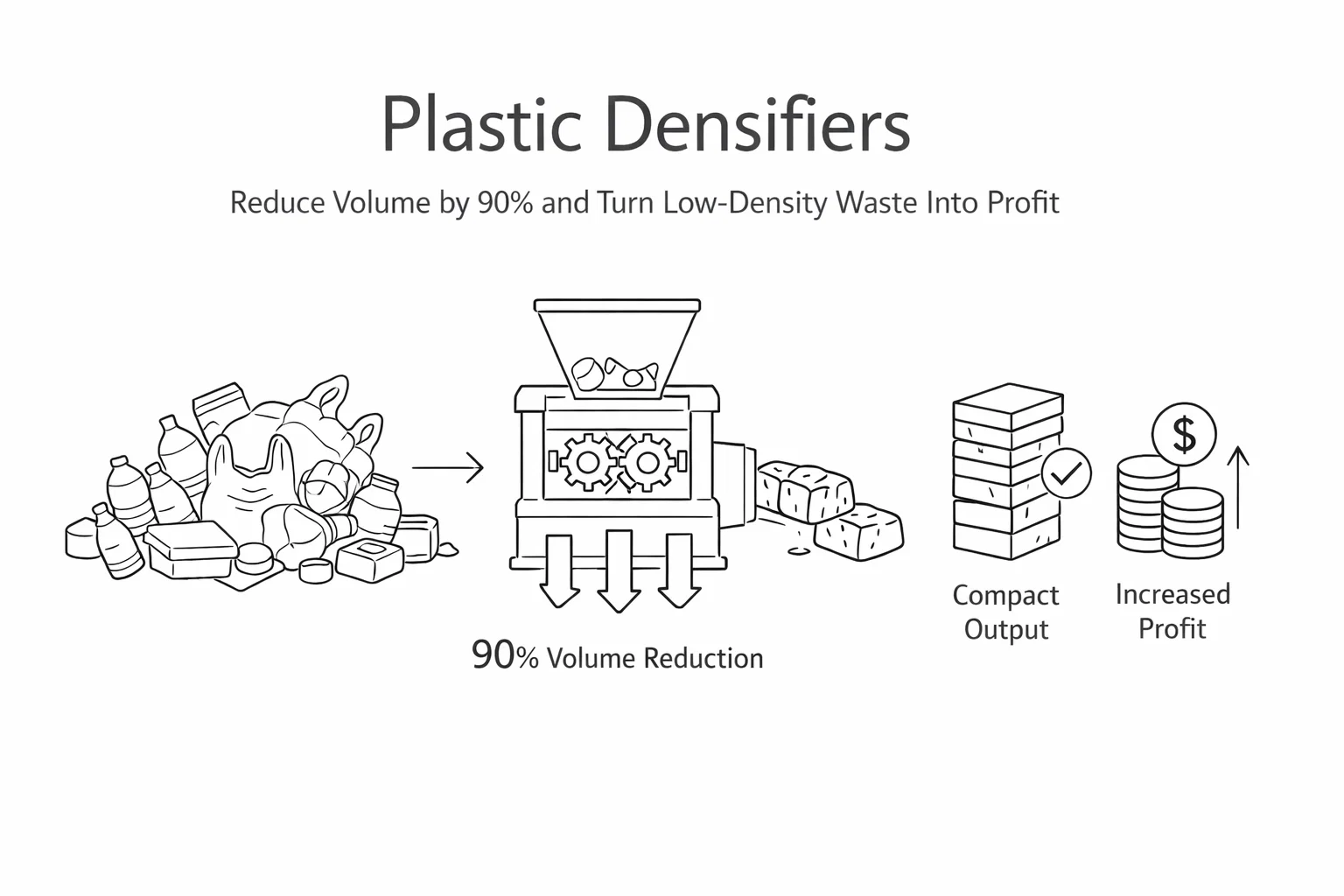
A plastic densifier machine solves one of two different problems: it reduces the shipping volume of EPS foam, or it turns loose PP/PE film into a denser feed for recycling. Those jobs need different machine designs, so the correct choice starts with the material and required output—not the highest compression claim.
This buyer’s guide separates EPS cold compactors and hot-melt densifiers from film squeezers, agglomerators and cutter-compactors. Use the comparison, material-test plan and RFQ checklist below before reviewing a plastic film densifier or a complete PP/PE film washing line.
Updated: July 18, 2026
Quick Answer: Match the Densifier to the Feedstock
| Feedstock and goal | Machine to evaluate | Typical output form | Main buying check |
|---|---|---|---|
| Clean EPS packaging; lower transport volume | Cold screw or hydraulic compactor | Dense log or block | Block integrity and buyer acceptance |
| EPS or compatible foam; fused output required | Hot-melt densifier | Melted ingot or block | Temperature control, fumes and energy demand |
| Washed PP/PE film; remove water and pre-densify | Film squeezing machine | Compressed, partly dry lumps | Residual moisture and steady discharge |
| Dry film, raffia or woven bags; stabilize extruder feed | Agglomerator or cutter-compactor | Dense crumb or hot compacted feed | Temperature control and feed consistency |
Do not use “densifier” as a universal specification. Ask the supplier to name the mechanism, accepted polymers and delivered output. This prevents an EPS machine and a film machine from being compared as if they perform the same job.
What Does Densification Mean in Recycling?
Densification means compressing low-bulk-density plastic — foam, film, fluff — into a compact, transport-ready form without necessarily melting it into pellets. A densifier machine raises bulk density by one to two orders of magnitude: loose EPS foam at 10–30 kg/m³ becomes blocks or ingots dense enough to ship economically, and fluffy washed film becomes stable feed for a pelletizer.
The benefits follow directly from that one change: freight that carries plastic instead of air, storage space cut by a factor of ten or more, stable dosing into downstream extruders, and material that actually sells — because buyers pay for pounds, not volume. Which machine achieves it depends entirely on the feed, which is what the rest of this guide compares.
1. Define the Material Before Choosing a Machine
A supplier needs more than “EPS” or “film.” For foam, identify EPS, EPE, EPP or XPS, then state whether the material contains tape, labels, food residue or moisture. For flexible plastics, separate PE from PP where the final buyer requires it and describe printing, metallized layers, paper, sand and organic contamination.
Send a feedstock data sheet with the RFQ
- Material: polymer, product format and known incompatible fractions.
- Condition: loose, baled, shredded, washed or already mechanically dried.
- Variation: normal and worst-case bulk density, moisture and contamination.
- Mass flow: kilograms per hour and operating hours per shift.
- Output destination: sale as compacted material, storage, or direct feeding to an extruder.
- Site limits: floor space, power, ventilation, noise, loading access and operator availability.
2. Compare EPS Densifier Options
Cold compaction
Cold compactors reduce EPS volume without melting the polymer. They are a strong starting point for clean, consistent packaging scrap when the downstream recycler accepts compacted logs or blocks. Judge the machine by continuous feed behavior, output stability and how well the block holds together during storage and transport.
Hot-melt densification
A hot-melt unit heats and fuses compatible foam into a dense output. It can be useful when the buyer wants an ingot-like form or when cold-compacted output is not stable enough. The trade-off is added heat, energy use, startup control and ventilation. Confirm which foam grades and additives the supplier has tested; “foam” alone is not a sufficient guarantee.
3. Compare PP/PE Film Densification Options
Washed film usually has two separate needs: mechanical water removal and steady extruder feeding. A plastic film squeezing machine addresses the first need. A film densifier, agglomerator or cutter-compactor addresses the second by cutting and compacting light scrap so it does not bridge in the feed system.
| Project condition | Preferred first check | Reason |
|---|---|---|
| Wet film after washing | Squeezing and mechanical drying | Control residual water before the melt stage |
| Clean dry edge trim | Direct cutter-compactor or agglomerator trial | Avoid adding a wet-process step that is not needed |
| Printed or mixed-condition film | Trial with degassing and filtration plan | Ink, moisture and contamination affect melt stability |
| Film sold as washed flake, not pelletized | Confirm whether densification adds buyer value | Extra processing is justified only if handling or price improves |
4. Specify the Material Trial and Acceptance Test
Run the trial with a representative batch that includes normal variation. Record a timed input mass, stable-output period, stoppages and the output condition. If the densified material feeds an extruder, continue the test through pelletizing; a dense-looking sample is not proof of stable melt pressure or acceptable pellets.
- Document the sample: polymer, moisture, bulk density and visible contaminants.
- Agree on operating settings: motor load, temperature where applicable and feed method.
- Measure output: kg/h, output bulk density, residual moisture and consistency.
- Inspect failure points: bridging, block breakage, wrapping, overheating, odors and metal damage.
- Confirm the next step: buyer acceptance or downstream extrusion performance.
5. Calculate ROI with Your Own Material Flow
Monthly benefit = avoided disposal and transport cost + sale value or recovered resin value − power − labor − wear parts − planned maintenance. Use measured monthly mass, not container count alone. A volume-reduction claim can lower freight cost, but it does not automatically increase material value.
Ask the supplier for power at the tested operating point and a wear-parts list. Include conveyors, dust or fume control, storage bins, electrical work and commissioning in the investment. Compare payback under normal and low-volume months so the result is not based on the best production week.
Plastic Densifier RFQ Checklist
- Accepted polymers and prohibited contaminants.
- Required pre-shredding, washing, drying and metal removal.
- Guaranteed kg/h on the supplied material sample.
- Input and output bulk density, moisture and output form.
- Connected load, measured operating power and ventilation needs.
- Blade, screw, heater and hydraulic maintenance schedule.
- Controls, guarding, emergency stops and operator training.
- Material-trial report, warranty, spare parts and commissioning scope.
Related Equipment and Next Step
For a wet-film project, compare the film squeezing and drying stage with the film densifier. If the goal is finished pellets, review the plastic pelletizer range and send the same material data to each supplier.
Frequently Asked Questions
Is an EPS compactor the same as a film densifier?
No. An EPS compactor collapses foam cells into logs or blocks. A film densifier, squeezer or cutter-compactor prepares flexible PP or PE scrap for stable downstream feeding.
Should I choose cold compaction or hot melt for EPS?
Choose according to accepted feedstock, the recycler’s required output form, energy and ventilation limits, and sample-test results. Cold compaction avoids melting; hot melt produces a fused output.
Does washed film need a squeezer before pelletizing?
Often yes. Mechanical squeezing removes water and raises bulk density, which helps the pelletizing extruder receive a more even feed. The required setup depends on residual moisture and final pellet specifications.
What should a densifier material trial measure?
Record feed rate, input and output bulk density, residual moisture, temperature, power demand, output consistency, contamination behavior and any stoppages. Test the actual worst-case feedstock, not only a clean sample.
How can I compare plastic densifier quotations?
Give every supplier the same material data and acceptance test. Compare the complete scope, proven output on your feedstock, power, wear parts, labor, installation requirements and output accepted by your buyer.
