


Every year, hundreds of millions of tires reach the end of their road life. They pile up in landfills, stockpiles, and illegal dumps — bulky, nearly indestructible, and prone to fires that burn for weeks. A tire shredder is the first and most critical machine in any tire recycling operation: it tears whole tires into manageable pieces so that rubber, steel wire, and fiber can be recovered and sold. This guide explains how tire shredding works, what makes the Rumtoo RTR tire re-shredding machine different, and what to confirm before you buy.
Why Tire Recycling Needs a Specialized Shredder
Tires are engineered to be almost indestructible. A passenger tire combines natural and synthetic rubber, steel belts, textile fiber, carbon black, and a cocktail of chemical additives — all vulcanized into a structure that resists tearing, cutting, and grinding. Standard plastic shredders cannot survive this: steel belts destroy ordinary blades within hours, and the elastic rubber springs back instead of fracturing.
A dedicated tire shredder is built for this punishment. Low-speed, high-torque twin-shaft designs bite into whole tires and pull them apart rather than chopping at high speed, which keeps blade wear manageable and prevents the rubber from heating and gumming. For operators, that difference decides whether tire recycling is profitable or a maintenance nightmare.
How a Tire Shredder Works: From Whole Tire to Clean Chips
Tire recycling is a two-stage size-reduction process. Whole tires go in; clean rubber chips and clean steel wire come out. Each stage has a distinct job, and getting the sequence right is what produces sellable end products instead of mixed waste.
Pre-Shredding: Breaking Whole Tires Down
The first stage — pre-shredding — accepts whole tires (passenger, truck, and many industrial sizes) and reduces them to rough chips, typically 50–150 mm. A double-shaft shredder for tires is the standard choice here: two counter-rotating shafts with intermeshing cutters grip the tire and tear it apart with enormous torque at low speed. Because the machine runs slowly, blade heat stays low and the rubber does not melt or smear.
Pre-shredding does three things: it makes the material conveyable, it starts liberating the steel belts from the rubber, and it exposes far more surface area for whatever comes next. Most operations then pass the chips over a magnetic separator to pull out loose wire before the second stage.
Re-Shredding: Turning Chips into Usable Product
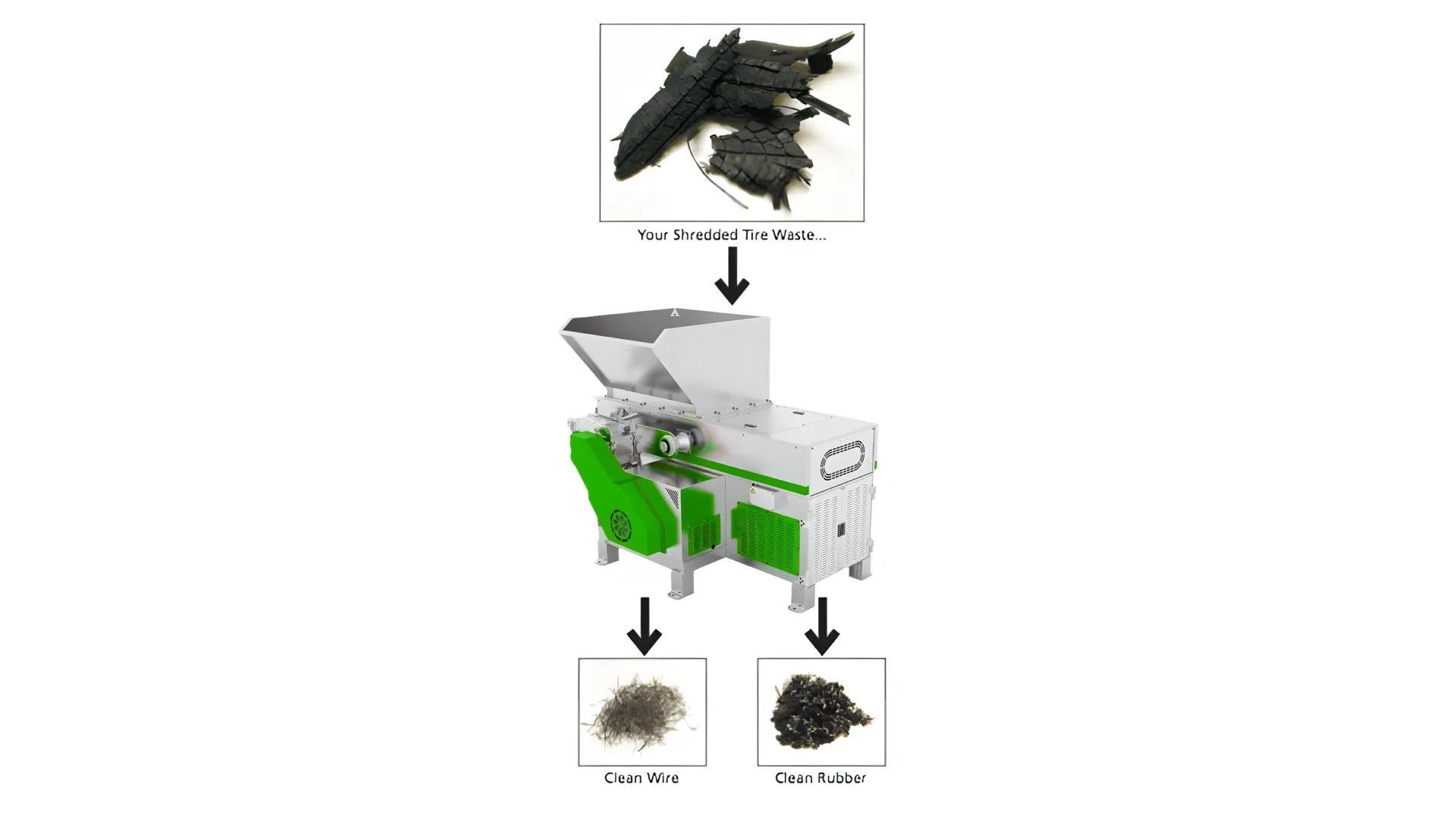
The second stage — re-shredding — takes pre-shredded chips and reduces them further, typically to 10–40 mm, while completing the liberation of steel wire from rubber. This is where the Rumtoo RTR tire re-shredding machine earns its keep: it is purpose-built to deliver two distinct products in one pass — clean rubber and clean wire.
Clean rubber means rubber substantially free of steel and fiber; clean wire means wire substantially free of rubber. That separation is what determines your revenue. Tire buyers — cement kilns, crumb-rubber mills, molded-product manufacturers — pay a premium for material that does not need further cleaning, and penalize mixed or contaminated feed.
The Rumtoo RTR Tire Re-Shredding Machine
The Rumtoo RTR is a dedicated tire re-shredder designed around one principle: maximize the value recovered per ton of tires. Unlike general-purpose shredders adapted for tires, every part of the RTR — cutter geometry, shaft speed, screen sizing, and discharge arrangement — is optimized for rubber with embedded steel.
- Dual product output. The RTR generates clean rubber and clean wire simultaneously, in a single pass. Two saleable streams from one machine means fewer handling steps and a shorter path to revenue.
- Low operating cost per ton. Cutter design and slow rotor speeds keep blade wear — the dominant consumable cost in tire shredding — as low as the process allows. Over a year of multi-shift operation, that is the difference between a line that pays for itself and one that does not.
- Versatility. The RTR handles passenger car tires, truck tires, and many industrial tires, with or without steel belting. Operations that receive mixed tire streams do not need to pre-sort aggressively.
Clean Rubber vs Clean Wire: Why Steel Separation Matters
Steel wire typically makes up 10–20% of a tire’s weight. If it stays tangled in your rubber, both products lose value: rubber buyers reject wire contamination because it damages their downstream equipment, and wire buyers reject rubber contamination because it lowers scrap density and melting yield.
Effective separation combines mechanical liberation in the shredder with downstream sorting — usually magnetic drums or overband magnets for wire, and air or vibrating tables for fiber. The quality target is simple: rubber clean enough for direct sale as chips or feedstock for crumb rubber, and wire clean enough for the steel scrap market. Rumtoo’s re-shredding approach is designed to liberate the wire thoroughly enough that standard magnetic separation finishes the job without secondary cleaning equipment.
End Products and Applications of Recycled Tire Material
Properly processed tire material has established, paying markets — which is why the separation quality discussed above matters so much.
- Tire-derived fuel (TDF). Shredded tire chips with high, consistent energy content (roughly comparable to coal by weight) are burned as fuel in cement kilns, pulp and paper mills, and power plants. Because Rumtoo’s process delivers chips substantially free of wire, the fuel burns cleaner and handles better in feeding systems — making it a more desirable fuel source than wire-contaminated chips.
- Crumb rubber. Further-ground rubber (typically 1–10 mm) goes into playground surfaces, athletic tracks, rubber-modified asphalt, molded mats, and new rubber products. This is the highest-value outlet, and it demands the cleanest feed.
- Rubber chips and mulch. Coarser chips serve as landscape mulch, equestrian footing, and drainage or lightweight fill material — steady-volume, lower-spec markets that absorb large tonnages.
- Recovered steel wire. Clean bead and belt wire is sold directly into the steel scrap stream, adding a second revenue line that many operators underestimate when costing a project.
How to Choose a Tire Shredder: RFQ Checklist
Before requesting quotes, pin down these six points — suppliers price very differently depending on your answers.
- Tire mix and size range. Passenger only, or truck and OTR as well? Maximum tire diameter determines the feed opening and shaft power you need.
- Target output size. TDF chips (coarse), crumb-rubber feed (fine), or both? Output size drives the re-shredder screen selection and capacity.
- Required throughput. Tons per hour and operating shifts per day. Tire shredders are torque-limited machines; be honest about peaks, not averages.
- Separation requirements. Do you need clean wire as a separate saleable product, or is mixed output acceptable for your buyer? This decides the sorting equipment downstream.
- Blade economics. Ask for expected blade life in tons per set, blade material and hardness, and whether cutters can be re-sharpened and re-used — blades are the main consumable cost.
- Installation and support. Foundation requirements, dust and noise control, spare-parts availability, and commissioning support. A tire shredder is a 20-ton machine; logistics matter.
Frequently Asked Questions
Can a tire shredder process whole tires, or do they need pre-cutting?
A purpose-built tire pre-shredder accepts whole passenger and truck tires without pre-cutting. Only very large OTR (off-the-road) mining tires typically need a debeader or section cutter first. If a supplier tells you to pre-cut car tires, the machine is undersized for the job.
What is the difference between pre-shredding and re-shredding?
Pre-shredding reduces whole tires to rough chips (50–150 mm) so the material can be conveyed and sorted. Re-shredding takes those chips down to final size (10–40 mm) while liberating the remaining steel wire. The Rumtoo RTR is a re-shredder: it finishes what the pre-shredder starts and separates clean rubber from clean wire in one pass.
How is steel wire separated from the rubber?
Liberation happens inside the shredder — cutters tear the wire free from the rubber matrix. Recovery happens downstream with magnetic drums or overband magnets that pull the ferrous wire out of the chip stream. The shredder’s job is to free the wire thoroughly enough that magnets can capture it; poor liberation is the main cause of wire-contaminated rubber.
What end products can I sell from tire recycling?
Four revenue streams: tire-derived fuel (TDF) for cement kilns and industrial boilers, crumb rubber for playgrounds, tracks, and molded products, coarse rubber chips for mulch and fill, and recovered steel wire sold as scrap. Pricing depends on cleanliness and consistency — which is why separation quality is the economic heart of the operation.
Should I choose a single-shaft or double-shaft shredder for tires?
For whole tires, double-shaft is the standard: two counter-rotating shafts grip and tear the tire with high torque at low speed, which survives steel belts far better than high-speed single-shaft cutting. A single-shaft shredder can work for the second stage on pre-shredded chips in some configurations, but whole-tire duty belongs to twin-shaft machines.
What does tire-derived fuel (TDF) get used for?
TDF is burned as a coal substitute in cement kilns — the largest market — plus pulp and paper mills, lime kilns, and dedicated power plants. Kilns value TDF because shredded tires have high heat content and the steel wire contributes iron to the cement chemistry. Wire-free chips command better terms because they feed and burn more predictably.
What should I confirm before buying a tire shredder?
Confirm your tire mix and maximum size, target output size and throughput, whether you need clean wire as a separate product, expected blade life and re-sharpening policy, and installation requirements. Ask for reference installations processing the same tire types you plan to run — tire mixes vary enormously by region, and a machine proven on European truck tires may behave differently on your feedstock.
See the Tire Shredder and Request a Quote
Explore the Rumtoo tire shredder range — from whole-tire pre-shredders to the RTR re-shredding machine — or browse the complete tire recycling machine line. Tell us your tire mix, target output, and required throughput, and we will recommend a configuration.
Related: explore the complete tire recycling machine line, or read our double-shaft shredder for tires.
