
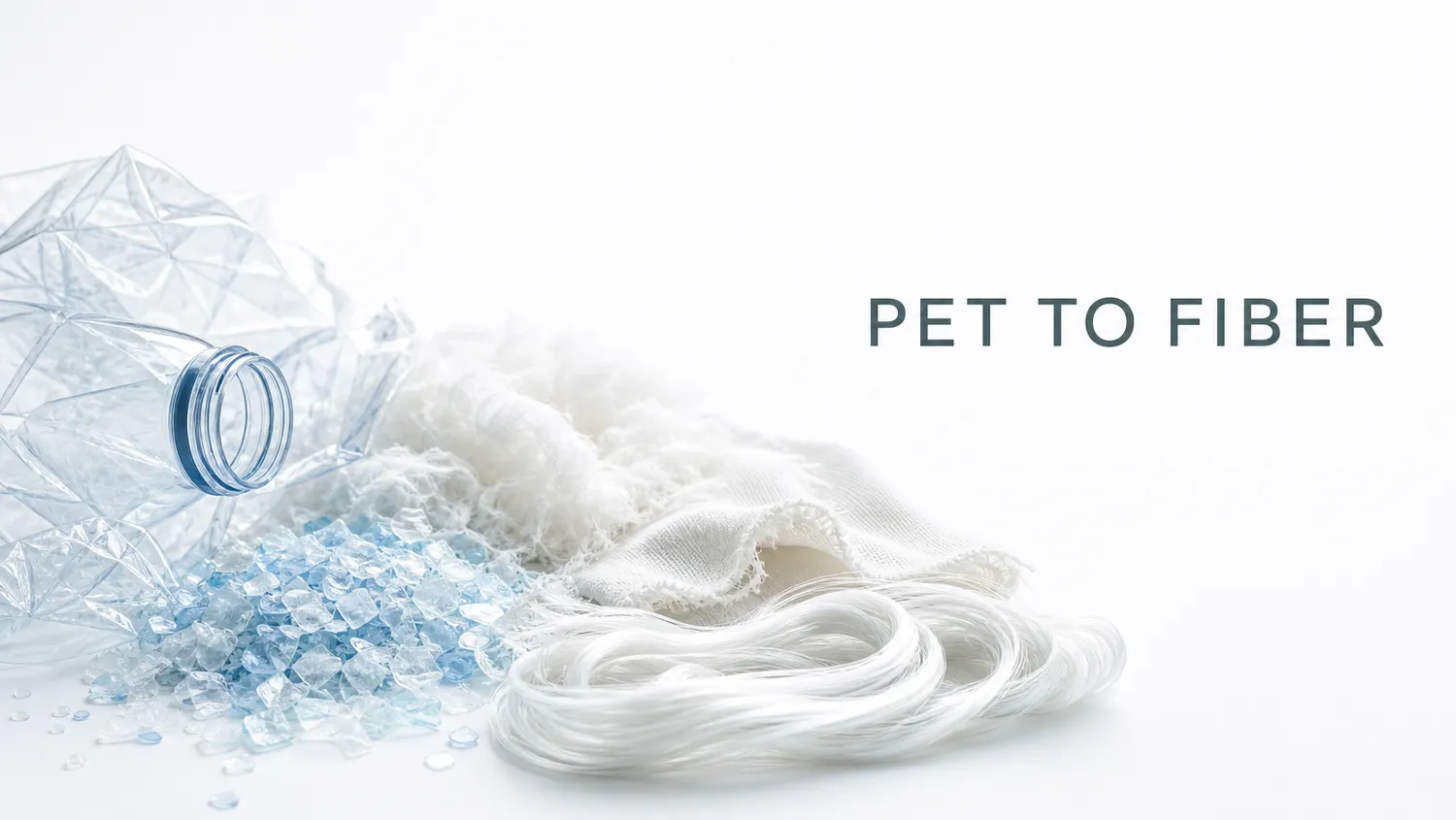
A polyester recycling machine turns PET waste — bottles or textiles — back into reusable polyester fiber or pellets. Polyester and PET are the same polymer, which is why the two biggest feedstock streams end in the same place: post-consumer bottles washed into flake that spinning mills draw into recycled fiber, and polyester garments or fabric scrap shredded and repelletized. This guide explains both routes, the equipment each one needs, and what actually determines the price of a line.
Polyester and PET: one polymer, two waste streams
Polyester fiber is polyethylene terephthalate — the same resin as a water bottle. A polyester recycling machine is therefore not one machine but a line matched to the form the waste arrives in:
| 피드스톡 | Process route | 출력 |
|---|---|---|
| PET bottles (baled) | Sort → wash → separate → dry | Hot-washed rPET flake for fiber spinning or pelletizing |
| Polyester textiles (garments, fabric scrap, offcuts) | Shred → open fiber → densify or pelletize | Recovered fiber for filling/nonwoven, or rPET pellets |
The bottle route is the volume business — most recycled polyester fiber in the market starts as bottle flake. The textile route is growing fast as brands take back garment waste, and it needs completely different front-end machinery.
Route 1: PET bottles to polyester fiber
Spinning mills buying flake for fiber have one non-negotiable demand: clean, dry, PVC-free flake with stable intrinsic viscosity. The washing line delivers that in five stages:
- Debaling and label removal — bales are opened and a label remover strips the PVC and PP label film that would contaminate the melt.
- Crushing to flake — bottles are wet-crushed into 10–14 mm flake.
- Hot washing — a 연속 뜨거운 세척기 with caustic solution removes glue, oil, and food residue that cold water cannot touch. For fiber-grade flake this stage is mandatory, not optional.
- 식빵 분리 — in a sink-float separation tank, PET flake sinks while PP/PE caps and label fragments float off, taking the polyolefin contamination out in one pass. A 마찰 와셔 scrubs the flake between stages.
- 건조 — centrifugal then hot-air drying brings moisture down so the flake stores and ships without hydrolysis loss.
From there the flake either sells directly to the spinning mill or runs through a PET flake pelletizer when the buyer wants pellets instead of flake. The complete configuration is our 페트병 재활용 시스템.
Route 2: polyester textile waste to recovered fiber
Garments, cutting-room scrap, and polyester fabric rolls cannot enter a bottle wash line — fabric wraps rotors and holds water. The textile route starts with size reduction built for fiber:
- Textile shredding. ㅏ 텍스타일 섬유 파괴기 with low shaft speed and anti-wrapping rotor geometry tears garments and fabric into staple without fusing the synthetic fiber — the failure mode of fast, standard shredders on polyester.
- Fiber opening. Downstream opening machines loosen the shredded material back into usable fiber for filling, padding, and nonwoven production.
- Pelletizing (optional). Clean, single-polymer polyester scrap can instead be densified and repelletized into rPET granules for extrusion — the route for post-industrial offcuts with known composition.
The fork in the road is contamination: mixed-fiber garments (poly-cotton blends) stay on the fiber-recovery route, while clean 100% polyester scrap is worth more as pellets.
What determines the price of a polyester recycling machine?
Quotes for “a polyester recycling machine” range from the cost of a single shredder to a seven-figure turnkey plant because the term covers both. Five factors set the real number:
- Feedstock form — a textile shredder line is a fraction of the cost of a bottle wash plant; know which route you are pricing.
- 처리량 — bottle lines are typically quoted at 500–3,000 kg/h; each step up in capacity scales every tank, dryer, and conveyor in the line.
- Hot wash or not — the hot washing loop (boiler or electric heating, caustic dosing, rinse stages) is the single biggest cost block, and fiber-grade flake cannot skip it.
- Output specification — flake for local sale needs less than export-grade flake with tight PVC ppm limits; pellets add the pelletizing stage.
- Water treatment — closed-loop filtration is increasingly required by environmental permits and belongs in the initial budget, not a retrofit.
Frequently asked questions
What machine turns PET bottles into polyester fiber?
A PET bottle washing line produces the hot-washed flake, and a fiber spinning line (usually a separate plant) draws the flake into polyester staple fiber. The recycling machinery covers debaling, label removal, crushing, hot washing, sink-float separation, friction washing, and drying — everything up to spinning-grade flake.
Can polyester clothes be recycled by machine?
Yes. Polyester garments and fabric scrap are shredded by a low-speed textile shredder and reopened into fiber for filling and nonwoven use. Clean 100% polyester scrap can also be repelletized into rPET granules. Blended fabrics (poly-cotton) stay on the fiber-recovery route because the two polymers cannot be separated mechanically.
Is recycled polyester the same as rPET?
Yes — recycled polyester (rPET) is recycled polyethylene terephthalate. Fiber marketed as recycled polyester is mostly spun from hot-washed PET bottle flake, which is why bottle wash lines are the backbone of the recycled polyester supply chain.
How much does a polyester recycling line cost?
It depends on the route and capacity: a textile shredding setup starts far lower than a bottle wash plant, and a complete 1,000 kg/h fiber-grade bottle line with hot washing and water treatment is a different budget class. Send your feedstock, target output, and capacity for a configured quote rather than pricing from a generic figure.
Get a line matched to your feedstock
The right polyester recycling machine follows from three answers: what form your waste arrives in, what the buyer of your output requires, and your hourly rate. Send Rumtoo your feedstock photos, capacity target, and output spec — we will configure the bottle-wash or textile route accordingly and quote the complete line. Contact our engineering team for a tested recommendation.
