


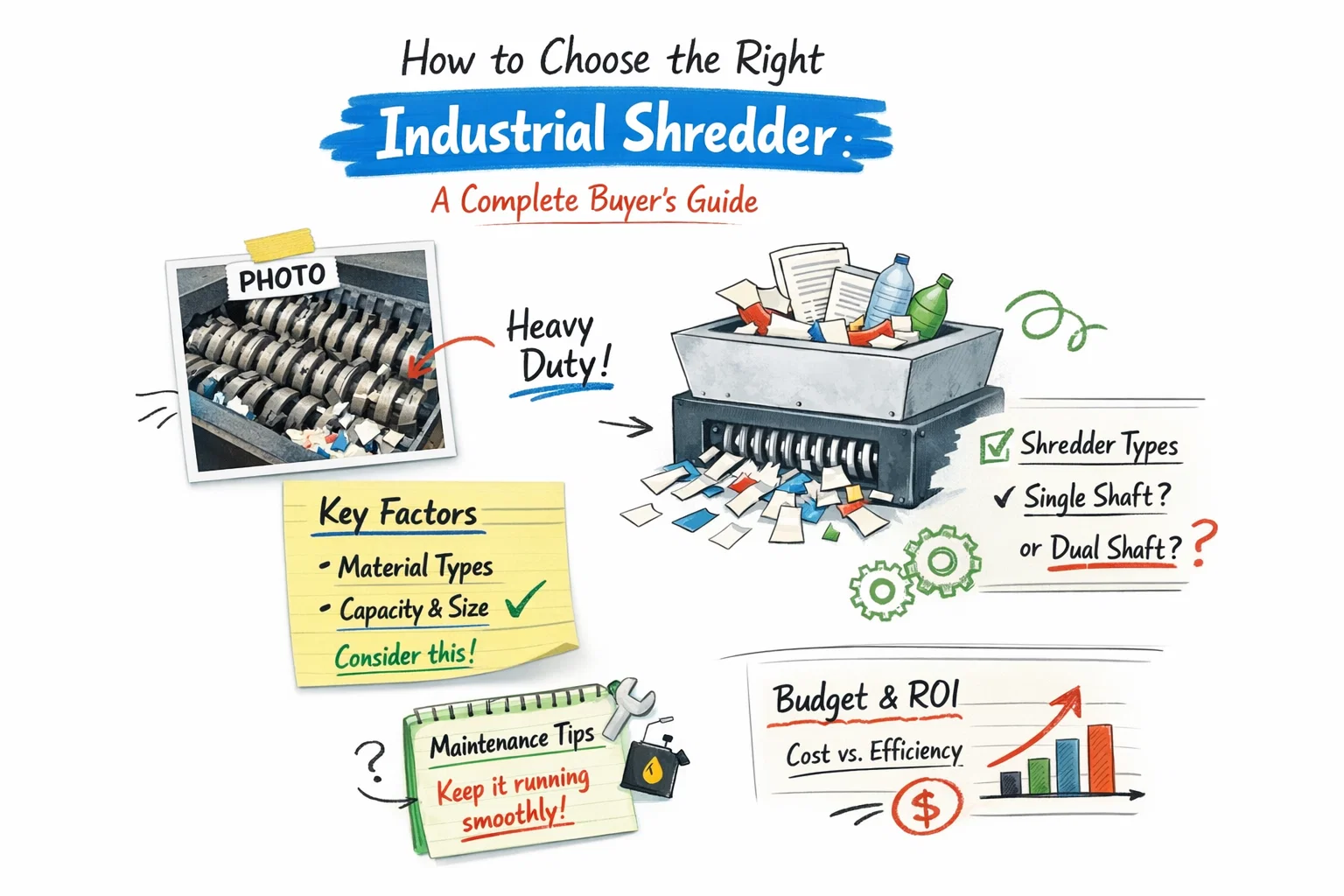
Choosing the wrong industrial shredder can cost your operation tens of thousands of dollars in downtime, inefficient throughput, and compliance failures. Whether you process plastic waste, scrap metal, or sensitive documents, matching the right machine to your materials and volume is the single most critical decision in your shredding workflow.
This guide covers every factor that matters — from shredder types and capacity planning to safety standards and maintenance protocols — so you can make a confident, data-backed purchasing decision.
What Is an Industrial Shredder and Who Needs One?
Industrial shredders are heavy-duty machines engineered for continuous, high-volume material reduction. Unlike commercial office shredders, industrial models handle materials ranging from rigid plastics and rubber tires to scrap metal and electronic waste — often processing several tonnes per hour under sustained load.
Industries that rely on industrial shredders include:
- Recycling and waste management facilities — processing mixed plastic, rubber, and municipal solid waste
- Manufacturing plants — reducing production rejects and off-cuts for reprocessing
- Financial institutions and government agencies — securely destroying classified documents and data storage media
- E-waste processors — shredding hard drives, circuit boards, and electronic components
- Tire recyclers — converting used tires into rubberized asphalt, boiler fuel, or landfill cover
The common thread: volume, consistency, and material versatility demand a purpose-built machine — not a scaled-up office unit.
Industrial Shredder Types: Matching Machine to Material
The most important first step is identifying which shredder configuration suits your input materials and output requirements. The four primary types each serve a distinct operational profile.
Single-Shaft Shredders
Single-shaft shredders use one rotating cutting shaft against a fixed counter-blade. They deliver precise, uniform particle sizing — ideal for rigid plastics, film waste, and light production scrap. Output particle size is controlled by screen selection, giving operators accurate and repeatable specification.
Dual-Shaft (Twin-Shaft) Shredders
Dual-shaft shredders apply slow-speed, high-torque cutting through two counter-rotating shafts. This design handles bulky and irregular materials such as mixed industrial waste, tires, metal-containing streams and construction debris. Actual throughput varies widely with material density, feed size, contaminants, cutter geometry and downstream size requirements, so use a representative material trial rather than a generic tonnes-per-hour range.
Best for: C&D waste, scrap metal, mixed solid waste, tires
Quad-Shaft (Four-Shaft) Shredders
Quad-shaft machines combine the tearing power of a dual-shaft primary stage with a secondary cutting stage for tighter particle size control. These are preferred in recycling operations that require precise sizing — such as electronics recovery or metal scrap processing.
Granulators and Hammer Mills
- Granulators reduce pre-shredded plastic into smaller, screen-controlled flakes or regrind. Pellet production requires a separate extrusion and pelletizing stage.
- Hammer mills use high-speed impact rather than cutting; suited for brittle materials like glass, ceramics, and certain plastics
| Shredder Type | Primary Use | Output Size Control | Speed Profile |
|---|---|---|---|
| Single-shaft | Rigid plastic, film | High (screen-controlled) | Medium |
| Dual-shaft | Metal, bulky waste, tires | Moderate | Low-speed, high torque |
| Quad-shaft | E-waste, fine recycling | Very high | Medium |
| Granulator | Post-shred plastic refining | Very high | High |
| Hammer mill | Brittle materials | Moderate | High |
Other Specialized Industrial Shredder Types
Single-, dual- and four-shaft machines cover most recycling duties, but several specialized designs serve narrower applications. Treat these names as descriptions of cutting action or application—not as substitutes for a material trial and an output specification.
| Type | Typical application | Selection caution |
|---|---|---|
| Pierce-and-tear shredder | Paper, confidential media, packaging and light mixed products | May not provide a precise, screened particle size for recycling. |
| Cardboard shredder or perforator | Turning cartons into loose fill or packing mats | Confirm required strip or mat width and remove staples or contaminants. |
| High-speed grinder | Wood, organics or selected pre-shredded materials | Higher speed can increase dust, noise, fines and sensitivity to tramp metal. |
| Application-specific shredder | Tires, cable, e-waste, medical waste or data media | Safety, separation and compliance requirements often determine the complete system. |
Ask suppliers to state the accepted feed size, contaminants, tested throughput, motor load, screen size, expected wear-part life and downstream separation needs. The correct choice is the machine that produces the required output consistently—not the model with the longest list of possible materials.
How to Assess Your Shredding Capacity Requirements
Undersizing your shredder creates bottlenecks; oversizing inflates capital and operating costs. Capacity planning should be based on three measurable inputs:
- Daily volume (kg or tonnes) — total weight of material to be processed per shift
- Peak load scenarios — maximum volume spikes that the machine must handle without stalling
- Material bulk density — loose plastic film behaves very differently from dense metal scrap at the same weight
Size the shredder from the highest sustained feed rate in kg/h, not only daily tonnage. Include bulk density, largest piece size, feeding method, contaminants, screen or output target, planned operating hours and downstream capacity. Add operational margin only after a supplier has tested representative material and stated the assumptions behind the quoted output.
Also consider feed format: is your material pre-sorted and uniform, or mixed and irregular? Irregular feeds benefit from large-hopper, dual-shaft configurations with pusher rams to force difficult material into the cutting chamber.
Feed Systems and How They Affect Throughput
The feed system determines how materials enter the cutting chamber — and directly impacts both throughput and operator safety.
- Manual feed: Operator-controlled loading; suitable for low-volume, variable material streams; allows material inspection before shredding
- Gravity feed (hopper-fed): Materials drop into the chamber by gravity; effective for bulk, uniform waste streams; low operator intervention required
- Conveyor feed: Automated belt feeding; ideal for high-throughput, continuous operations; integrates well with upstream sorting or downstream granulation lines
For most industrial recycling and waste processing applications, conveyor-fed systems maximize throughput and reduce labor costs per tonne processed. Manual feed remains appropriate where material inspection, selective shredding, or classified document destruction is required.
Security Levels and Compliance Standards
For document destruction, security classification is non-negotiable. The internationally recognized benchmark is DIN 66399, published by the German Institute for Standardization (DIN), which defines seven security levels for paper destruction:
- P-1 to P-3: General office and commercial document destruction
- P-4: Sensitive personal data (recommended baseline for most businesses under GDPR and equivalent regulations)
- P-5 to P-7: Secret and top-secret government and military documents
For data storage media, the same standard covers optical discs (O-class), magnetic media (T-class), and hard drives (H-class). Verify that your shredder’s certified security level matches your regulatory or compliance requirements before purchasing.
Key Operational Factors: Power, Noise, and Safety
Power and Energy Efficiency
Shredder motor power varies from compact units to multi-motor heavy-duty systems. Confirm the facility voltage, phase, available current, starting method and transformer capacity, then compare energy use per tonne under tested material conditions. A variable-frequency drive can improve control in suitable variable-load applications, but the saving depends on the motor, control strategy, feed consistency and duty cycle.
Noise Levels
Slow-speed, high-torque shredders are generally easier to enclose and control than high-speed impact equipment, but actual sound exposure depends on the material, feed system, building and operating pattern. Require measured sound data for the proposed application, assess exposure at operator positions, and follow the applicable local occupational-noise requirements. Include acoustic enclosures and isolation where needed.
Safety Features to Require
Do not accept a machine without these baseline safety systems:
- Emergency stop (E-stop) buttons accessible at multiple points around the machine
- Overload protection with automatic reverse or shutdown to prevent jam damage
- Safety guards and interlocked access panels that cut power when opened
- Slow-speed, high-torque cutting to reduce risk of sudden mechanical failure
- Smart control panels with remote diagnostics and real-time performance alerts
Output Processing: What Happens After Shredding
Shredded material is rarely the final product. Your downstream processing requirements should influence machine selection from the start.
- Granulating: A secondary granulator reduces shredded plastic to smaller, screen-controlled flakes or regrind for washing, separation or extrusion. It does not replace the downstream pelletizing stage.
- Baling: Shredded material is compressed into bales for efficient storage, transport, or sale to commodity buyers — common in paper, plastic film, and metal scrap recycling
- Mulching: Organic shredded material (wood waste, green waste) is converted to mulch for landscaping or composting applications
If your operation feeds shredded output into a granulator or pelletizer line, ensure particle size consistency from your shredder is tight enough to prevent downstream jams or yield loss.
Industrial Shredder Maintenance: Protecting Your Investment
A poorly maintained shredder will underperform, consume more energy and fail prematurely. Structured inspection and wear-part planning reduce unplanned downtime and help keep output size and motor load stable.
Daily Checks
- Clear debris from cutting chamber and discharge area
- Inspect blades or cutters for wear or chipping
- Check lubrication levels on all moving parts
Weekly/Monthly Tasks
- Lubricate cutting shafts and bearings per manufacturer specification
- Inspect drive belts, hydraulic lines, and screen integrity
- Verify emergency stop and safety interlock function
Long-Term Servicing
- Rotate or replace cutting blades on a scheduled cycle based on tonnage processed — not just time elapsed
- Log all maintenance events for warranty compliance and operational analysis
- Only authorize trained, qualified personnel to conduct internal repairs
Proactive blade management is the single highest-impact maintenance practice. Dull blades increase motor load, reduce throughput, and generate excess fines — all indicators that replacement is overdue.
RFQ Data a Shredder Supplier Needs
| Input | What to provide | Why it matters |
|---|---|---|
| Material | Polymer or waste type, photos, dimensions, bulk density and contaminants | Determines cutter, shaft, chamber and protection design. |
| Feed rate | Average and peak kg/h plus operating hours per shift | Prevents bottlenecks and unnecessary oversizing. |
| Output | Maximum piece size, screen requirement and downstream process | Determines whether one or two size-reduction stages are needed. |
| Feeding | Manual, conveyor, loader or automated production scrap | Affects hopper, ram and safety layout. |
| Site | Power, footprint, dust/noise controls and maintenance access | Confirms the machine can be installed and serviced safely. |
Industrial Shredder Buyer FAQs
When should I use a single-shaft instead of a dual-shaft shredder?
Choose a single-shaft machine when screen-controlled output is important and the feed is relatively consistent. Dual-shaft machines suit bulky, irregular or contamination-prone material that needs high-torque primary reduction.
Do I need a shredder and a granulator?
Use two stages when large or bulky feed must first be opened and the downstream washing or extrusion process then requires smaller, uniform regrind. A material trial should confirm whether one stage can meet the output specification.
How should quoted throughput be compared?
Require the material, bulk density, feed size, screen or output size, motor load and test conditions behind each figure. Nominal capacities from different materials are not directly comparable.
Choosing a Shredder Supplier: What to Evaluate
Beyond the machine itself, supplier quality directly affects your total cost of ownership:
- Application engineering support: Can they conduct material trials or provide throughput guarantees for your specific waste stream?
- Spare parts availability: Are wear parts (blades, screens, bearings) stocked locally, or will lead times create downtime risk?
- After-sales service: Do they offer installation, commissioning, operator training, and remote diagnostics?
- Track record: Established manufacturers with documented installations in your industry are lower risk than unfamiliar brands
Request references from customers running similar materials and volumes before finalizing any purchase.
Final Checklist Before You Buy
Before committing to a purchase, verify the following:
- ✅ Shredder type matches your primary material (plastic, metal, paper, mixed waste)
- ✅ Rated capacity exceeds your peak daily volume by at least 20–30%
- ✅ Security level meets your compliance requirements (DIN 66399 if applicable)
- ✅ Power supply at your facility matches machine specifications
- ✅ Feed system aligns with your material handling workflow
- ✅ All required safety features are standard — not optional add-ons
- ✅ Downstream output format (granulate, bale, mulch) is supported
- ✅ Supplier offers parts availability, service support, and application expertise
Choosing the right industrial plastic shredder means aligning the machine with the material, peak feed rate, output specification and downstream process—not simply buying the most powerful unit available. Service life and return depend on application fit, operating hours, contamination, maintenance and parts support, so compare suppliers using the same material test and RFQ data.
Ready to evaluate a shredder for your waste stream? Compare our single-shaft shredder and double-shaft shredder, or send the engineering team representative material photos, peak kg/h and required output size.
