


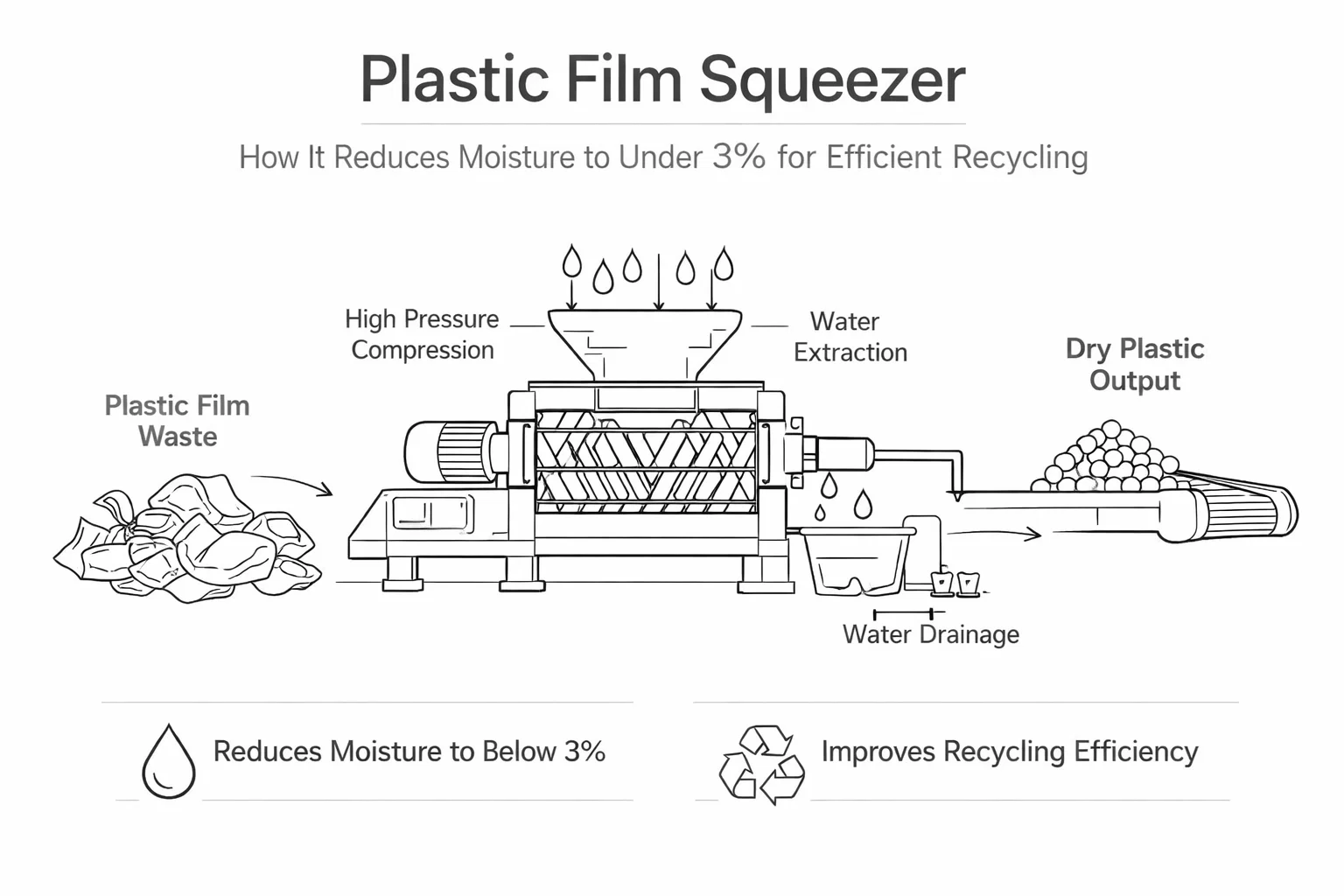
Washed plastic films retain up to 30% moisture after cleaning — a level that disrupts pelletizing lines, degrades output quality, and drives up energy costs. A plastic film squeezer solves this directly: it uses mechanical screw compression to reduce that moisture to under 3%, preparing film for extrusion without thermal drying systems.
If you’re running a film washing line and struggling with wet feedstock, inconsistent pellet quality, or high drying energy costs, this guide breaks down exactly how squeezer technology works, what it integrates with, and what operational results to expect.
Why Moisture Is the Core Problem in Plastic Film Recycling
Plastic films — LDPE, LLDPE, PP woven bags, agricultural mulch — are lightweight and highly absorbent. After a standard wash cycle, these materials routinely retain 25–30% moisture by weight. That’s a critical problem for downstream processing.
Feeding high-moisture film into an extruder or pelletizer causes three measurable problems:
- Reduced output capacity: Wet material requires more heat and processing time per kilogram
- Pellet quality degradation: Residual moisture creates voids, bubbles, and inconsistent density in final pellets
- Higher energy consumption: Thermal dryers consume significantly more electricity than mechanical dewatering methods
Traditional centrifugal dryers and thermal systems can reduce moisture to 10–15%, but rarely below that threshold consistently. The screw-press squeezer architecture achieves sub-3% — a fundamentally different outcome.
How a Plastic Film Squeezer Works: Step-by-Step
The plastic film squeezer operates through a four-stage mechanical process, with no combustion or external heat required for the primary dewatering stage.
Stage 1: Feeding
Washed film — still wet from the washing line — is conveyed into the machine via hopper or belt conveyor. Material enters continuously, making the squeezer compatible with high-throughput, 24/7 industrial operations.
Stage 2: Screw Compression
A heavy-duty rotating screw forces the material through a perforated barrel under intense mechanical pressure. As the film is compressed against the barrel walls, water is physically extracted and expelled through drainage holes. This is purely mechanical — no heat, no chemicals.
Stage 3: Dehydration and Drainage
Expelled water is collected through a drain port system and directed away from the processing area. At this stage, moisture content drops from ~30% to below 3%.
Stage 4: Densification and Discharge
After squeezing, the dried film is compacted into dense granules or strips — significantly heavier and more uniform than loose flake. This form feeds directly and consistently into plastic extruders and pelletizing systems. Some models apply controlled electrical heating at this stage to drive residual moisture to the lowest possible level.polystarco+1
Workflow position: Washing Line → Plastic Film Squeezer → Recycling Extruder / Pelletizer[recyclemachine]
Bulk Density Before and After Squeezing
The densification effect is as valuable as the moisture removal. Focus on bulk density (mass per unit volume of a pile, including air voids)—not the polymer’s true density (LDPE ≈ 0.91–0.93 g/cm³). Bulk density is what drives container fill rate, warehouse footprint, and extruder feed stability.
| Condition | Typical bulk density | What it means operationally |
|---|---|---|
| Loose LDPE film / light flakes | 30–80 kg/m³ | High void fraction; “shipping air” |
| Washed wet LDPE flakes (≈20–30% moisture) | 60–100 kg/m³ | Still voluminous and unstable to feed |
| After screw-press squeeze (typical) | 250–400 kg/m³ | Stable feed to extruder/pelletizer |
| High-pressure optimized densification | 400–600+ kg/m³ (upper ~650–700) | Transport-ready agglomerates / compact lumps |
Practical volume reduction is typically 6:1 to 10:1 (about 70–85% less volume). Examples: 80 → 500 kg/m³ ≈ 6.25×; 60 → 600 kg/m³ ≈ 10×. Moisture commonly moves from the wet post-wash range toward 1–3% with mechanical dewatering—without requiring a finished pellet for intermediate logistics.
Container math: a 40-foot high-cube (~76 m³) loaded with fluffy washed film may carry only 1.5–2.5 tons, far below weight limits. Densified output lets trucks and containers approach legal weight instead of cubing out early—cutting cost per ton shipped and storage space in proportion.
The economics follow directly: every kilogram of water squeezed out mechanically costs a fraction of evaporating it with heat, and the denser output lets the pelletizing line run at steady load. See the plastic film densifier for machine configurations, or the PP/PE film washing line it typically serves. For process context across densifying options, also read the PP/PE film densifying guide.
Key Technical Specifications to Know
When evaluating a plastic film squeezer for a recycling line, these are the performance parameters that matter:
| Parameter | Typical Range |
|---|---|
| Input moisture | 25–30% |
| Output moisture | <3% |
| Processing capacity | 300–800 kg/h |
| Energy savings vs. thermal dryer | 40–50% |
| Compatible materials | LDPE, LLDPE, PP woven bags, agricultural film |
Processing capacity varies by model and configuration. A 500 kg/h unit is a common benchmark for mid-scale recycling operations. Energy savings of 40–50% compared to thermal drying methods make the mechanical squeezer the lower operating cost option for continuous production.retechmachine+1
Key component specifications to verify before purchasing:
- Gearbox: Heavy-duty D-type rated for continuous high-torque operation
- Barrel material: Wear-resistant, compatible with SUS 304 stainless steel for corrosion resistance
- Die treatment: Nitrided pelletizing die for long service life
- Drive control: Frequency-conversion speed control to adjust output based on load
Compatible Materials and Application Scenarios
The plastic film squeezer is engineered for soft, flexible plastic films — not rigid plastics. It is not suitable for PET flakes, hard HDPE, or thick-walled packaging.
Confirmed compatible materials:
- LDPE waste film (agricultural mulch, stretch wrap, packaging film)
- LLDPE film (stretch film, produce bags)
- PP woven jumbo bags and bulk bags
- Mixed post-consumer flexible film after washing
Primary application environments:
- Post-consumer film washing lines: Position between the friction washer and the extrusion stage to maximize line throughput
- Agricultural film recycling: Processes heavily contaminated mulch film after multi-stage washing — a notoriously difficult material stream
- Industrial scrap recycling: LDPE and PP off-cuts from manufacturing operations, typically cleaner and higher consistency
- Bottle label and sleeve film processing: After label separation and washing, squeezers prepare film for repelletizing
For facilities running integrated washing and pelletizing lines, placing the squeezer as the dedicated bridge stage between washing and extrusion eliminates the need for a separate thermal dryer unit entirely.
Integration with the Full Recycling Line
The plastic film squeezer does not operate in isolation. It is one component in a multi-stage film recycling system. Understanding its position clarifies both its value and its requirements.
Typical complete line for post-consumer LDPE film:
- Conveyor / Bale breaker — material intake
- Shredder / Pre-crusher — size reduction
- Friction washer — surface contamination removal
- Float-sink separation tank — density-based material sorting
- Plastic film squeezer ← dewatering and densification
- Extruder / Pelletizer — melt and strand pelletizing
- Water ring or air-cooled pellet cutter — final pellet form
When the squeezer is removed from this sequence, the extruder receives high-moisture feedstock. This forces the extruder screw to work harder, increases melt instability, and reduces throughput — often by 20–30% depending on the extrusion system design.
For operations looking to upgrade an existing washing line rather than build from scratch, the squeezer can typically be retrofitted between the existing dewatering conveyor and the extruder feed hopper with minimal civil work.
Explore how the squeezer fits into a complete plastic film washing and recycling line to evaluate integration requirements for your facility.
Plastic Film Squeezer vs. Alternative Dewatering Methods
Three dewatering approaches are commonly used in plastic film recycling. Here’s how they compare on the metrics that matter operationally:
| Method | Output Moisture | Energy Use | Throughput | Pellet Quality |
|---|---|---|---|---|
| Centrifugal dryer | 8–15% | Moderate | High | Moderate |
| Thermal hot-air dryer | 5–10% | High | Moderate | Moderate |
| Screw press squeezer | <3% | Low | High | High |
The screw press squeezer achieves the lowest moisture output while consuming less energy than thermal systems. The trade-off is that it requires a perforated barrel and screw that must be maintained and periodically replaced — but the mechanical simplicity keeps maintenance intervals manageable compared to heat-based dryer systems.recyclingtoday+1
For facilities where pellet consistency and line efficiency are the priority, the squeezer delivers better results than alternatives at comparable or lower operating cost.
Frequently Asked Questions
What moisture level does a plastic film squeezer achieve?
A properly sized screw-press squeezer consistently reduces moisture from 25–30% down to below 3%. Some configurations reach even lower levels when an auxiliary heating element is included in the discharge stage.
Does a plastic film squeezer replace an extruder?
No. The squeezer is a dewatering and densification machine — it prepares film for the extruder but does not melt or pelletize. The output from the squeezer feeds directly into the extruder hopper.polystarco+1
Can it handle contaminated agricultural film?
Yes, but the washing line upstream must be adequate. The squeezer processes the film after washing — it removes moisture, not soil or chemical contamination. Pre-washing quality directly affects squeezer output and downstream pellet purity.
What is the typical capacity range?
Industrial models range from 300 to 800 kg/h, with 500 kg/h being a common mid-range configuration. Capacity depends on screw diameter, motor power, and input moisture level.
How does it save energy compared to thermal drying?
Mechanical compression uses only motor power — no heating elements, burners, or gas consumption. Compared to thermal dryers operating at equivalent throughput, screw-press squeezers reduce electricity consumption by 40–50%.
Take the Next Step for Your Recycling Line
The plastic film squeezer addresses one of the most consistent bottlenecks in post-consumer film recycling: wet feedstock that limits extruder performance and pellet quality. By reducing moisture from 30% to under 3% through mechanical compression — without thermal energy — it improves line throughput, reduces operating costs, and produces higher-quality recycled pellets.
Key takeaways for equipment decision-makers:
- Sub-3% moisture output enables direct, high-quality extruder feeding
- 40–50% energy savings versus thermal drying on equivalent throughput
- Compatible with LDPE, LLDPE, and PP woven materials across industrial and agricultural film streams
- Retrofittable into existing washing lines between the washer and extruder
- Mechanical simplicity means lower maintenance complexity than heat-based systems
Ready to spec a squeezer for your film recycling line? Review the full technical specifications and configuration options for the plastic film squeezing machine — including capacity, motor options, and integration requirements — or contact the team to request a material processing assessment for your specific film type.
