


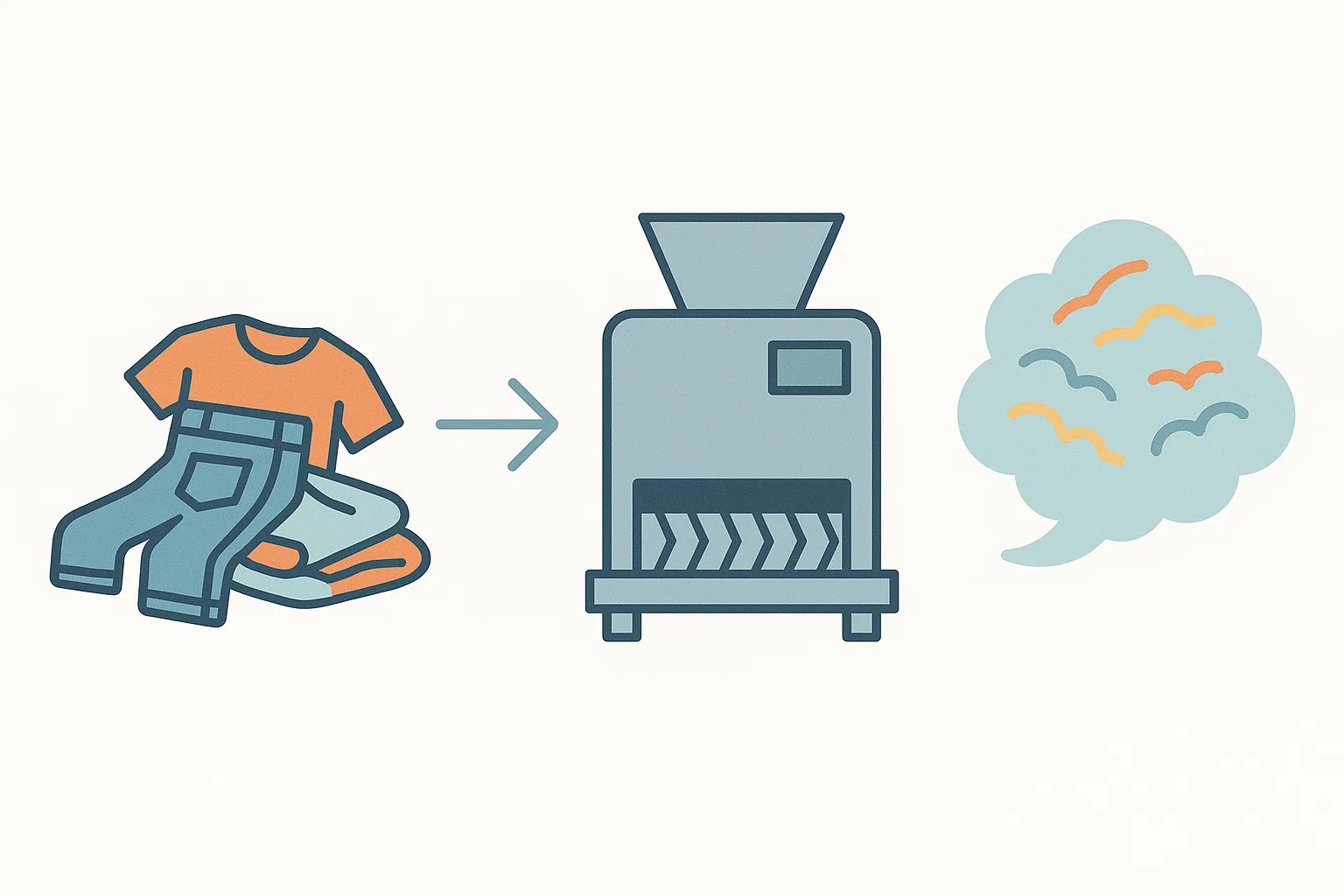
Textile waste recycling applications differ by material construction and the intended output. Cotton cutting waste can be opened for recovered fiber, mixed garments may be reduced for insulation or fuel, and carpets often require staged size reduction and metal removal. The correct process starts with the application—not a generic shredder specification.
For a complete explanation of machine design and working principle, read our textile shredder working guide. Buyers comparing industrial equipment can review the textile and fiber waste shredder product page.
Textile Waste Streams and Their Best Recycling Routes
| Waste Stream | Preparation Challenge | Typical Output / Application |
|---|---|---|
| Clean cotton cutting waste | Low bulk density and long fibers | Fiber opening, wiping material, stuffing |
| Mixed clothing and uniforms | Zippers, buttons, elastic, blended fibers | Insulation, felt, acoustic panels, RDF |
| Denim and heavy fabric | Dense seams and multiple layers | Recovered fiber, nonwoven products |
| Carpet and upholstery | Backing, adhesives, wire, and high wear | Granulated feed, fuel, separated polymer/fiber |
| Nonwoven production scrap | Elastic, springy sheets that wrap around rotors | Reprocessing feed or densified material |
| Rope, yarn, and fishing net | Extreme wrapping risk | Controlled-size feed for washing or pelletizing |
Application 1: Garment Factory Offcuts
Pre-consumer cutting waste is usually the cleanest textile stream. The main challenge is feeding light, irregular pieces without bridging. A low-speed cutter or shredder can prepare material for opening, carding, densification, or downstream nonwoven production.
- Separate cotton, polyester, nylon, and blended lots when possible.
- Keep oil, paper patterns, plastic film, and floor sweepings out of the feed.
- Preserve fiber length when recovered fiber is the target; smaller output is not always better.
Application 2: Post-Consumer Clothing
Used garments vary in fiber, moisture, construction, and contamination. Sorting by composition and removing metal accessories improves downstream quality and reduces blade damage. Where fiber-to-fiber recycling is not practical, shredded textiles may enter insulation, padding, molded composites, or prepared fuel applications.
Application 3: Carpet, Upholstery, and Automotive Textile
Carpet and upholstery combine face fiber, backing, adhesive, foam, and sometimes wire. A staged line is normally more reliable than one aggressive pass: pre-cut bulky pieces, remove metal, shred to a controlled size, then separate or granulate according to the recovery target.
Application 4: Nonwoven, Yarn, Rope, and Fiber Waste
Long flexible material can wrap around high-speed shafts. Low-speed torque, anti-wrapping geometry, controlled feeding, and reversible overload protection are more important than maximum rotor speed. For ropes and nets, pre-cutting length and metal detection should be defined during trials.
Process Layout by Final Product
| Final Product | Typical Process | Key Control |
|---|---|---|
| Recovered fiber | Sorting → cutting → opening → cleaning | Fiber length and contamination |
| Insulation or felt feed | Sorting → accessory removal → shredding → blending | Uniform size and composition |
| Plastic pellet feed | Sorting → shredding → washing/drying → densifying/pelletizing | Polymer purity and moisture |
| RDF/SRF | Sorting → metal removal → primary/secondary shredding | Calorific value, chlorine, and output size |
Material Trial Checklist
- Representative material composition and moisture
- Maximum piece, roll, bale, rope, or carpet dimensions
- Metal accessories, wire, buttons, zippers, and hard contaminants
- Required output size and acceptable fines
- Target downstream process and required fiber length
- Hourly throughput, shifts, and available operators
A successful textile recycling line is built around the waste stream and end use. Run a representative material trial before finalizing rotor, screen, feeding, and separation configuration.
