


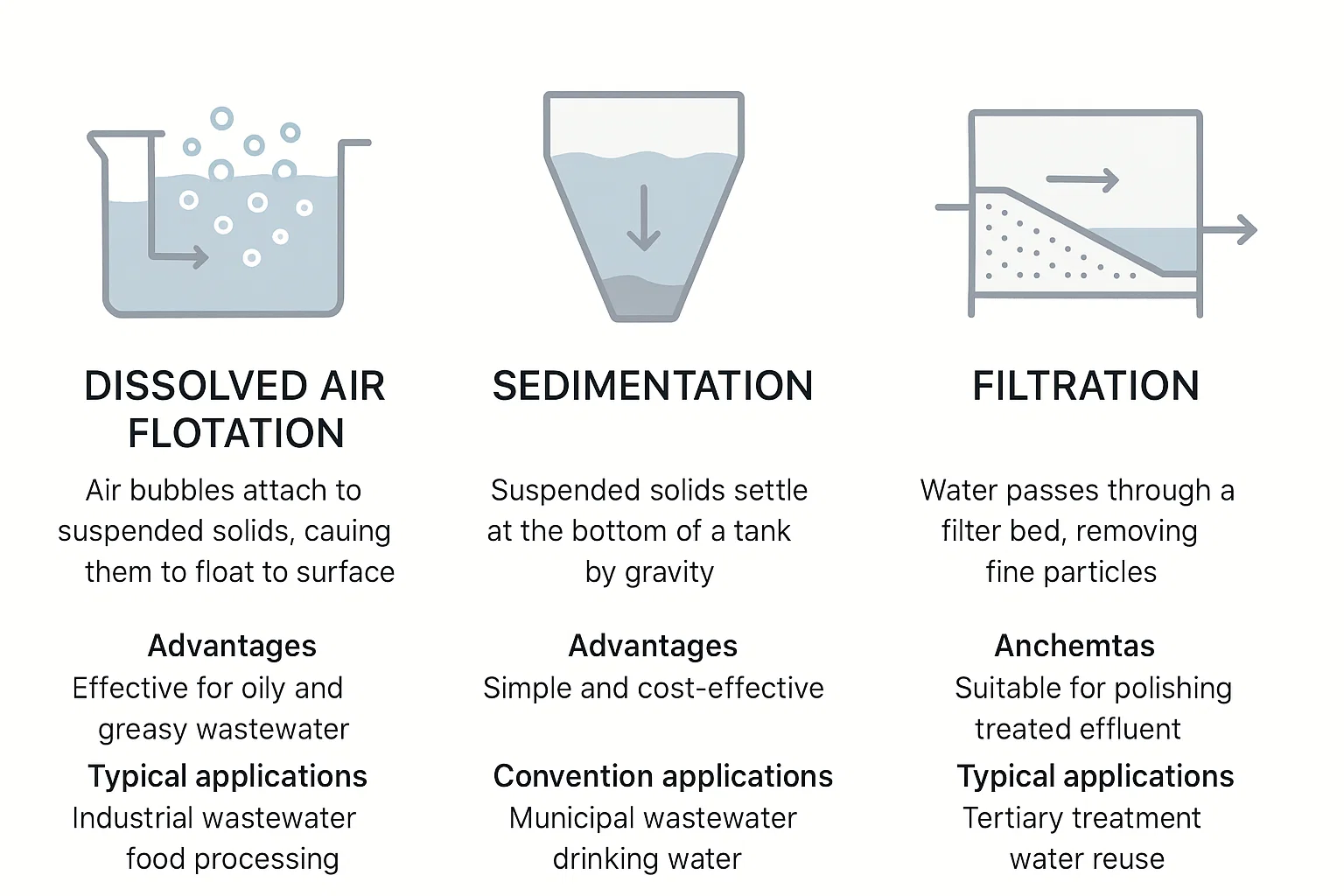
Plastic washing lines generate some of the most challenging wastewater in industrial recycling. Every ton of washed film, flakes, or bottles leaves behind a cocktail of fine plastic particles, label residues, adhesives, oils, detergents, and suspended solids. Treating this effluent is not optional: discharge regulations keep tightening, fresh water costs keep rising, and closed-loop water reuse has become a competitive advantage for serious recycling plants. Choosing the right primary treatment technology — dissolved air flotation (DAF), sedimentation, or filtration — determines whether your plant meets its permit limits comfortably or fights chronic compliance problems.
This article compares the three options head to head — dissolved air flotation (DAF), sedimentation, and filtration — and explains why DAF has become the preferred first line of defense for wash-line wastewater.
The Wastewater Challenge in Plastic Washing Lines
A modern plastic washing line consumes large volumes of water at every stage: pre-washing, hot washing with caustic soda, friction washing, and rinsing. The effluent is heavily loaded with contaminants that are difficult to treat: microplastic fragments from film edges, label fibers, printing inks, emulsified oils from dirty post-consumer material, fine adhesive residues, and dissolved organics that drive up chemical oxygen demand (COD).
The defining characteristic of wash-line effluent is that most of its problematic load is low-density and slow to settle. When the bulk of your solids float rather than sink, a technology built around floating them to the surface on purpose — dissolved air flotation — has a fundamental advantage over one built around waiting for them to sink.
How Dissolved Air Flotation Works in Plastic Recycling
A DAF water treatment unit separates solids and oils from wastewater by generating millions of microscopic air bubbles, typically 30–50 microns in diameter. These microbubbles attach to suspended particles, oil droplets, and flocculated colloids, lowering their effective density so they rise to the surface as a floating sludge blanket. A mechanical skimmer continuously removes that blanket, while clarified water exits from the bottom of the tank.
The process sequence runs as follows:
- Coagulation and flocculation. Chemicals are dosed into the raw effluent to neutralize charges and agglomerate fine particles into larger flocs that attach to bubbles more readily.
- Air saturation. A portion of clarified water is recycled, pressurized to 4–6 bar, and saturated with dissolved air in a pressure vessel.
- Bubble release. The saturated water is released through nozzles into the flotation tank. The sudden pressure drop releases the air as a cloud of microbubbles.
- Flotation. Microbubbles collide with and attach to flocs, oil droplets, and plastic fines, carrying them to the surface.
- Skimming. A chain-and-flight skimmer sweeps the floating sludge into a collection hopper.
- Clarified water discharge. Clean water exits beneath the sludge blanket and returns to the wash line or proceeds to discharge or polishing treatment.
Because the bubbles do the lifting, DAF achieves retention times of just 15–30 minutes — compared to 2–4 hours for sedimentation — which is why DAF units are compact enough to retrofit where space is scarce.
Sedimentation and Filtration: What They Do Best
To make a fair comparison, it helps to understand where the conventional alternatives genuinely excel.
Sedimentation is a gravity-driven process: wastewater enters a large basin, flow slows, and particles heavier than water settle to the bottom as sludge. It is simple, energy-efficient, and needs no chemicals. For heavy, dense loads such as sand, grit, and mineral fines, sedimentation is a proven and economical choice. Its weaknesses appear with light, fibrous, or colloidal material — precisely the profile of plastic wash water. It also demands a very large footprint and long retention times, and it reacts poorly to flow surges.
Filtration passes water through a porous medium — sand beds, disc filters, or membranes such as ultrafiltration and reverse osmosis. It is the strongest option for polishing: removing very fine particles, bacteria, and even dissolved salts. But filtration is a poor primary treatment for high-solid effluents: media blinds and fouls quickly when fed dirty water. It works best after a primary step like DAF has removed the bulk load.
DAF vs Sedimentation vs Filtration: Head-to-Head Comparison
The table below summarizes how the three technologies compare on the parameters that matter most for a plastic recycling plant.
| Feature | DAF | Sedimentation | Filtration |
|---|---|---|---|
| Core Principle | Buoyancy — microbubbles float solids | Gravity — solids settle | Physical barrier — sieving |
| Best For | Oils, grease, plastic fines, label fibers | Sand, grit, dense solids | Fine particles, pathogens, dissolved solids |
| TSS Removal Efficiency | Very high (90–99%) | Moderate (50–70%) | High to very high (depends on type) |
| Footprint | Compact | Very large | Variable, often compact |
| Hydraulic Retention Time | 15–30 minutes | 2–4 hours | Varies |
| Sludge Characteristics | Thick (3–5% solids) | Dilute (0.5–2% solids) | N/A — retained on media |
| Chemicals Required | Coagulants, flocculants | None | Often none, but pretreatment may be needed |
| Energy Demand | Moderate (pumps, compressors) | Low | High (especially membranes) |
| Capital & Operating Costs | Moderate to high | Low to moderate | Moderate to high |
| Load and Flow Sensitivity | Low — handles surges well | High — short-circuits under surges | Medium |
Why DAF Water Treatment Outperforms the Alternatives
The comparison table tells the story at a glance, but four advantages deserve a closer look.
1. It removes what plastic wash water actually contains. DAF is purpose-built for light, suspended, and emulsified contaminants — microplastics, label fibers, printing inks, and oils — that simply will not settle. Sedimentation misses them; filtration clogs on them. DAF floats them out reliably at 90–99% total suspended solids removal. For a deeper look at the mechanism, see our explainer on what dissolved air flotation is and how it works.
2. Compact footprint and fast response. With retention times measured in minutes rather than hours, a DAF unit treats the same flow in a fraction of the floor space — often the deciding factor for retrofits and leased buildings.
3. Thick, low-volume sludge. DAF produces floated sludge at 3–5% solids versus 0.5–2% from sedimentation. Less water in the sludge means smaller dewatering equipment, fewer disposal loads, and lower handling cost.
4. Stability under variable loads. Recycling plants run batch-wise, and wash water quality swings with the feedstock. DAF responds within minutes and keeps effluent quality consistent, while sedimentation tanks short-circuit under flow surges.
Where DAF Fits in a Plastic Washing Line
In a complete water management scheme, DAF typically sits as the primary treatment step right after coarse screening and grit removal. It takes the full wash-line effluent and removes the bulk of suspended solids, oils, and floatable material. Clarified water then returns to the wash process as recycled process water — the standard arrangement in modern plants — or proceeds to discharge or polishing treatment.
For plants pursuing zero liquid discharge or high-grade reuse, DAF pairs naturally with downstream polishing: DAF removes the coarse and floatable load that would blind filters, and a filtration stage delivers the final water quality. This is why filtration should be seen as a complement to DAF rather than a competitor.
If you are planning or upgrading the water side of a wash line, look at the complete system together — the plastic recycling washing line and its water treatment loop are designed as one integrated process, not two separate purchases.
Operating Costs and Practical Considerations
DAF is not the cheapest technology to install or run. The main operating costs are chemical dosing (coagulant and flocculant), electricity for recycle pumps and the air compressor, and periodic maintenance of the skimmer and saturation system. Against these, weigh the savings: reduced fresh-water intake, avoided discharge penalties, smaller sludge volumes, and protection for downstream membranes that would otherwise foul and fail.
In practice, plants that recycle wash water in a closed loop typically recover the DAF investment through water savings alone — and the compliance certainty is difficult to put a price on. The key to keeping operating costs in check is correct chemical dosing: overdosing wastes money and can degrade performance, so look for suppliers that offer jar-test support and operator training, not just hardware.
How to Choose a DAF System: RFQ Checklist
Before requesting quotes, assemble this information so suppliers can size the system correctly:
- Flow rate and variability. Average and peak hourly flow (m³/h), plus how much it swings between shifts and feedstock types.
- Influent characteristics. TSS, oil and grease, COD, and pH ranges — lab analysis of your actual wash water beats generic assumptions.
- Target effluent quality. Discharge permit limits or internal reuse targets the treated water must meet.
- Available footprint. Length, width, and height constraints at the installation site.
- Chemical preferences. Whether you can accept coagulant/flocculant dosing and who will manage chemical inventory.
- Integration scope. Whether the supplier provides the full water loop — screening, DAF, sludge handling, and controls — or the DAF unit alone.
See the DAF Water Treatment System and Request a Quote
If your wash line is struggling with cloudy effluent, discharge compliance, or rising water bills, a properly sized DAF system is usually the fastest fix. See the DAF water treatment system and request a quote tailored to your flow rate and water quality.
Frequently Asked Questions
What is dissolved air flotation, and how does it treat plastic recycling wastewater?
Dissolved air flotation is a water treatment process that injects microscopic air bubbles into wastewater. The bubbles attach to suspended solids, oils, and plastic fines, floating them to the surface where a skimmer removes them. In plastic recycling, it is used as the primary treatment step for wash-line effluent, removing the low-density contaminants that sedimentation cannot capture.
Can DAF replace sedimentation tanks entirely?
For wash-line effluent dominated by light, floatable contaminants, yes — DAF typically outperforms sedimentation on removal efficiency, footprint, and sludge thickness. Sedimentation may still be kept upstream for heavy grit and sand removal, but as the main clarification step, DAF is the stronger choice for plastic recycling wastewater.
Does a DAF system need chemicals to work?
DAF normally uses coagulants and flocculants to agglomerate fine particles so the microbubbles can capture them efficiently. Without chemical conditioning, removal rates drop significantly for colloidal material. Dosing should be optimized with jar tests on your actual wastewater to avoid waste.
What removal efficiency can I expect from DAF?
A well-designed DAF unit achieves 90–99% removal of total suspended solids and very high removal of oils and grease. Actual performance depends on influent characteristics, chemical dosing, and hydraulic loading, so ask suppliers for performance guarantees tied to your water analysis.
How much space does a DAF unit need compared to a sedimentation basin?
Substantially less. DAF retention times of 15–30 minutes versus 2–4 hours for sedimentation translate into a much smaller tank for the same flow. This makes DAF the practical option for retrofits and plants with limited floor space.
Should filtration come before or after DAF?
After. Filtration is a polishing step, not a primary treatment for high-solid effluents. Placing DAF first removes the bulk load that would blind filter media, extending filter life and cutting backwash and membrane replacement costs.
What information does a supplier need to size a DAF system?
At minimum: average and peak flow rates, influent TSS, oil and grease, COD, and pH, your target effluent quality (permit limits or reuse specs), available footprint, and whether the unit must integrate with an existing wash line water loop. A lab analysis of your actual wash water is the most valuable input you can provide.
