


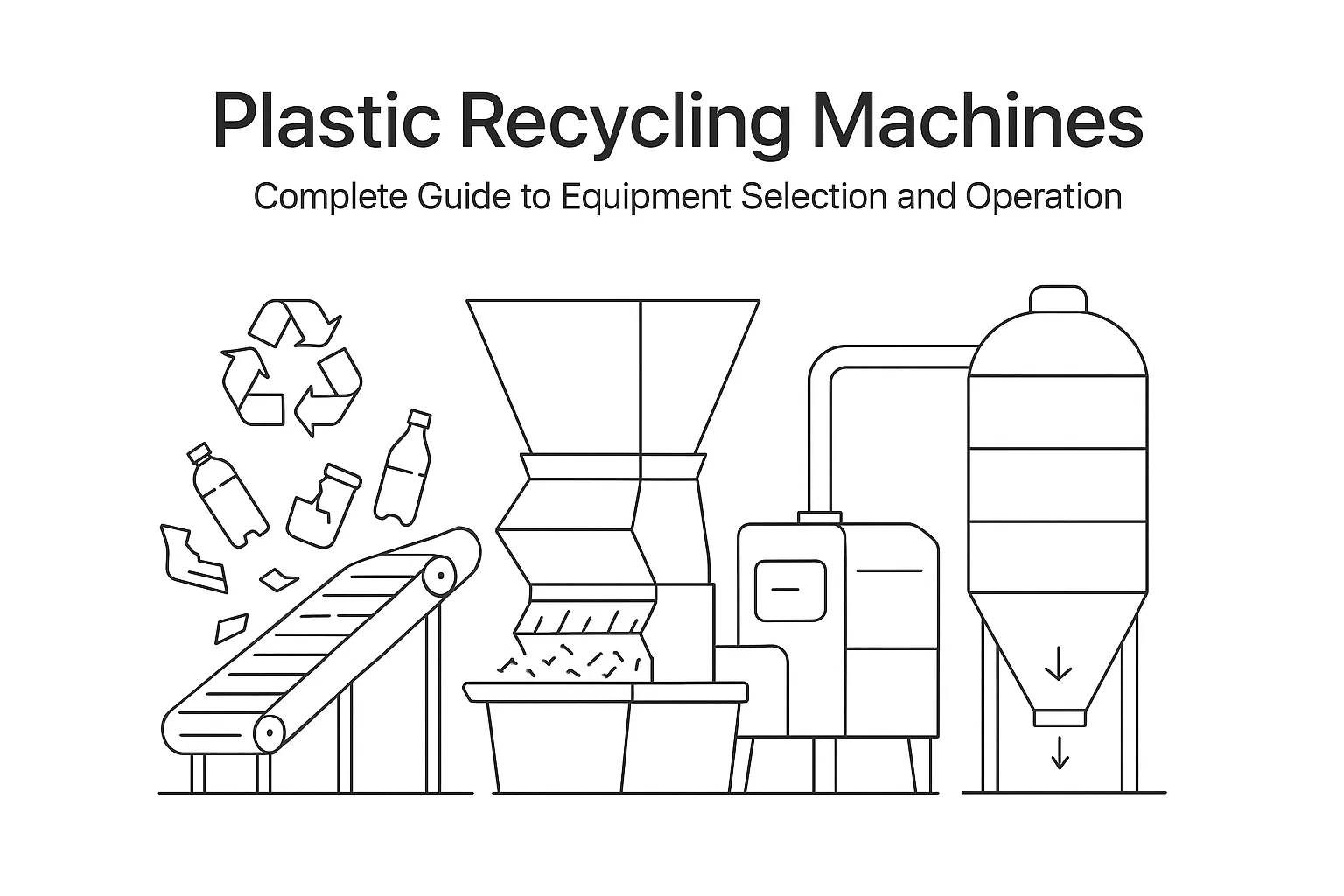
A plastic recycling machine is any piece of equipment that takes plastic waste — bottles, films, containers, pallets, industrial scrap — and turns it back into usable raw material. Depending on the setup, that output can be washed flakes ready for remanufacturing, or finished pellets that feed directly into extruders and injection molding machines. A complete recycling operation usually chains several machines together: shredders break material down, washers remove contamination, dryers pull out moisture, and pelletizers melt and reform the clean flakes into uniform granules.
Plastic recycling machines convert post-consumer and post-industrial waste into valuable reusable materials, reducing landfill pressure while supporting global circular-economy goals. Rumtoo Machine provides advanced, customized recycling solutions that reliably process PET bottles, HDPE containers, PP films, and rigid plastics using integrated shredding, washing, and pelletizing technologies.
Global plastic production exceeded 400 million tons in 2023, yet recycling rates remain under 10% (OECD). Modern plastic recycling equipment — especially high-efficiency systems from Rumtoo — helps bridge this gap by delivering stable performance, low energy consumption, and long-term return on investment.
This guide walks through every major machine type in a recycling line, explains how different plastics demand different processing, and covers the selection factors, automation options, and maintenance practices that determine whether a line runs profitably for a decade or becomes a maintenance headache in year two.
Why Rumtoo?
- 15+ years of recycling machinery manufacturing
- European CE-standard design & global installation support
- Customizable washing and pelletizing lines (200–3,000 kg/h)
- Energy-saving motors & intelligent PLC systems
- Turnkey engineering: design → manufacturing → installation → training
Core Plastic Recycling Machine Types
Shredders and Granulators
Size reduction is where every recycling line starts. Plastic shredders use high-torque, low-speed blade assemblies to tear bulky items — drums, crates, pallets, pipes, purgings — into manageable flakes. Single-shaft shredders work best on rigid, bulky feedstock: the hydraulic ram pushes material steadily into one rotor, giving consistent output with minimal dust. Dual-shaft shredders run two counter-rotating rotors that shear through flexible and tangled materials like films, woven bags, and packaging waste without wrapping.
Granulators handle the second stage of size reduction, cutting pre-shredded flakes into uniform 8–20 mm particles that wash evenly and feed smoothly into extruders. Wet granulators add water at the cutting chamber, which cools the blades, suppresses dust, and gives a preliminary rinse in one step — particularly useful for rigid HDPE and PP. Plastic crushers sit between the two: simpler and cheaper than shredders, ideal for brittle materials like PET bottles and thin-wall containers where aggressive tearing is not needed.
Key specifications include motor power (15–200 kW), throughput (300–3,000 kg/h), and wear-resistant blades made from D2 or SKD-11 tool steel. Blade life is the main running cost here: expect 400–600 operating hours between sharpenings on clean material, less on abrasive or contaminated feedstock.
Washing Systems
Washing is what separates a recycling line that produces sellable material from one that produces low-value downgrade. Recycling washing systems from Rumtoo run material through a sequence: pre-washing removes loose dirt and sand, hot washing (60–85°C with caustic soda) dissolves adhesives and oils, high-speed friction washers at 900–1,200 RPM scrub labels and organics off the flake surface, and float-sink tanks finish the job by density — PET sinks (1.38 g/cm³) while PP/PE caps and labels float (0.90–0.95 g/cm³).
Water management decides operating cost. Rumtoo’s recirculation designs filter and reuse process water, cutting fresh water demand to 1–2 m³ per ton of output. For plants in water-scarce regions or facing strict discharge rules, a compact wastewater treatment stage can be integrated so the line runs near zero-discharge.
Pelletizing Equipment
Pelletizing is the final value-add step: clean, dry flakes go in, uniform pellets come out. Plastic pelletizers melt flakes in a heated barrel, push the melt through screen filters that catch any remaining contamination, and cut the strands into granules. Single-screw extruders (200–1,500 kg/h) handle relatively clean HDPE and PP rigid flakes well. Twin-screw systems earn their keep on contaminated films and mixed streams: the intermeshing screws provide far better degassing and dispersive mixing, which stabilizes melt quality when feedstock varies.
Cutting method matters for pellet shape and bulk density. Strand pelletizers are simple and cheap but need a water bath and strand dryer. Water-ring and die-face cutters produce round 3–5 mm pellets directly at the die, with better bulk density for conveying and bagging — the standard choice for film recycling lines where throughput and automation matter.
Drying and Dewatering
Moisture is the enemy of pellet quality. Wet flakes entering an extruder cause bubbles, voids, and degraded mechanical properties in the finished pellet. Drying systems attack the problem in stages: screw-press dewaterers squeeze film flakes from 40% moisture down to around 15% mechanically, centrifugal dryers spin rigid flakes nearly dry, and thermal dryers or hot-air systems finish the job to below 1% — the threshold for stable extrusion. Skipping or undersizing the drying stage is one of the most common reasons new lines produce off-spec pellets.
Material-Specific Processing Requirements
PET Bottle Recycling
PET bottle recycling is the most standardized stream in the industry, and also the most demanding on wash quality. Hot caustic washing at 80–85°C with 1–3% NaOH strips labels and adhesives; a pre-sort removes PVC bottles (which contaminate PET at even 50 ppm) and colored fractions. Rumtoo PET lines include de-labelers, metal separators, and optional optical sorters, delivering 95%+ purity flakes with intrinsic viscosity above 0.70 dL/g — the baseline for bottle-to-bottle applications.
Food-grade rPET adds another layer: the flakes must go through super-clean processing (high-temperature decontamination under vacuum) and pass challenge tests for contaminant migration. Not every line qualifies — this is a specification to confirm with the equipment supplier before purchase, not after installation.
PE/PP Film Processing
Films are the opposite problem from PET: low bulk density, high surface contamination, and enormous water retention. Agricultural films arrive caked with soil and sand; post-consumer packaging carries food residue and labels. After shredding, powerful dewatering is non-negotiable — screw presses and centrifugal dryers take moisture from 40% down to under 3% before pelletizing. Two-stage pelletizing with 80–120 mesh melt filtration then handles the residual contamination, producing pellets suitable for garbage bags, drainage pipes, and construction films.
Film lines live or die on the cutter compactor (agglomerator) or the force-feeding design of the extruder. Loose film flakes bridge and starve a standard hopper; a compactor densifies them into crumbs that feed consistently, which is why film pelletizing lines cost more per kg/h than rigid lines of the same nominal capacity.
Rigid HDPE/PP Containers
Detergent bottles, crates, buckets, and automotive parts form a middle ground: rigid enough to granulate cleanly, contaminated enough to need real washing. Wet granulation prevents thermal degradation at the cutting chamber while giving a first rinse. Float-sink separation then splits the stream — HDPE/PP floats, while stones, glass, and stray PET sink — producing clean mono-material fractions that command higher resale prices than mixed polyolefin.
Color sorting is the value lever here. A basic line produces mixed-color flakes worth commodity prices; adding color sorters yields natural and single-color streams that sell at a meaningful premium to compounders and product manufacturers.
Critical Selection Factors
Processing Capacity
Size the line to your actual material supply, not your aspirations. A 1,000 kg/h line running at 40% utilization costs more per kilogram than a 500 kg/h line running full — the motors, heaters, and labor are largely fixed regardless of throughput. Rumtoo offers 200–3,000 kg/h configurations, from compact setups for small recycling stations to full industrial lines. Map your feedstock contracts for the next 2–3 years before choosing: the most expensive mistake in this industry is buying capacity you cannot feed.
Material Contamination Level
Contamination level dictates how much washing hardware you need, and washing hardware is a large share of line cost. Post-industrial scrap — clean edge trim, purgings, off-spec parts — can run on a simplified line with basic rinsing. Post-consumer films and agricultural waste need the full sequence: pre-wash, hot caustic wash, friction washers, float-sink separation, and often wastewater treatment. Be honest about your feedstock during the quoting stage; underspecifying the wash section to save capital cost guarantees off-spec output.
End-Product Specifications
Work backward from what you intend to sell. Flakes for internal reuse need only basic washing. Pellets for garbage bags tolerate moderate contamination. Food-grade rPET demands FDA-compliant super-clean processing, documented decontamination, and batch traceability. Textile-grade pellets require contamination below 50 ppm and stable melt flow index. Each step up in specification adds equipment cost — but also multiplies the selling price. Define the target product before requesting quotes, because a line designed for commodity pellets cannot be cheaply upgraded to food-grade later.
Operational Environment
Practical constraints shape the layout. Rumtoo systems adapt to 380–480V 3-phase power supplies, municipal or recycled water sources, and typical footprints of 300–800 m² per ton/hour of capacity. Check ceiling height for conveyors and silos, floor loading for heavy extruders, and local noise and effluent regulations before finalizing the plant layout. For existing factories, measure twice: retrofitting a line into a building that is 2 meters too short is a painful and expensive lesson.
Integration and Automation
A recycling line is only as reliable as its weakest interlock. Rumtoo integrates PLC controls with touchscreen HMIs across the full line: each machine reports its status, and sequential interlocking stops upstream equipment automatically if a downstream unit jams or overloads. Metal detectors ahead of granulators and extruders catch tramp metal before it destroys a blade set or a screw — a single undetected bolt can cause thousands of dollars in damage.
VFD-controlled motors match power draw to actual load instead of running flat-out, cutting energy consumption noticeably on variable feedstock. Overload protection, emergency stops at every station, and guarded access points come standard. For multi-shift operations, IoT connectivity adds remote diagnostics, real-time production dashboards, and predictive maintenance alerts — the maintenance team sees a bearing trending hot before it fails at 2 a.m., not after.
Performance Metrics and ROI
Four numbers tell you whether a line is healthy. Material recovery rate — the share of input weight that becomes sellable output — should land at 85–95% on typical feedstock; anything lower usually points to excessive fines in shredding or losses in washing. Energy consumption runs 0.4–0.8 kWh per kilogram of output on a well-tuned line, with drying and extrusion as the main draws. Water usage with recirculation stays at 0.5–2 m³ per ton. Finished pellet moisture must stay below 1%, verified by regular sampling, because wet pellets degrade in storage and cause processing defects for your customers.
- Material recovery rate: 85–95%
- Energy consumption: 0.4–0.8 kWh/kg
- Water usage: 0.5–2 m³/ton with recirculation
- Pellet moisture: <1%
On the financial side, typical payback periods run 18–36 months depending on feedstock cost, utilization rate, and product grade. The spread is wide for a reason: a line running cheap post-industrial scrap into commodity pellets pays back slowly, while food-grade rPET or high-purity natural HDPE pellets command premium prices that shorten payback dramatically. Model your own numbers with local material and energy prices — generic ROI claims from any supplier deserve scrutiny.
Maintenance and Long-Term Operation
Recycling machines earn their keep over 10+ years, but only with disciplined maintenance. Blades are the primary wear item: sharpen shredder and granulator blades every 400–600 operating hours, and keep a spare set on the shelf so a changeover takes hours, not weeks waiting for parts. Washing screens blind over time — inspect quarterly and replace when open area drops. Bearings on high-speed equipment (friction washers, centrifugal dryers) need scheduled lubrication; a seized bearing on a 1,200 RPM washer is a safety incident, not just downtime.
- Sharpen blades every 400–600 hours
- Replace washing screens quarterly
- Lubricate bearings on schedule
- Inspect extruder heating elements and thermocouples annually
- Check conveyor belts, seals, and hydraulic hoses monthly
Rumtoo supplies essential spare parts — blades, screens, seals, belts, heating elements — for rapid shipment to minimize downtime. Before buying any line, ask the supplier for a priced spare-parts list and typical lead times; a cheap machine with unobtainable parts is the most expensive machine you will ever own.
Regulatory Compliance
Compliance is not paperwork — it determines which markets you can sell into. Rumtoo systems are built to CE standards with UL-listed electrical components available for North American installations, and manufacturing follows ISO 9001 quality management. On the product side, know your test methods: melt flow rate (ASTM D1238) and tensile strength (ASTM D638) are the baseline specifications buyers ask for, and food-contact applications require documented contamination analysis under FDA or EFSA frameworks.
Extended producer responsibility (EPR) schemes spreading across the EU, Canada, and parts of Asia are steadily increasing demand for certified recycled content — which is good news for line owners, but it also means buyers increasingly ask for traceability documentation. A line with proper process monitoring and batch records is easier to certify than one without, so treat data logging as a commercial asset, not an overhead.
Equipment Details
PET Bottle Washing Line
Processes 500–2,000 kg/h of PET bottle waste through bale breaking, de-labeling, pre-washing, hot caustic washing, friction cleaning, float-sink separation, rinsing, and drying. Output is clean PET flakes at 95%+ purity, suitable for sheet, fiber, strapping, or bottle-to-bottle applications with super-clean configuration. Modular design allows capacity expansion by adding parallel wash trains.
PP/PE Film Pelletizing Line
Two-stage extrusion lines purpose-built for agricultural films, shopping bags, and post-consumer packaging. A cutter compactor densifies loose film for stable feeding, twin-screw extrusion with vacuum degassing handles moisture and volatiles, and 80–120 mesh automatic screen changers maintain melt quality without stopping the line. Capacity 300–1,200 kg/h depending on contamination level and target pellet grade.
Heavy-Duty Plastic Shredders
Single-shaft and dual-shaft units from 22–200 kW for pallets, pipes, crates, drums, and bulky purgings. Replaceable blade seats, hydraulic ram feed, and oversized bearings keep these machines running on the toughest feedstock. Screen sizes from 30–120 mm let you dial output size to match the downstream granulator or washing line.
Summary
Choosing the right plastic recycling machine starts with three questions: what material are you processing, how contaminated is it, and what do you want to sell at the end. The answers determine your shredder type, how much washing hardware you need, whether single or twin-screw pelletizing is justified, and how aggressively you must dry. Get those decisions right, size capacity to real feedstock supply, and maintain the line on schedule — and the equipment will run profitably for well over a decade.
Rumtoo provides turnkey, high-reliability recycling solutions backed by professional engineering, installation, and technical support — helping your factory achieve strong productivity, stable quality, and long-term sustainability.
Frequently Asked Questions
What is a plastic recycling machine?
A plastic recycling machine is any equipment that converts plastic waste back into usable material. In practice the term covers individual machines — shredders, granulators, washers, dryers, pelletizers — as well as complete lines that chain them together to turn dirty post-consumer or post-industrial plastic into clean flakes or finished pellets.
What types of plastic recycling machines are there?
The five core types are shredders (bulk size reduction), granulators (fine size reduction to 8–20 mm), washing systems (pre-wash, hot wash, friction wash, float-sink separation), dryers (screw press, centrifugal, and thermal drying), and pelletizers (single or twin-screw extrusion with melt filtration and cutting). Most commercial operations combine several types into one continuous line.
How much does a plastic recycling machine cost?
A single machine such as a shredder or granulator typically starts in the low tens of thousands of dollars, while a complete washing and pelletizing line runs from roughly $150,000 for a small 300–500 kg/h setup to over $1 million for a high-capacity food-grade PET line. The washing section and the pelletizing configuration are the two biggest cost drivers. Typical payback periods are 18–36 months depending on feedstock cost and product grade.
What capacity do I need?
Match capacity to contracted feedstock supply, not to optimistic projections — a line running at 40% utilization costs more per kilogram than a smaller line running full. Small recycling stations typically start at 200–500 kg/h; industrial operations run 1,000–3,000 kg/h. Secure your material supply agreements before finalizing capacity.
Single-shaft or dual-shaft shredder — which should I choose?
Choose a single-shaft shredder for rigid, bulky materials like drums, crates, pallets, and pipes — the hydraulic ram gives steady, controlled feeding. Choose a dual-shaft shredder for flexible and tangled materials like films, woven bags, and packaging waste, where two counter-rotating rotors shear through without wrapping. For brittle materials such as PET bottles, a simpler crusher is often sufficient and cheaper.
Can one recycling line handle multiple plastic types?
Up to a point. A well-designed rigid-plastics line can switch between HDPE, PP, and similar polyolefins with screen and parameter changes, but PET and films each need dedicated configurations — PET because of its density and wash chemistry, films because of their low bulk density and extreme water retention. Running incompatible materials through one line without proper changeover procedures produces contaminated, low-value output.
What maintenance does a plastic recycling line require?
Blade sharpening every 400–600 operating hours is the main recurring task, followed by quarterly washing-screen replacement, scheduled bearing lubrication on high-speed equipment, and annual inspection of extruder heaters and thermocouples. Keep a spare blade set and critical wear parts in stock — with proper maintenance, a quality line runs 10+ years.
Ready to build your recycling line?
