
The demand for non-woven fabrics (PP, PET) has skyrocketed globally, driven by the medical, hygiene, and automotive industries. From surgical masks to geotextiles, production lines are running 24/7. However, high production volume brings a significant challenge: Industrial Waste.
Edge trims, start-up lumps, and defective rolls can account for a significant percentage of material loss. Simply disposing of this high-quality polymer into landfills is not just environmentally irresponsible—it is a massive financial leak for your business.
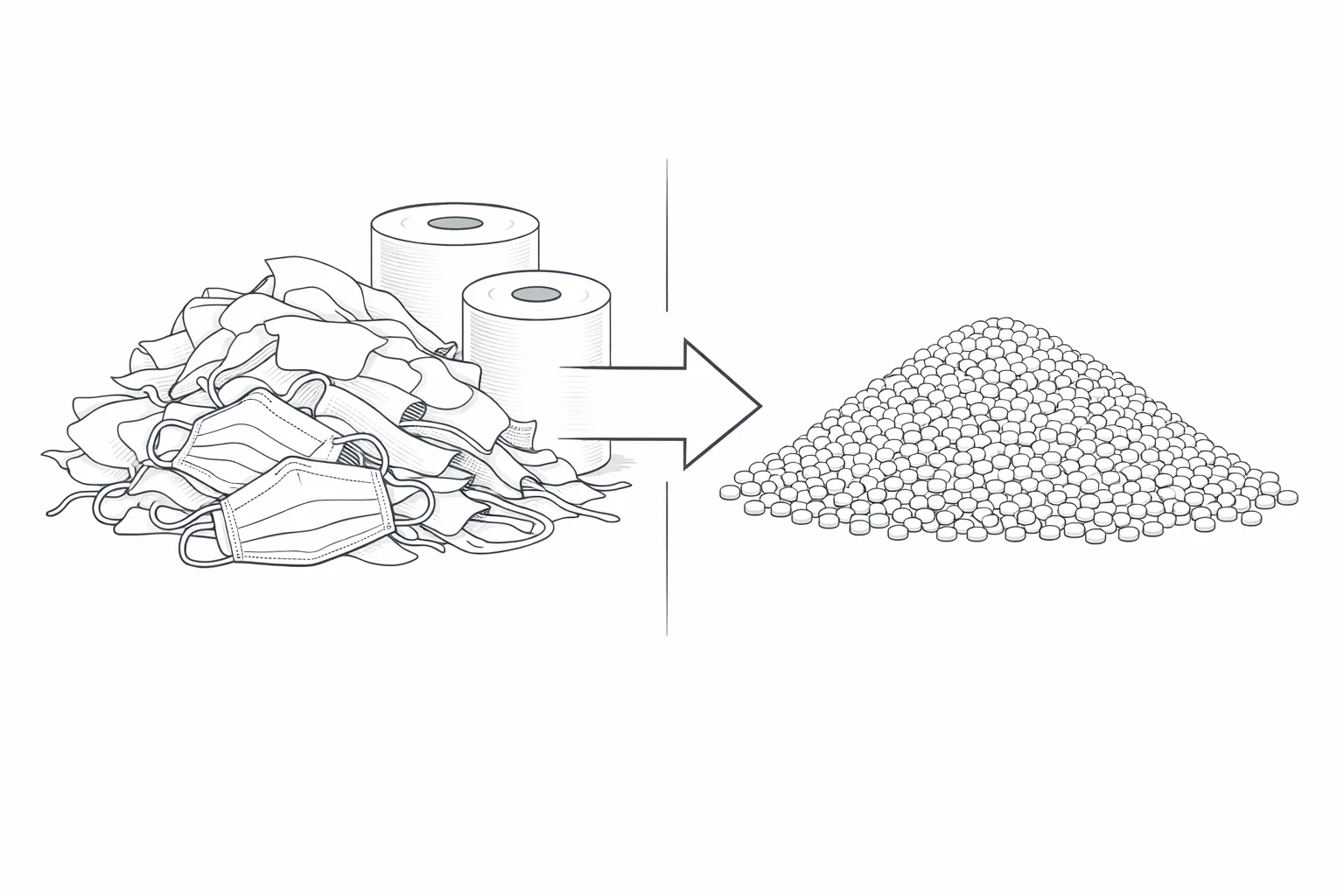
At Rumtoo, we provide specialized Non-Woven Recycling Machines designed to tackle the unique challenges of fiber recycling. We help manufacturers close the loop, turning scrap fabric back into high-grade pellets that can be immediately reintroduced into production.
Why Non-Woven Fabrics Are Difficult to Recycle
Not all plastic recycling machines are up to the task. Non-woven fabrics (such as Spunbond, Meltblown, and Spunlace) possess high tensile strength and a loose, fibrous structure.
If you use a standard crusher or extruder, you likely face these common issues:
- Material Feeding Issues: Light, fluffy fabric “bridges” in the hopper and won’t feed into the screw efficiently.
- Tangling & Jamming: Long fibers wrap around the shredder rotor, causing frequent downtime.
- Contamination: Post-consumer waste (like agricultural covers) carries dirt that can ruin standard machinery.
The Recycling Process: From Scrap to Pellets
To ensure high-quality output, the recycling process must be tailored to the condition of your waste material—whether it is clean factory offcuts or dirty post-consumer waste.
1. Sorting and Collection
The first step involves separating non-woven fabrics based on polymer type (usually PP or PET). Keeping the material stream pure is essential for maintaining the physical properties of the final recycled pellets.
2. Washing (For Contaminated Waste)
If you are recycling post-consumer material, such as agricultural non-wovens or dirty packaging, simple shredding is not enough. Dirt, sand, and oils must be removed to protect the extruder.
For these applications, we utilize Rumtoo’s specialized Plastic Film Washing Line. Although originally designed for soft LDPE films, this high-efficiency friction washing system is perfectly adapted for soft, floating plastics like PP/PET non-woven fabrics. It effectively separates contaminants and dries the material, preparing clean flakes for the pelletizing process.
3. Compacting and Densification
This is the most critical step for non-wovens. Because the material is so light and fluffy, it must be densified. Rumtoo machines use a Cutter-Compactor system that cuts and friction-heats the material simultaneously. This shrinks the volume and pre-conditions the polymer without degrading it.
4. Extrusion and Pelletizing
The compacted material is fed directly into the extruder. Here, it is melted, degassed (to remove moisture or ink volatiles), and filtered. Finally, the melt is cut into uniform pellets, ready to be sold or reused.
The Rumtoo Advantage: Integrated Compactor Technology
For clean industrial waste (like edge trims), Rumtoo offers a 3-in-1 Integrated Recycling Machine that combines shredding, compacting, and extrusion into a single, automated step.
- Anti-Tangling Design: The compactor uses centrifugal force to densify the material immediately as it is cut, making it impossible for long fibers to wrap around the rotor.
- High Efficiency: By pre-heating the material in the compactor using friction, the extruder requires less energy to melt the polymer, lowering your operational costs.
- Superior Quality: The gentle processing ensures the recycled pellets retain near-virgin properties, allowing you to mix them back into your production line at high percentages.
Key Benefits for Manufacturers
Investing in a specialized Rumtoo non-woven recycling machine offers immediate ROI:
- Cost Reduction: Replace up to 20%-100% of virgin material with your own recycled pellets.
- Zero Waste Production: Achieve a “circular economy” within your own factory. Every scrap of edge trim is recovered.
- Automation: Our systems require minimal labor—often just one operator to manage the entire line.
Frequently Asked Questions (FAQ)
Q: Can your machine handle both PP (Polypropylene) and PET (Polyester) non-wovens? A: Yes. While PP and PET have different melting points, our machines can be customized with specific screw designs and temperature controls to handle either material efficiently.
Q: What if my non-woven waste is heavily printed? A: Printed surfaces can release gas when melted. Rumtoo machines are equipped with a Vacuum Degassing System and a double-piston screen changer. This ensures that inks and volatiles are removed, producing solid, bubble-free pellets.
Q: Do I need a separate crusher for large rolls? A: No. Our integrated machine features a “Nip Roll Feeder” that can pull in entire defective rolls automatically, while the compactor handles loose trims simultaneously.
Ready to Recover Value from Your Waste?
Don’t let valuable polymer go to waste. Whether you need a simple compactor for factory trims or a complete Plastic Film Washing Line for dirty agricultural waste, Rumtoo has the solution.
Contact us today for a free consultation and let us calculate your potential ROI.
