



Bulk Density Change Before and After Squeezing
In LDPE film recycling lines, washed film flakes typically present a major challenge for downstream handling and logistics due to their extremely low bulk density and high moisture content.
A screw press squeezer (also referred to as a film densifier) is widely used to address this issue by combining mechanical dewatering and physical densification, significantly reducing material volume without pelletizing.
This guide explains how and why bulk density changes before and after screw press densification, and what this means for transportation and further processing.
1. Understanding Bulk Density vs. Material Density
Before reviewing the data, it is important to clarify a common misconception:
- Bulk Density refers to the mass per unit volume of a pile of material, including air voids between particles.
- Material (True) Density refers to the intrinsic density of the polymer itself (LDPE ≈ 0.91–0.93 g/cm³).
This article discusses bulk density only, as it directly affects:
- Transportation efficiency
- Storage volume
- Feeding stability in downstream equipment
2. Typical Bulk Density of LDPE Film Before Densification
Feedstock condition: washed LDPE film flakes
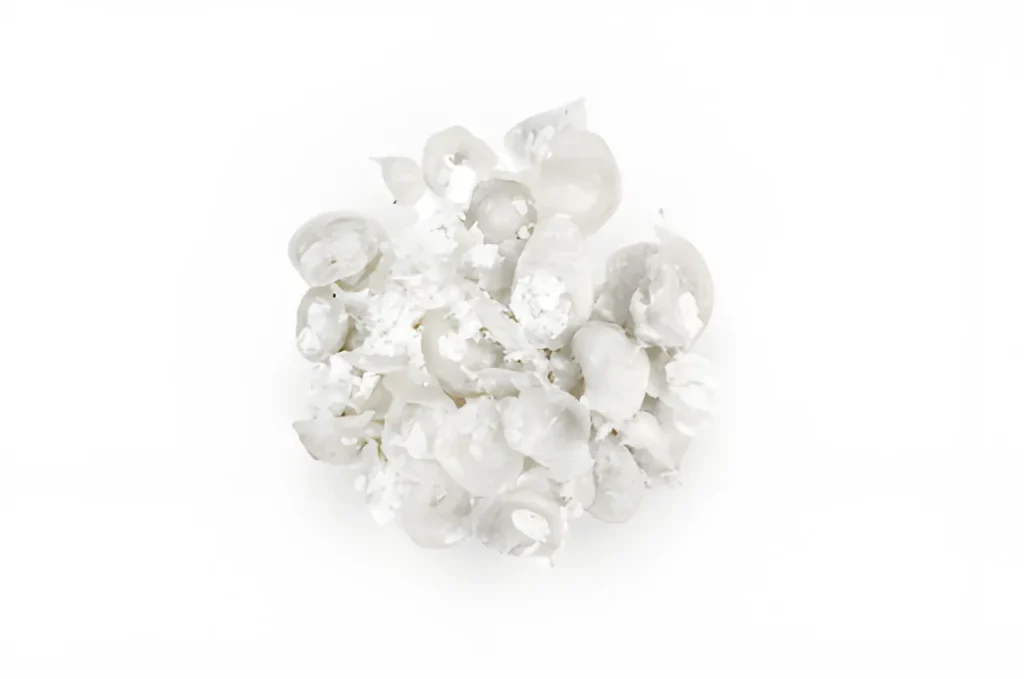
After shredding and washing, LDPE film usually exists as thin, irregular flakes with trapped air and surface moisture.
Typical bulk density ranges:
- Loose LDPE film / light flakes: 30–80 kg/m³ (0.03–0.08 g/cm³)
- Washed wet LDPE flakes (20–30% moisture): 60–100 kg/m³ (0.06–0.10 g/cm³)
Despite being washed, the material remains voluminous and unstable, making efficient transport and consistent feeding difficult.
Logistics implication:
A fully loaded 40-foot high-cube container (≈76 m³) may carry only 1.5–2.5 tons of material, far below weight limits.
3. Bulk Density After Screw Press Densification
Output condition: mechanically dewatered and compacted LDPE
During screw press operation, the material undergoes:
- Progressive mechanical compression
- Water and air removal through screen sections
- Friction-induced softening and partial agglomeration
Typical output bulk density:
- Densified LDPE agglomerates / compacted lumps: 400–600 kg/m³ (0.40–0.60 g/cm³)
- Optimized high-pressure operation (upper practical range): up to ~650–700 kg/m³
At this stage, LDPE film is transformed from a low-density, two-dimensional structure into a three-dimensional, compact form suitable for transport or stable feeding.
4. Practical Volume Reduction Achieved
Based on the above bulk density ranges:
- Typical volume reduction ratio: 6:1 to 10:1
- Equivalent volume reduction: approximately 70–85%
For example:
- From 80 kg/m³ → 500 kg/m³ ≈ 6.25× densification
- From 60 kg/m³ → 600 kg/m³ ≈ 10× densification
This level of densification is consistent and repeatable in industrial recycling lines.
5. How Screw Press Densification Works
Mechanical Compression and Dewatering
A tapered or variable-pitch screw gradually reduces available volume, forcing:
- Free water
- Entrapped moisture
- Air voids out through perforated barrel sections.
Thermal Softening and Agglomeration
Friction and compression raise material temperature (typically 60–90°C), softening LDPE and allowing flakes to bond at contact points, eliminating internal voids.
Final Discharge Form
The output typically appears as:
- Irregular compact agglomerates
- Short dense strips or lumps
This form is not pelletized and does not require cutting, making it ideal when the goal is transport or intermediate storage, not finished granules.
6. Key Benefits of Increased Bulk Density
Transportation Efficiency
Higher bulk density allows containers and trucks to approach legal weight limits instead of “shipping air,” dramatically reducing logistics cost per ton.
Stable Feeding for Downstream Equipment
Densified material feeds reliably into:
- Extruders
- Agglomerators
- Pelletizing lines (if added later)
without bridging or inconsistent throughput.
Energy Efficiency
Mechanical dewatering consumes significantly less energy than thermal drying, and residual heat in the material can reduce energy demand in subsequent processes.
7. Typical Operating Results (Summary)
- Bulk density increase: ~6–10×
- Moisture reduction: ~20–40% → 1–3%
- Primary purpose: Volume reduction and transport efficiency
- Pelletizing: Not required
Conclusion
In LDPE film recycling, screw press densification is a critical intermediate step that transforms washed, low-density film flakes into a compact, transport-ready material.
By increasing bulk density from approximately 50–100 kg/m³ to 400–600+ kg/m³, the process enables efficient logistics, stable handling, and scalable downstream processing—without the need for pelletizing.
