


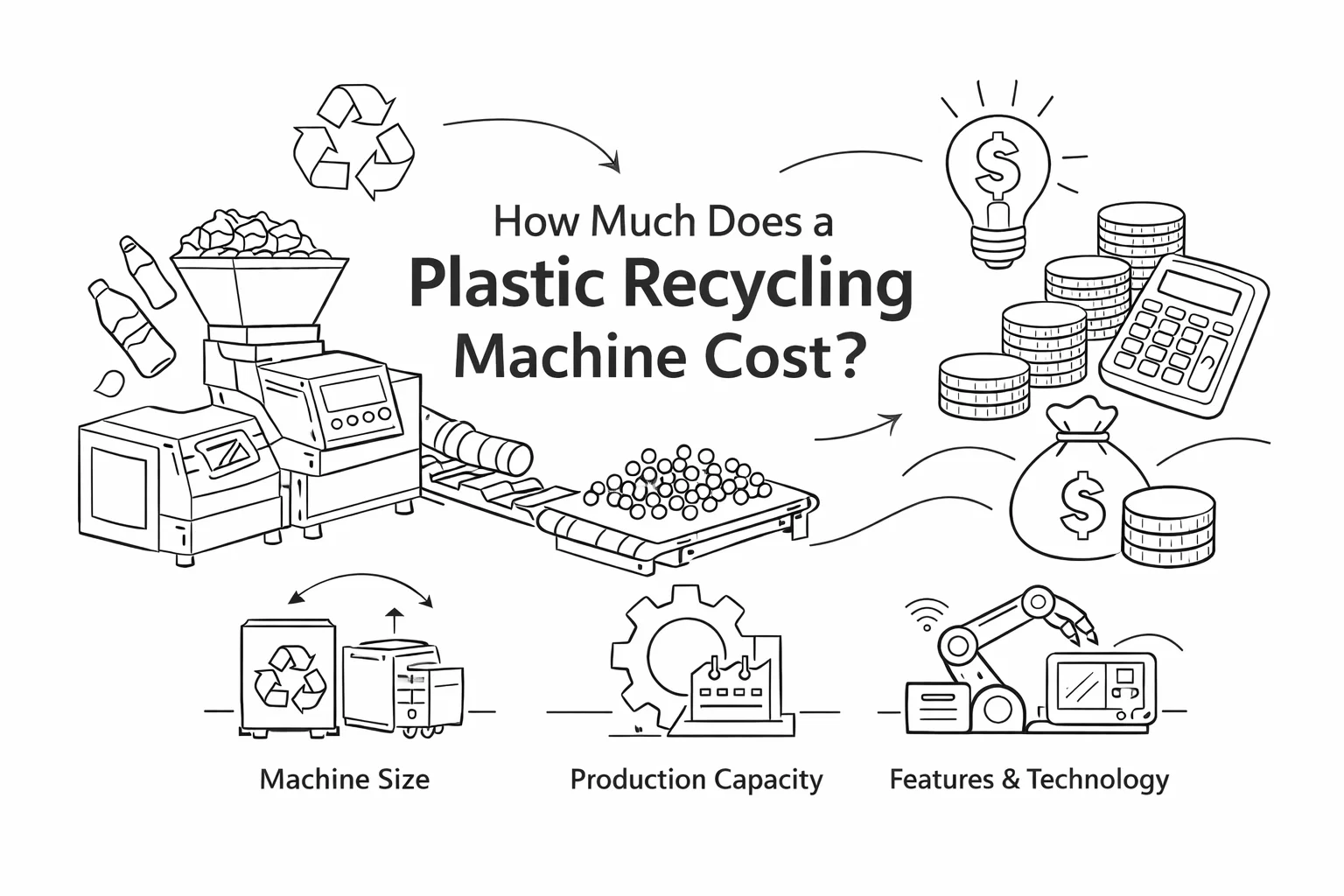
How Much Does a Plastic Recycling Machine Cost in 2026?
Real price ranges, machine types, and budget planning tips—written from a manufacturer & project-implementation perspective.
Investing in plastic recycling equipment in 2026 is not just about “machine price.” The true investment depends on your material (rigid vs. film vs. PET), contamination level, target output (flakes or pellets), automation needs, and local power standards. This guide helps you budget accurately and avoid common purchasing mistakes.
| Machine / Line (2026) | Typical Price Range |
|---|---|
| Small shredder or crusher (entry level) | $3,000 – $15,000 |
| Industrial shredder / granulator | $15,000 – $60,000 |
| Washing line (film or rigid) | $100,000 – $450,000 |
| Pelletizing line | $50,000 – $250,000 |
| PET bottle washing plant | $300,000 – $1,000,000+ |
| Complete recycling plant | $500,000 – $5,000,000+ |
What Determines the Cost of a Plastic Recycling Machine?
1) Machine Type (Process Stage)
- Size reduction: Plastic Shredder, granulator
- Cleaning: Plastic Washing Line
- Pellet production: Plastic Pelletizing Line
- Turnkey lines: Complete Recycling Solution
2) Capacity (kg/h) & Duty Level
- 200–300 kg/h: workshop scale
- 500–1,000 kg/h: mainstream industrial
- 2,000 kg/h+: plant scale (heavier frames & motors)
3) Automation & Control
- Manual/semi-auto: lower initial cost
- PLC + auto feeding + interlocks: higher investment, lower labor
- Stable output quality often improves ROI
4) Material Type & Contamination
- Rigid PP/HDPE: simpler processing, lower cost
- LDPE film/woven bags: needs enhanced drying/squeezing
- PET bottles: washing-intensive, higher system cost
Plastic Recycling Machine Price Ranges (2026)
These ranges reflect common industrial configurations in 2026. Exact pricing depends on your material, capacity, and required output.
Plastic Shredders
| Shredder Type | Typical Price Range (USD) | Best For |
|---|---|---|
| Small-scale shredders | $3,000 – $10,000 | Small workshops, clean scrap |
| Medium industrial shredders | $15,000 – $60,000 | General rigid plastics, moderate throughput |
| Heavy-duty shredders | $80,000 – $300,000+ | High-volume, bulky materials, demanding duty |
Related: Plastic Shredder models & configurations
Plastic Granulators
| Granulator Type | Typical Price Range (USD) | Best For |
|---|---|---|
| Entry-level granulators | $5,000 – $20,000 | Small-scale recycling, pre-shredded feedstock |
| Medium-capacity granulators | $20,000 – $80,000 | Industrial operations, consistent flake size |
| Large industrial granulators | $100,000 – $300,000 | Heavy-duty processing & high throughput |
Related: Plastic Granulator options
Plastic Washing Lines
| Washing Line Scale | Typical Price Range (USD) | Best For |
|---|---|---|
| Small washing lines | $20,000 – $60,000 | Light contamination, smaller volumes |
| Medium washing lines | $60,000 – $200,000 | Most PP/PE post-consumer materials |
| Large industrial washing lines | $250,000 – $1,000,000+ | High-capacity, heavily contaminated feedstock |
Related: PP/PE Plastic Washing Line solutions
Plastic Pelletizing Lines
| Pelletizing System | Typical Price Range (USD) | Best For |
|---|---|---|
| Small pelletizing machines | $10,000 – $30,000 | Lab / small business, basic pellet output |
| Medium pelletizing lines | $50,000 – $150,000 | Moderate production, stable quality targets |
| Industrial extrusion lines | $200,000 – $800,000+ | High-volume pellet production, automation-ready |
Related: Plastic Pelletizing Line configurations
Complete Plastic Recycling Plants
| Plant Scale | Typical Price Range (USD) | Best For |
|---|---|---|
| Small plants | $80,000 – $200,000 | Clean industrial scrap, limited process steps |
| Medium plants | $250,000 – $1,000,000 | Most commercial recycling operations |
| Large industrial plants | $1,000,000 – $5,000,000+ | Turnkey, high throughput & complex materials |
Typical Investment Scenarios (Real-World Examples)
These project-level estimates help you budget beyond single-machine pricing.
| Scenario | Typical Capacity | Estimated Budget (USD) |
|---|---|---|
| PP/HDPE rigid recycling line | 500 kg/h | $100,000 – $180,000 |
| PET bottle washing + pelletizing line | 1,000 kg/h | $300,000 – $600,000 |
| LDPE film washing + pelletizing system | 500–800 kg/h | $200,000 – $450,000 |
| Turnkey recycling plant (full process) | Varies | $500,000 – $3,000,000+ |
How to Compare Plastic Recycling Machine Quotes
A low headline price is only useful when every supplier is quoting the same equipment boundary, production duty, and service scope.
| Quote Item | What to Confirm | Why It Changes the Price |
|---|---|---|
| Commercial basis | EXW, FOB, CIF, or delivered and installed | Freight, insurance, customs, and inland transport may sit outside the machine quote. |
| Equipment boundary | Standalone machine, connected line, or turnkey plant | Conveyors, tanks, drying, electrical cabinets, and packaging equipment can add substantial cost. |
| Capacity definition | Nameplate input versus stable output of saleable material | Moisture, contamination, reject rate, and downtime affect real production. |
| Utilities and civil work | Transformer, water loop, wastewater treatment, drainage, and foundations | These items are often excluded from equipment-only proposals. |
| Commissioning and support | Installation, startup, training, warranty, and spare-parts package | A complete support scope costs more upfront but reduces deployment risk. |
Plastic Recycling Plant Cost by Throughput
Capacity-based planning ranges are more useful than a generic “plant price.” These 2026 budgets assume industrial systems; final scope depends on feedstock and output specifications.
| Typical System | Nominal Capacity | Planning Budget (USD) |
|---|---|---|
| Starter pre-processing line | 100–300 kg/h | $60,000–$180,000 |
| Commercial washing line | 500–800 kg/h | $180,000–$300,000 |
| Commercial washing line | 1,000–1,500 kg/h | $250,000–$450,000 |
| High-capacity washing line | 2,000–2,500 kg/h | $350,000–$650,000 |
| Large recycling plant | 3,000–4,000 kg/h | $500,000–$1,000,000+ |
Film, PET, and high-contamination feedstocks usually sit toward the upper end because they require more washing, drying, water treatment, and automation.
RFQ Checklist for an Accurate Machine Price
Feedstock and output
- Polymer type, photos, bale size, and contamination percentage
- Target product: washed flakes or pellets
- Required moisture, particle size, purity, and filtration level
Production duty
- Target throughput and annual operating hours
- Shifts per day, staffing plan, and automation level
- Expected stable output rather than peak nameplate capacity
Site constraints
- Voltage, available power, water, compressed air, and drainage
- Building dimensions and installation access
- Local wastewater and environmental requirements
Commercial scope
- Incoterm, destination, lead time, and payment milestones
- Installation, commissioning, operator training, and warranty
- Recommended wear parts and two-year spare-parts list
Use the same RFQ for at least three suppliers. Once the upfront scope is normalized, evaluate electricity, labor, water, maintenance, yield, and downtime in our plastic recycling machine ROI and payback analysis.
How to Budget Smart in 2026
Start with the material
- Rigid PP/HDPE: often starts with granulation
- Film/woven: needs enhanced drying and stable feeding
- PET bottles: washing is usually the biggest cost driver
Define the end product
- Flakes: simpler systems, lower investment
- Pellets: requires extrusion and pelletizing equipment
- Stable quality targets improve resale value & ROI
Right-size capacity
- Oversizing increases CAPEX and energy costs
- Undersizing bottlenecks output
- Balanced line design = stable operation
Choose a system, not just a machine
- Matching equipment prevents feeding/throughput issues
- Ask for process flow + layout + configuration list
- Turnkey planning reduces integration risk
A small plastic recycling machine — a compact shredder or small crusher for in-house scrap — typically costs $3,000 to $15,000. Adding a small pelletizer for a complete mini line brings a starter budget to roughly $30,000–$60,000 depending on capacity and automation.
A complete PET bottle washing line producing hot-washed flake typically runs $300,000 to $1,000,000+ depending on capacity (500–3,000 kg/h), hot-wash configuration, and water treatment. Single machines within the line — label remover, crusher, sink-float tank — can be quoted separately for line upgrades.
A turnkey plant covering shredding, washing, drying, and pelletizing generally runs $500,000 to $5,000,000+, driven by capacity, material (film lines cost more per ton than rigid), output specification, and site utilities. Water treatment and installation typically add 10–20% on top of the equipment price.
For clean industrial scrap, a starter setup using a shredder and/or granulator can often begin under $50,000, depending on capacity and material.
Yes—if the feedstock is clean factory scrap. Post-consumer plastics typically require washing and drying to reach acceptable output quality.
Provide the polymer and contamination level, target throughput, required flake or pellet specification, site voltage and utilities, destination, automation level, and the required installation, commissioning, training, and spare-parts scope.
Used equipment can reduce upfront cost but may increase downtime, maintenance, and quality risks. For long-term stable production, new machines often provide better total value.
Yes. Film, PET, and rigid plastics require different process steps (especially washing and drying), which can significantly change total investment.
Testing the business case? Use our project payback and operating-cost model.
