


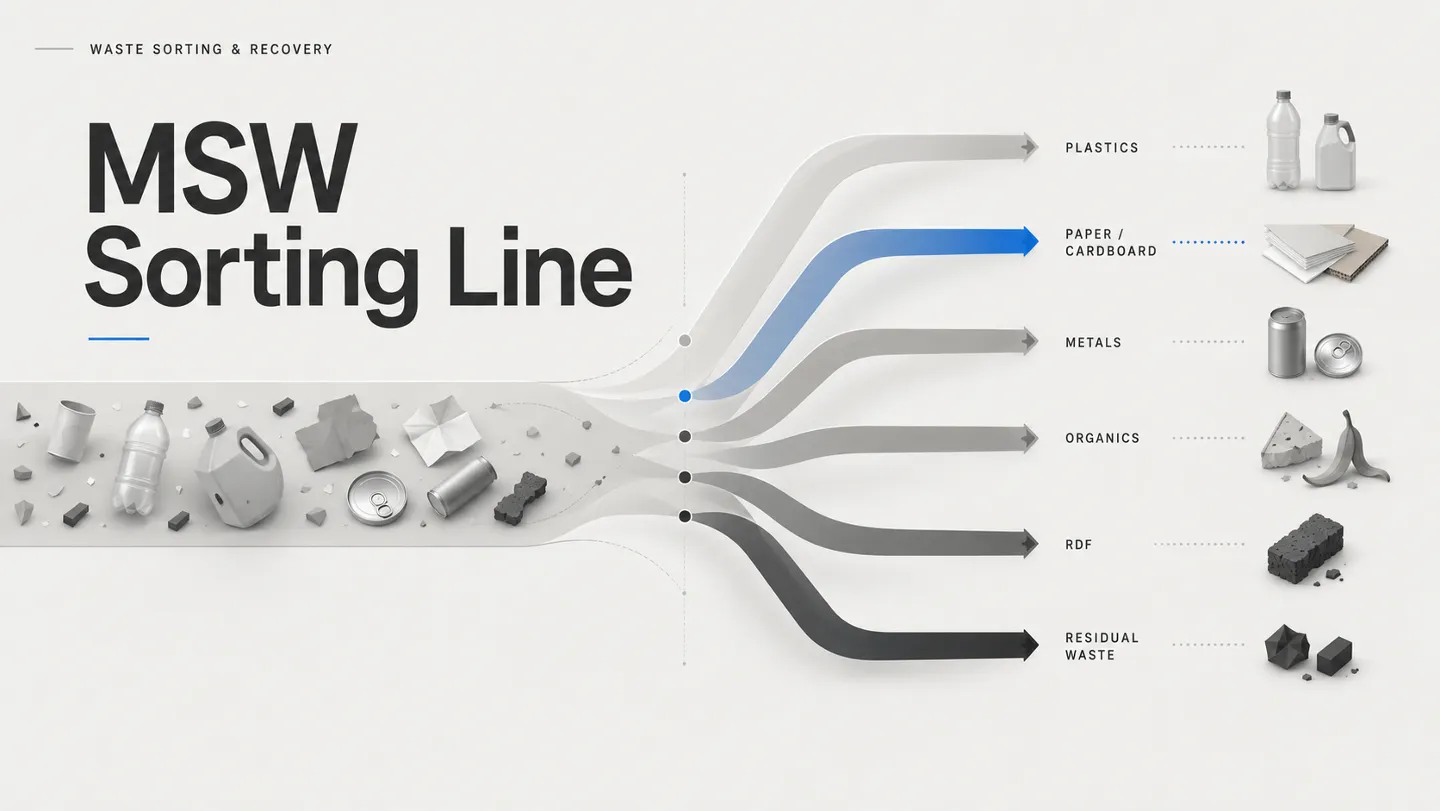
Municipal solid waste (MSW) contains a complex mixture of plastics, paper, metals, organics, glass, and other materials. An MSW sorting line separates these mixed waste streams into recyclable, recoverable, and residual fractions.
Modern sorting systems combine mechanical screening, magnetic separation, air classification, optical sorting, and manual quality control to improve material recovery and reduce the amount of waste sent to landfill.
What Is an MSW Sorting Line?
An MSW sorting line is an integrated processing system designed to separate mixed municipal waste into different material fractions.
Depending on the waste composition and recovery goals, a sorting line may recover:
- البلاستيك
- Paper and cardboard
- Ferrous metals
- Non-ferrous metals
- Organic and fine fractions
- زجاج
- RDF materials
- Residual waste
How Does an MSW Sorting Line Work?
Although every facility is different, a typical sorting process follows several main stages.
1. Feeding and Pre-Sorting
Mixed waste is introduced into the system at a controlled rate.
Large or unsuitable objects may be removed before the main sorting process to protect downstream equipment.
2. Size Separation
Trommel screens or other screening equipment separate waste according to particle size.
Smaller fractions often contain a higher proportion of organics, fines, broken glass, and other small materials.
3. Magnetic Separation
Magnetic separators remove ferrous metals such as steel cans and other magnetic materials.
4. Air Separation
Air classifiers separate lightweight materials from heavier fractions.
This can help separate materials such as:
- Plastic film
- Paper
- Lightweight packaging
from heavier plastics, metals, glass, and other dense materials.
5. Non-Ferrous Metal Separation
Eddy current separators can recover aluminum and other non-ferrous metals from the waste stream.
6. Optical and Manual Sorting
Optical sorting systems can identify materials based on properties such as polymer type or color.
Manual sorting may also be used for quality control or to recover specific materials.
7. Baling and Material Recovery
Recovered materials such as plastics, paper, and metals can be compacted into bales for storage, transportation, and further recycling.
What Materials Can Be Recovered?
The output of an MSW sorting line depends heavily on the composition of the incoming waste.
Typical recovered fractions include:
| نهر المواد | Typical Examples |
|---|---|
| البلاستيك | PET, HDPE, PP, film |
| Paper | Cardboard, mixed paper |
| Ferrous Metals | Steel cans, metal packaging |
| Non-Ferrous Metals | Aluminum cans |
| Organics / Fines | Food waste, small organic fractions |
| RDF | High-calorific combustible materials |
| Residual Waste | Non-recoverable materials |
Main Technologies Used in MSW Sorting
Modern MSW sorting facilities normally combine several separation technologies rather than relying on a single machine.
Common technologies include:
- Trommel screening
- Magnetic separation
- Eddy current separation
- Air classification
- Ballistic separation
- Optical sorting
- Manual sorting
- Baling
The exact combination depends on the incoming waste and the desired recovered materials.
Why Waste Composition Matters
There is no universal MSW sorting line.
Waste composition can vary significantly between countries, cities, and collection systems.
Important factors include:
- Organic content
- Plastic content
- الرطوبة
- Particle size
- Packaging composition
- Collection method
- Required recovery rate
For this reason, sorting systems are normally designed around the characteristics of the local waste stream.
MSW Sorting Line vs. Material Recovery Facility
The terms are often used together but are not exactly the same.
ان MSW sorting line refers to the actual sequence of sorting and separation equipment.
أ Material Recovery Facility (MRF) is the larger facility in which sorting lines, storage areas, balers, conveyors, and other supporting systems operate.
The Role of Automation
Automation can improve throughput, consistency, and material recovery.
Technologies such as optical sorting, automated screening, and sensor-based separation can reduce dependence on manual sorting, although human quality control may still be used.
The appropriate level of automation depends on:
- القدرة على المعالجة
- Labor costs
- Waste composition
- Required purity
- Project budget
خاتمة
An MSW sorting line transforms mixed municipal waste into separate material streams that can be recycled, recovered, converted into RDF, or sent for further treatment.
The effectiveness of the system depends less on any single machine and more on how screening, density separation, metal recovery, optical sorting, and material handling are combined around the characteristics of the incoming waste.
